Corals -- More complex than you?
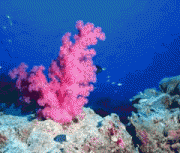
The humble coral may possess as many genes – and possibly even more – than humans do. And remarkably, although it is very distant from humans in evolutionary terms, it has many of the immune system genes that protect people against disease. In fact, it is possible some of these were pioneered by corals.
Corals are among the simplest animals in the world – yet they may possess a set of genes as large and complex as our own, says Professor David Miller of the ARC Centre of Excellence in Coral Reef Studies and the ARC Special Research Centre for the Molecular Genetics of Development.
"Four years ago researchers in this field were predicting that coral would be found to have about 10,000 genes – but we’ve found almost that many already and clearly have a long way to go yet.
"Based on the rate of gene discovery, we estimate that corals have as many as 20 or 25,000 genes, compared with the human complement of 20-23,000."
Why a simple creature should have such a huge genetic repertoire is a mystery, but scientists are excited by it because corals are near the root of the family tree of all living animals and can throw new light on the origin of such complex features as the nervous and immune systems of vertebrates.
Around 10 or 12 per cent of the known coral genes are in fact shared uniquely with vertebrates – these are genes that have been lost from all other animals so far examined. These include genes for the development of nerves, vision, DNA imprinting, stress responses and key immune system genes.
"We actually have quite a lot in common with corals, though it might not appear so," Professor Miller says. "For example, we have been amazed at how many of the genes involved in innate immunity in man are present in coral – and just how similar they are."
The significance of this may lie in the fact that scientists now suspect coral is facing a number of pandemics: ‘black band’, ‘white plague’, ‘white pox’ ‘white syndrome’ and ‘white band’ are the names of some of these diseases.
"The coral immune system is a black box at present. How corals cope with the worldwide upsurge in diseases, and the extent to which they are affected by other stresses caused by human activity are important questions. The similarity of the coral and human innate immune repertoires implies that they may function in similar ways, so the hope is that we can apply what we know about human health to better understand coral disease.
There may also be a direct payback, in the sense that, by exploring the ancestral immune genetic repertoire of corals and how it functions in a simple animal, we will gain new insights which will help in the battle against human disease, he adds.
The richness of the coral genome – unexpectedly loaded with genes, many of which were thought to have evolved much later– is also casting new light on evolution.
It appears that all animals lose genes during evolution; those with fast generation turnover times – like fruit flies – shed genes particularly fast. Corals which take at least 5years to reach sexual maturity (compared with the laboratory fruitfly whose generation lasts only 3-4 weeks), and which have long and overlapping generation times, may thus be a living ‘museum’ of ancestral animal genes.
However corals use all those genes to produce only 12-14 types of body cells. Humans, on the other hand, have developed hundreds, even thousands of different cell types.
A possible explanation for this, Prof. Miller believes, is that coral genes may interact with each other in far less complex ways. Humans, on the other hand, are the product of a continuous and complicated dialogue between thousands of genes.
Who has the best formula for long-term survival remains unclear. Today’s corals first appeared 240 million years ago. So far humans have barely survived for 2 per cent of the time that corals have endured.
Despite all they mean to Australia and have to offer science and medicine, our corals remain genetically largely unexplored, Prof. Miller says. "There is no project to sequence the coral genome, in spite of the tremendous benefits to medicine and other branches of science such a project would offer.
"There has never been a "home grown" genome project. The genomes of several iconic Australian species have been sequenced overseas, and we are being left behind. If important discoveries leading to new technologies are made, we will have to pay to import them.
"Sequencing a coral genome is a real contribution which Australia can make to human knowledge – with potential benefit to society, the environment and the economy."
Source: James Cook University


