pHLIP, a novel technology to locate and treat tumors
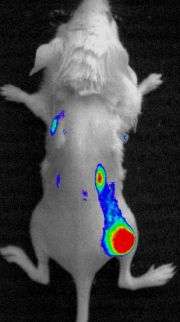
Research teams at Yale University and the University of Rhode Island have demonstrated a new way to target and potentially treat tumors using a short piece of protein that acts like a nanosyringe to deliver “tags” or therapy to cells, according to a report in the Proceedings of the National Academy of Sciences.
The researchers show that, the protein fragment, called “pHLIP” (pH (Low) Insertion Peptide) can be injected into the abdomen of a mouse, find its way into the blood and then specifically accumulate in tumors. Within 20 hours after injection of labeled pHLIP, the molecules had passed through the bloodstream and accumulated in mouse breast tumors grown to different “stages” on the leg of a mouse.
The researchers demonstrated that by attaching fluorescent probes to a pHLIP peptide, tumors could be detected. They expect that by attaching and delivering active agents with pHLIP, that tumors may be able to be treated. Targeting is based on the fact that most tumors, even very small ones, are acidic as a result of the way they grow.
“Since the mechanism is general, and since even very small tumors can be targeted, there is an exciting array of possible applications for pHLIP,” said Donald Engelman, Eugene Higgins Professor of Molecular Biophysics & Biochemistry at Yale and a co-author of the paper.
“Andreev and Reshetnyak [co-authors of the paper] have taken a recent discovery from our lab and we are pushing hard as a team to test possible applications,” said Engelman. “We are very excited by the possibilities for both imaging and treating tumors.”
The pHLIP molecule has three states: soluble in water, bound to the surface of a membrane, and inserted across the membrane as an alpha-helix. Under normal tissue conditions of neutral pH, the water-soluble form is favored. At acidic pH, the transmembrane alpha-helix predominates.
An earlier paper from the same groups shows that at low pH, pHLIP can move cell-impermeable molecules across a cell membrane, where they are released in the cytoplasm. “pHLIP acts as a molecular nanosyringe, inserting itself into the cell membrane and injecting compounds into cell,” said co-author Yana Reshetnyak, of the University of Rhode Island. “The transported molecules can be therapeutic or toxic to the cell, depending on the intended outcome—for treating cancer, the idea is to cause cell death.”
In addition to targeting tumors, other disease states that produce inflammation and cause tissue to be acidic are a target for pHLIP. “Acidosis is a physiological marker of many diseases — and pHLIP feels acidity,” said Reshetnyak. “Therefore, pHLIP could also be used for monitoring of disease development and therapeutic outcomes. It might play very important role in the study of arthritis, ischemia and stroke.”
Lead author Oleg Andreev said, “We believe that universal medical tests to reveal many health problems at earlier stages may be developed based on pHLIP technology”
“Our discovery is an example of the reason that the NIH and DOD support basic science—we were working on the principles of membrane protein folding, and made a discovery with important medical implications that wouldn’t have happened without the ideas and approaches used in that work,” Engelman said.
Among the applications the team is actively pursuing are PET imaging of tumors, treatment of breast cancer, and alternative designs using the principles they have already established.
Source: Yale University


