Ultrashort light pulse blazes new paths for science, industry
May 1st, 2007 Ultrashort light pulse blazes new paths for science, industry

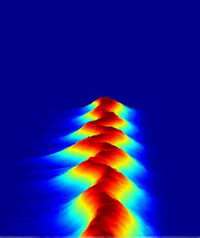
Light pulses lasting just 130 attoseconds offer possibilities for unlocking secrets of atoms and molecules. Credit: National Laboratory for Ultrafast and Ultraintense Optical Science in Milan, Italy

Researchers in Italy have created an ultrashort light pulse—a single isolated burst of extreme-ultraviolet light that lasts for only 130 attoseconds. Their achievement currently represents the shortest artificial light pulse that has been reported in a refereed journal.

Shining this ultrashort light pulse on atoms and molecules can reveal new details of their inner workings—providing benefits to fundamental science as well as potential industrial applications such as better controlling chemical reactions.

Working at Italy's National Laboratory for Ultrafast and Ultraintense Optical Science in Milan (as well as laboratories in Padua and Naples), the researchers believe that their current technique will allow them to create even shorter pulses well below 100 attoseconds. Results will be presented in Baltimore at CLEO/QELS, May 6 – May 11.

Whereas humans perceive the world in terms of seconds and minutes, the electrons in atoms and molecules often perform actions on attosecond time scales. How short is this? 130 attoseconds is to one second as a second is to approximately 243 million years—roughly the time that has passed since the first dinosaurs walked the Earth. Aiming a human-made attosecond-scale light pulse on atoms and molecules can trigger new effects in electrons—which are responsible for all chemical reactions—and provide new details on how they work.

In previous experiments, longer pulses, in the higher hundreds of attoseconds, have been created, and the general process is the same. An intense infrared laser strikes a jet of gas, usually argon or neon. The laser’s powerful electric fields rock the electrons back and forth, causing them to release a train of attosecond pulses consisting of high-energy photons in the extreme ultraviolet or soft x-ray part of the spectrum.

Creating a single isolated attosecond pulse, rather than a train of them, is more complex. To do this, the researchers employ their previously developed technique for delivering intense short (5 femtoseconds, or millionths of a billionth of a second) laser pulses to an argon gas target. They use additional optical techniques (including ones borrowed from the research that won the 2005 Nobel Prize in Physics) for creating and shaping a single attosecond pulse.

These isolated attosecond pulses promise to probe electron phenomena such as "wavepackets"—specially tailored electron waves inside atoms and molecules that may help scientists use lasers to change the course of chemical reactions for scientific and practical uses, such as controlling the breaking of bonds in complex molecules for medical and pharmaceutical applications.

Source: Optical Society of America


print this article email this article download pdf blog this article bookmark this article     Digg this Stumble it share on Facebook share on Reddit add to delicious save to Yahoo! bookmarks
4.4/5 after 23 votes


May 1st, 2007 all stories
Physics / General Physics

Comments: 0
Rank: 4.4/5 after 23 votes

  • Stumble this up

  • Digg this

  • Share it:
  • share on Facebook
  • share on MySpace
  • share on Slashdot
  • rss-newsfeed
  • share on Google
  • share on Reddit
  • add to delicious
  • save to Yahoo! bookmarks
  • share on Windows Live
  • Add to Mixx!
Rating: 4.4/5 after 23 votes

  • Related Stories

  • Making nanoparticles in artificial cells
    created Jun 26, 2009 | popularity not rated yet | comments 0
  • Power thrust for spider silk
    created Apr 24, 2009 | popularity not rated yet | comments 0
  • World's First Hard X-ray Laser Achieves 'First Light'
    created Apr 21, 2009 | popularity not rated yet | comments 0
  • Coke Bottle Quantum Physics
    created Apr 16, 2009 | popularity not rated yet | comments 0
  • Scientists hope to unlock mysteries of proteins
    created Apr 14, 2009 | popularity not rated yet | comments 0

Tags


  • Physicists Demonstrate Quantum Memory with Matter Qubits
    Physicists Demonstrate Quantum Memory with Matter Qubits
    Physics / General Physics
    created Jul 03, 2009 | popularity 4.4 / 5 (17) | comments 1
  • 'Holey' Nanosheets for Wastewater Dye Removal
    Nanotechnology / Nanomaterials
    created Jul 01, 2009 | popularity 5 / 5 (5) | comments 1
  • Jellyfish Robot Swims Like its Biological Counterpart
    Jellyfish Robot Swims Like its Biological Counterpart
    Electronics / Robotics
    created Jun 26, 2009 | popularity 4.4 / 5 (8) | comments 1
  • Could Maxwell's Demon Exist in Nanoscale Systems?
    Could Maxwell's Demon Exist in Nanoscale Systems?
    Physics / General Physics
    created Jun 24, 2009 | popularity 4.4 / 5 (18) | comments 29
  • Living Safely with Robots, Beyond Asimov's Laws
    Living Safely with Robots, Beyond Asimov's Laws
    Electronics / Robotics
    created Jun 22, 2009 | popularity 4.6 / 5 (52) | comments 40
  • Other News

    Scientists create first electronic quantum processor

    Scientists create first electronic quantum processor

    Physics / General Physics

    created Jun 28, 2009 | popularity 4.8 / 5 (53) | comments 39

    A team led by Yale University researchers has created the first rudimentary solid-state quantum processor, taking another step toward the ultimate dream of building a quantum computer.


    Science journals

    How to Spot an Influential Paper Based on its Citations

    Physics / General Physics

    created Jul 04, 2009 | popularity 4 / 5 (9) | comments 5

    (PhysOrg.com) -- At first it may seem that the number of citations received by a published scientific paper is directly related to that paper's quality of content. The higher the quality, the more people read ...


    Fermilab's CDF observes Omega-sub-b baryon

    Fermilab's CDF observes Omega-sub-b baryon

    Physics / General Physics

    created Jun 29, 2009 | popularity 4.7 / 5 (16) | comments 7

    (PhysOrg.com) -- At a recent physics seminar at the Department of Energy’s Fermi National Accelerator Laboratory, Fermilab physicist Pat Lukens of the CDF experiment announced the observation of a new particle, ...


    New insights, and a new angle, on high-temperature superconductivity

    New insights, and a new angle, on high-temperature superconductivity

    Physics / Superconductivity

    created Jun 29, 2009 | popularity 4.8 / 5 (13) | comments 6

    (PhysOrg.com) -- A Princeton-led research team has revealed surprising information about how electron behavior influences the conduction of electricity in a class of high-temperature superconductors. An increased ...


    The art of invisibility and the perfect cat's eye

    The art of invisibility and the perfect cat's eye

    Physics / Optics & Photonics

    created Jun 30, 2009 | popularity 4 / 5 (8) | comments 6

    (PhysOrg.com) -- In recent years scientists have explored the impossible by developing invisibility or 'cloaking' devices, but can the same technology also help make things more visible?