Scientists target manta ray mysteries
May 1st, 2007 Scientists target manta ray mysteries

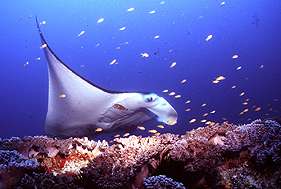
Manta rays are one of the ocean's mysteries. Photo: Andrea Marshall

Manta rays are hard to miss —big, black and stretching up to seven metres wide, but scientists are still in the dark about the world's largest ray.

A team of UQ scientists is joining forces with industry and government partners to launch the most comprehensive study of manta rays yet.

Project Manta will detail manta ray populations, their behaviours, feeding patterns, movements, migrations using observations and satellite imagery and will identify individuals via DNA and photographic analysis.

One of the project's lead scientists, Dr Kathy Townsend, said little was known about manta rays, which were listed as vulnerable by the World Conservation Union.

“Manta rays are a big ecotourism drawcard, forming the basis of multimillion dollar industries around the globe,” Dr Townsend said.

“Our research focuses on the population of manta rays along the eastern seaboard of Australia and includes Moreton Bay and the Great Barrier Reef Marine Park.

“Surprisingly, basic information about their population, lifespan, migrations and breeding information remains unknown.”

Dr Townsend said local divers and snorkellers, some with 20 years of diving photos, would be involved in creating an image database to identify manta rays.

“We specifically want the pictures of the underbelly of the manta ray because this can be used to identify individuals,” she said.

“The black and white pattern is as unique as a fingerprint.”

She said much of the research work would start in October when the manta rays returned to Moreton Bay Marine Park.

Fellow lead scientists,Associate Professor Mike Bennett and Dr Scarla Weeks said the project built on a four-year-study of the world's largest known manta ray population off the Mozambican coast by UQ PhD student Andrea Marshall.

“We are in a unique position of having over a decade's worth of data on Australian, African and Japanese manta ray populations which together with satellite imagery, will allow us to address many questions about the rays' biology,” Associate Professor Bennett said.

Project Manta will also address the broader issues of the effect of climate change on the marine environment.

“Understanding the manta ray's feeding activities, movements and migrations in relation to oceanic conditions will allow us to use this highly visible species as a biological indicator of ecosystem impacts resulting from climate change,” Dr Weeks said.

Dr Townsend said the project had support from Consolidated Rutile Limited (CRL), South East Queensland Catchment, Lady Elliott Eco Resort, Undersea Explorer and Bounty Divers from Norfolk Island.

“Manta rays are a key drawcard for divers and naturalists and generally all of those that use Moreton Bay and the Great Barrier Reef Marine Park,” CRL Environment and Community Relations Manager Paul Smith said.

“By sponsoring research into this animal that lives right on our doorstep, we can assist not just manta rays, but the marine environment for future generations.”

Source: University of Queensland


print this article email this article download pdf blog this article bookmark this article     Digg this Stumble it share on Facebook share on Reddit add to delicious save to Yahoo! bookmarks
3/5 after 5 votes


May 1st, 2007 all stories
Biology /

Comments: 0
Rank: 3/5 after 5 votes

  • Stumble this up

  • Digg this

  • Share it:
  • share on Facebook
  • share on MySpace
  • share on Slashdot
  • rss-newsfeed
  • share on Google
  • share on Reddit
  • add to delicious
  • save to Yahoo! bookmarks
  • share on Windows Live
  • Add to Mixx!
Rating: 3/5 after 5 votes

  • Related Stories

  • Spotting the killer hot spots
    created Jun 26, 2008 | popularity not rated yet | comments 0
  • Inhaled tuberculosis vaccine more effective than traditional shot
    created Mar 12, 2008 | popularity not rated yet | comments 0

Tags


  • Physicists Demonstrate Quantum Memory with Matter Qubits
    Physicists Demonstrate Quantum Memory with Matter Qubits
    Physics / General Physics
    created Jul 03, 2009 | popularity 4.4 / 5 (17) | comments 1
  • 'Holey' Nanosheets for Wastewater Dye Removal
    Nanotechnology / Nanomaterials
    created Jul 01, 2009 | popularity 5 / 5 (5) | comments 1
  • Jellyfish Robot Swims Like its Biological Counterpart
    Jellyfish Robot Swims Like its Biological Counterpart
    Electronics / Robotics
    created Jun 26, 2009 | popularity 4.4 / 5 (8) | comments 1
  • Could Maxwell's Demon Exist in Nanoscale Systems?
    Could Maxwell's Demon Exist in Nanoscale Systems?
    Physics / General Physics
    created Jun 24, 2009 | popularity 4.4 / 5 (18) | comments 29
  • Living Safely with Robots, Beyond Asimov's Laws
    Living Safely with Robots, Beyond Asimov's Laws
    Electronics / Robotics
    created Jun 22, 2009 | popularity 4.6 / 5 (52) | comments 40
  • Other News

    California water plan aims to save Puget Sound orcas

    Biology / Ecology

    created 5 hours ago | popularity not rated yet | comments 0

    A plan to restore salmon runs on California's Sacramento River also could help revive killer whale populations 700 miles to the north in Puget Sound, as federal scientists struggle to protect endangered species in a complex ...


    Scientists 'rebuild' giant moa using ancient DNA

    Biology / Plants & Animals

    created Jul 01, 2009 | popularity 5 / 5 (10) | comments 12

    (PhysOrg.com) -- Scientists have performed the first DNA-based reconstruction of the giant extinct moa bird, using prehistoric feathers recovered from caves and rock shelters in New Zealand.


    Pacific Giant Salamander (Dicamptodon tenebrosus)

    Salamanders, regenerative wonders, heal like mammals, people

    Biology / Microbiology

    created Jul 01, 2009 | popularity 4.9 / 5 (19) | comments 10

    The salamander is a superhero of regeneration, able to replace lost limbs, damaged lungs, sliced spinal cord -- even bits of lopped-off brain. But it turns out that remarkable ability isn't so mysterious after ...


    Genetically modified trees

    Anti-biotech groups obstruct forest biotechnology

    Biology / Biotechnology

    created Jun 30, 2009 | popularity 3.7 / 5 (7) | comments 5

    The potential of forest biotechnology to help address significant social and environmental issues is being "strangled at birth" by the rigid opposition of some groups and regulations that effectively preclude ...


    Super-sleepers could help super-sizers!

    Super-sleepers could help super-sizers!

    Biology / Plants & Animals

    created Jun 29, 2009 | popularity 5 / 5 (2) | comments 4

    Burrowing frogs can survive buried for several years without food or water. Scientists have discovered that the metabolism of their cells changes radically during the dormancy period allowing the frogs to ...