'Personality-gene' makes songbirds curious
Whether you are an anxious type, or a fearless person - such individual differences in personality could be partly due to the genes you carry. In humans, it is hard to prove the existence of such "personality genes" - there are simply too many factors that influence human behaviour and these factors are hard to control experimentally. Birds are an easier target for research and indeed, they also have different personalities.
An international team of researchers have now found evidence for the existence of a "curiosity-gene" in a songbird, the great tit (Parus major). The gene (Drd4) carries the building instructions for a receptor in the brain, which forms the docking station for the neurotransmitter dopamine. Birds with a specific variant of this dopamine receptor D4 gene show a stronger exploratory behaviour than individuals with other variants.
There is already evidence that variations (polymorphisms) in neurotransmitter-related genes are associated with personality differences among humans. Research from the last decade suggested a promising link between the Drd4-gene and the trait curiosity (novelty-seeking). Scientists from the Max Planck Institute for Ornithology in Seewiesen, together with a former lab member who is now at the Cawthron Institute in Nelson (New Zealand) and with colleagues from the Netherlands Institute of Ecology in Heteren, have shown that the choice of the Drd4-gene in the study of the great tit turned out to be a good bet.
In the Drd4 gene of this bird, they discovered 73 polymorphisms, of which 66 were so-called Single Nucleotide Polymorphisms (SNPs), where only a single nucleotide has been exchanged between the two variants. One such SNP, located at position 830, is indeed associated with the exploratory behaviour (read: curiosity) of the birds. This is first shown in two breeding lines of great tits, which the researchers had selected over four generations according to their level of curiosity (a low and a high curiosity line).
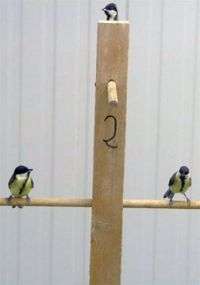
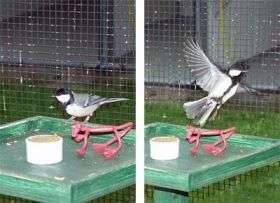
The scientists assessed the curiosity of the birds in a test which shows similarities to the traditional "open-field" test used by psychologists. They tested the exploratory behaviour of each bird soon after it left the nest (Early Exploratory Behaviour, EEB), as follows. In one behavioural test, the biologists measured the time until a bird had visited four artificial "trees" (see figure 1) after being released in the observation room. In a second test, they quantified the reaction of the bird towards each of two unknown objects that had been put in its cage. One such novel object was a pink panther (see figure 2).
The results from the group of selected birds were confirmed with data from free-living, unselected great tits. In the forest-living birds, the scientists also found a significant association between the SNP830-genotypes of individuals and variation in their level of curiosity.
"The personality trait can be an important predictor of how individuals will respond to predictable and unpredictable changes in their environment and how well they cope with these changes", explains Bart Kempenaers. "If we want to understand the ecological and evolutionary importance of variation in personality in natural, free-living animal populations, it would help a lot to know the molecular genetic mechanisms behind the trait." Typing the behavioural relevant Drd4 polymorphism it should be possible to follow micro-evolutionary changes in populations, which would result from changing selection pressures on different personality types.
Citation: Andrew E. Fidler, Kees van Oers, Piet J. Drent, Sylvia Kuhn, Jacob C. Mueller and Bart Kempenaers, Drd4 gene polymorphisms are associated with personality variation in a passerin bird, Proceedings of the Royal Society London B, May, 2 2007
Source: Max-Planck-Gesellschaft


