Hubble finds multiple stellar 'baby booms' in a globular cluster
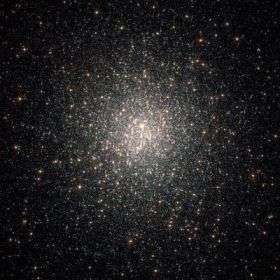
New observations by the NASA/ESA Hubble Space Telescope have overturned conventional ideas about the early life of some massive globular clusters, showing that they can go through several periods of intense stellar formation rather than the previously accepted single burst. The analysis of Hubble data from the massive globular cluster NGC 2808 provides evidence that star birth occurred over three generations early in the cluster's life.
"We had never imagined that anything like this could happen," said Giampaolo Piotto of the University of Padua in Italy and leader of the team that made the discovery. "This is a complete shock."
Globular clusters are among the earliest settlers of our Milky Way Galaxy, born during our Galaxy's formation. A typical cluster consists of hundreds of thousands of stars held together by gravity in a compact swarm.
"The standard picture of a globular cluster is that all of its stars formed at the same time, in the same place, and from the same material, and that they have co-evolved for billions of years," said team member Luigi Bedin of ESO in Garching, Germany, the European Space Agency, and Space Telescope Science Institute in Baltimore, USA. "This is the cornerstone on which much of the study of stellar populations has been built. So we were very surprised to find several distinct populations of stars in NGC 2808. All of the stars were born within 200 million years very early in the life of the 12.5-billion-year-old massive cluster."
Finding multiple stellar populations in a globular cluster so close to home has deep cosmological implications, the researchers said. "We need to do our best to solve the enigma of these multiple generations of stars found in these Hubble observations so that we can understand how stars formed in distant galaxies in our early Universe," Piotto explained.
The astronomers used Hubble's Advanced Camera for Surveys to measure the brightness and colour of the cluster stars. Hubble's exquisite resolution allowed the astronomers to sort out the different stellar populations. The Hubble measurements showed three distinct populations, with each successive generation appearing slightly bluer. This colour difference suggests that successive generations contain a slightly different mix of some chemical elements.
"One assumption, although we have no direct proof," said team member Ivan King of the University of Washington in Seattle, USA, "is that the amount of helium increases with each generation of stars. The successively bluer colour of the stellar populations indicates that the amount of helium increases in each generation. Perhaps massive star clusters like NGC 2808 hold onto enough gas to ignite a rapid succession of stars."
The star birth would be driven by shock waves from supernovae and stellar winds from red giant stars, which compress the gas and make new stars, King explained. The gas would be increasingly enriched in helium from previous generations of stars more massive than the Sun.
Astronomers commonly assumed that globular clusters produce only one stellar generation because the energy radiating from the first batch of stars would clear out most of the residual gas needed to make more stars. But a hefty cluster like NGC 2808 is two to three times more massive than a typical globular cluster and may have sufficient gravity to hang onto enough gas, which is then enriched by helium from the first stars. Of the about 150 known globular clusters in our Milky Way Galaxy, NGC 2808 is one of the most massive, containing more than 1 million stars.
Another possible explanation for the multiple stellar populations is that NGC 2808 may only be masquerading as a globular cluster. The stellar grouping may have been a dwarf galaxy that was stripped of most of its material due to gravitational capture by our Milky Way.
Omega Centauri, the first globular cluster Piotto's group found to have multiple generations of stars, is suspected to be the remnant core of a dwarf galaxy, Bedin said.
Although the astronomers have searched only two globular clusters for multiple stellar populations, they say this may be a typical occurrence in other massive clusters.
"No one would make the radical step of suggesting that previous work on other clusters is no longer valid," King said. "But this discovery shows that the study of stellar populations in globular clusters now opens up in a new direction."
The team plans to use ESO's Very Large Telescope in Chile to make spectroscopic observations of the chemical abundances in NGC 2808, which may offer further evidence that the stars were born at different times and yield clues to how they formed. They also will use Hubble to hunt for multiple generations of stars in about 10 more hefty globular clusters.
Source: Hubble Information Centre


