Puzzling Plankton Yield Secrets to Role in Evolution/Global Photosynthesis
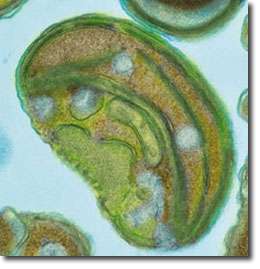
The analysis of DNA sequences from tiny green algae have provided new insights into the mystery of how new species of plankton evolve—and further highlights their critical role in managing the global cycling of carbon. These findings, by a group led by the DOE Joint Genome Institute (DOE JGI); the Scripps Institution of Oceanography, University of California, San Diego; and the Pierre & Marie Curie University, were published this week in the Proceedings of the National Academy of Sciences.
Ocean-dwelling phytoplankton from the genus Ostreococcus emerge at the primitive root of the green plant lineage, dating back nearly 1.5 billion years. Today, these microscopic, free-living creatures, among the smallest eukaryotes ever characterized, barely a micron in diameter, contribute to a significant share of the world’s total photosynthetic activity. These “picophytoplankton” also exhibit great diversity that contrasts sharply with the dearth of ecological niches available to them in aquatic ecosystems. This observation, known as the “paradox of the plankton,” has long puzzled biologists.
Plumbing the depths of molecular-level information of related species, genomics offers a novel glimpse into this paradox. The researchers compared the genomes of two Ostreococcus species, O. lucimarinus and O. tauri, and saw dramatic changes in genome structure and metabolic capabilities.
“We found several striking features of genome organization,” said DOE JGI’s Igor Grigoriev, the PNAS paper’s senior author. “Overlapping genes conserved across the species may enable them to cross-regulate their expression, while species-specific chromosomes with horizontally transferred genes can account for changes in the cell surface to adapt to different ecological niches.” Grigoriev and his colleagues noted the abundance of selenium-rich proteins that surfaced in their analysis, which he said allows the organisms to horde nutrients and reduced their appetite for iron—an adaptive process in Ostreococcus.
“This work builds on the community’s emerging understanding about how carbon fixation is carried out by picoplankton,” said Brian Palenik, lead author and researcher at the Scripps Institution of Oceanography, University of California, San Diego.
“From an applied perspective, we are learning some of the tricks nature has employed to ‘engineer’ an extremely small eukaryote to thrive in nature—which may well find applications in bioengineering,” said Palenik. “It was particularly interesting to see the predicted use of selenium-containing enzymes as one of the tricks to maintain such tiny cells. There are many mechanisms that can account for species formation in photosynthetic phytoplankton, and this is just one of the major pieces to this long-standing puzzle for biologists.”
“Assimilation of atmospheric CO2 by marine phytoplankton is a global-scale process that is responsible for about half of the biosphere net primary production,” said collaborator and co-author Hervé Moreau of the Pierre & Marie Curie University Oceanic Observatory in Banyuls-sur-mer, France. “This active absorption of hundreds of millions of tons of carbon per day is essential for maintaining the control of the planet’s climate by counteracting greenhouse effects due to human activities. Clearly, this storage capacity is affected by changes in the photosynthetic efficiency of the algae, which in turn is linked to the environmental conditions experienced by these organisms in their environment.”
The ecology of picoeukaryotes, said Moreau, has thus become an intense field of investigation over the last decade as these microalgae, although representing a minor component of the plankton, nevertheless play major roles in oceanic biomass production.
“With even more picoplankton genomes in the sequencing queue at DOE JGI, we’re positioned to secure a better grasp on the mechanisms of species adaptation and the great diversity of biological pathways operating in the oceans,” said Grigoriev. “This will also enable us to predict the roles of these organisms in contributing to primary marine productivity.”
Source: Lawrence Livermore National Laboratory


