May 3, 2007 feature
Solar cells make OLEDS luminous enough for mobile devices
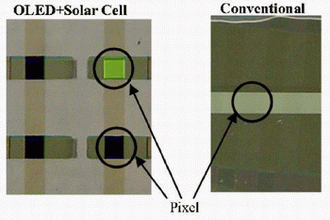
Organic light-emitting diodes (OLEDs) offer an alternative to conventional electronic displays (such as LCDs) and have advantages generally including wide viewing angles, rapid response and thin shapes. However, one area that scientists would like to improve is achieving better contrast, especially under strong lighting environments. A low-power, high-contrast OLED could provide higher quality displays for mobile electronics, and also result in longer battery lifetimes.
Recently, scientists at National Taiwan University have found a way to improve the contrast by integrating OLEDs with another hot technology: solar cells. Not only do solar cells positioned behind an OLED provide a contrast superior to that achieved with polarizers, but they can also recycle energy that is usually wasted.
Scientists Chih-Jen Yang, Ting-Yi Cho, Chun-Liang Lin, and Chung-Chih Wu explain that OLEDs generally consist of a reflective back electrode, organic layers, and a semi-transparent electrode for light to exit. The reflective back electrode means that the device constantly reflects light, even when the device is off, and degrades the contrast when the display is on. Previous approaches to reduce the ambient light reflection and enhance the contrast result in lost energy from both the incident photons and the stifling of some internal OLED emission.
“Our lab works on both OLEDs and solar cells,” Wu explained to PhysOrg.com. “One day we were inspecting the solar cells which look so absorbing and black, and somehow got the idea that maybe we could put the solar cell behind the OLED to increase the contrast of the OLED for displays. I believe this is the first time a solar cell is used as part of a display device, although previously you may find some consumer electronic products carrying solar cell panels.”
When the scientists placed a solar cell in the back of the OLED, the solar cell absorbed the incident light and internal OLED emission and then converted the light to electrical power for reuse via photovoltaic action. Although the power recycling efficiency achieved in this trial was a modest 0.26%, the scientists explained that there is much room for improvement beyond this initial demonstration, simply by using more efficient OLEDs and solar cells.
“The solar cell stack put behind the OLED actually play two roles,” said Wu. “First, it functions as a black absorbing material. Second, it also functions as an optical coating to induce destructive interference of incident ambient light, so that the ambient light reflection can be much suppressed.”
Overall, this arrangement could reduce the reflectance of the OLED from 70% in a conventional OLED to about 1.4%, without compromising the electroluminescence efficiency. The device even improves upon the OLED polarizer approach, which has a reflectance of about 5%. By getting the reflectance down to that level, the scientists are helping to prepare OLEDs to be highly competitive with current light displays.
“In addition to the improvement in contrast, one of other issues is to further reduce the production cost, including materials and manufacturing, so that it could be more competitive with other displays already used in mobile devices,” said Wu. “For example, LCDs have a strong advantage in cost currently due to their scale of mass production, i.e. economic scale. But I think that is only a matter of time. OLEDs have made progresses rapidly.”
Citation: Yang, Chih-Jen, Cho, Ting-Yi, Lin, Chun-Liang, and Wu, Chung-Chih. “Organic light-emitting devices integrated with solar cells: High contrast and energy recycling.” Applied Physics Letters 90, 173507 (2007).
Copyright 2007 PhysOrg.com.
All rights reserved. This material may not be published, broadcast, rewritten or redistributed in whole or part without the express written permission of PhysOrg.com.


