COROT discovers its first exoplanet
May 3, 2007
COROT discovers its first exoplanet

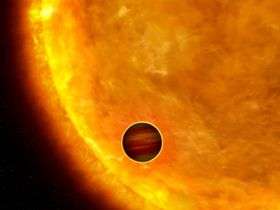
This is an artist’s impression of a Jupiter-sized planet passing in front of its parent star. Such events are called transits. When the planet transits the star, the star’s apparent brightness drops by a few percent for a short period. Through this technique, astronomers can search for planets across the galaxy by measuring periodic changes in a star’s luminosity. The first class of exoplanets found by this technique are the so-called “hot Jupiters,” which are so close to their stars they complete an orbit within days, or even hours. Credits: NASA, ESA and G. Bacon

COROT has provided its first image of a giant planet orbiting another star and the first bit of ‘seismic’ information on a far away, Sun-like star- with unexpected accuracy.

The unanticipated level of accuracy of this raw data shows that COROT will be able to see rocky planets - perhaps even as small as Earth - and possibly provide an indication of their chemical composition.
COROT discovers its first exoplanet

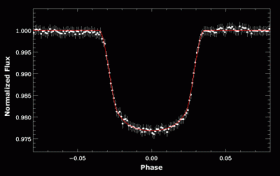
This image shows the signature of the presence of a planet orbiting a star. The intensity of light coming from the star is represented on the y-axis whereas the x-axis shows the phase, or the revolution of the planet around the star. The amount of light from the star reaching COROT decreases each time the planet passes in front of the star itself. This is when the drop is registered. This was the first planet detected by COROT since the beginning of its mission. This light curve is part of a data set obtained between February and April 2007. The planet is a very hot gas giant, of radius equal to 1.78 times that of Jupiter. The planet takes 1.5 days to revolve around the star. Coordinated spectroscopic observations from the ground have allowed to determine that the mass of the planet is about 1.3 times that of Jupiter. The parent star is a yellow dwarf star similar to our Sun. It is located in the direction of the constellation Unicorn (Monocerus), roughly 1 500 light years from us. Credits: COROT exo-team

COROT, a CNES project with ESA participation, is a mission with a dual goal. It is the first space mission dedicated entirely to the search of extra-solar planets. It provides a wide-field survey of planets like our own at an unprecedented level of accuracy. It is also making the most comprehensive study ever of the interior of stars other than our Sun. Both objectives are achieved by analysing the behaviour of light emitted by a target star.

An exoplanet is detected by COROT due to a sudden decrease in the intensity of light or the ‘light curve’ of a parent star when a planet transits in front of it.

The study of stellar interiors – or ‘asteroseismology’ – is carried out by analysing the oscillations in the light curve of the star. The oscillations are created due to mechanical waves propagating in the star itself and they give a clue to the structure of its interior.

COROT’s strength lies in the continued observation of the same targets in a given area of the sky. The observations have been on since the science operations began, 60 days ago. Another strong point is the accuracy with which it measures the variations in the luminosity of the star.

The first planet detected by COROT, now named ‘COROT-Exo-1b’, is a very hot gas giant, with a radius equal to 1.78 times that of Jupiter. It orbits a yellow dwarf star similar to our Sun with a period of about 1.5 days. ‘COROT-Exo-1b’ is situated roughly 1500 light years from us, in the direction of the constellation Unicorn (Monoceros). Coordinated spectroscopic observations from the ground have also allowed the determination of the mass of the planet, equivalent to about 1.3 Jupiter masses.

The scientific evaluation of the results that are streaming in will take some time. “The data we are presenting today is still raw but exceptional,” says Malcolm Fridlund, COROT Project Scientist for ESA. “It shows that the on-board systems are working better than expected in some cases - up to ten times the expectation before launch. This will have an enormous impact on the results of the mission.”

All the sources of noise and disturbance have not yet been taken into account in the data. This first exoplanet was detected with an error of only five parts out of 100 000 during one hour of observation. When all the corrections are applied to the light curves, the error will be reduced to only one part out of 100 000.

As a consequence, small planets down to the size of our Earth – three times smaller than initially thought possible - will be in the grasp of COROT. The satellite may also be able, in specific circumstances, to detect subtle variations in the stellar light reflected by the planet itself. This would give an indication of its chemical composition.

The quality of the asteroseismological data is equally impressive. Excellent ‘starquake’ data were obtained during the first 60 days of observations, with a margin of error of less than one part per million.

COROT observed a bright Sun-like star continuously for 50 days, showing large, unexpected luminosity variations on time scales of a few days. This may be related to the star’s magnetic activity.

The accuracy of these measurements was truly outstanding: with an error of five parts out of 100 000 in one minute (corresponding to one part per million over four minutes), COROT has already reached the maximum performance for a telescope of its size.

The preliminary analysis of the oscillations in stellar luminosity clearly shows the seismic signature typical of a Sun-like star. This analysis will eventually help scientists understand the star’s internal structure and age.

“COROT, a joint endeavour between France, Europe and Brazil under the leadership of CNES, was certainly born under a lucky star,” concluded Fridlund. “After a perfect launch, and a faster-than-expected start of its science operations, we have been eagerly awaiting its data. Now, having seen its quality, we can expect great discoveries in the future.”

Source: ESA

4.7 /5 (32 votes)  

Rank 4.7 /5 (32 votes)
Tags

Related Stories
Relevant PhysicsForums posts
  • Never ending outer space.....
    created2 hours ago
  • Neutron Star fragments?
    created4 hours ago
  • stationary or not?
    created8 hours ago
  • Scale of the Universe
    createdFeb 10, 2012
  • Titan's lack of impact craters
    createdFeb 09, 2012
  • Real pictures of black hole eating a star?
    createdFeb 08, 2012
  • More from Physics Forums - General Astronomy

More news stories

Europe stakes billion-dollar bet on new rocket

A pencil-slim rocket is scheduled to lift into space from South America on Monday, carrying a billion-dollar bet that Europe can grab a juicy slice of the market to place satellites in low orbit.

Space & Earth / Space Exploration

created 15 hours ago | popularity 3.5 / 5 (2) | comments 0

Political leaders play key role in how worried Americans are by climate change: study

More than extreme weather events and the work of scientists, it is national political leaders who influence how much Americans worry about the threat of climate change, new research finds.

Space & Earth / Environment

created Feb 06, 2012 | popularity 5 / 5 (6) | comments 72

NASA budget will axe Mars deal with Europe: scientists

US President Barack Obama's budget proposal to be submitted next week for 2013 will cut NASA's budget by 20 percent and eliminate a major partnership with Europe on Mars exploration, scientists said Thursday.

Space & Earth / Space Exploration

created Feb 10, 2012 | popularity 5 / 5 (3) | comments 48

Humans may have helped the decline of African rainforests 3000 years ago

(PhysOrg.com) -- Large areas of rainforests in Central Africa mysteriously disappeared over three thousand years ago, to be replaced by savannas. The prevailing theory has been that the cause was a change ...

Space & Earth / Environment

created Feb 10, 2012 | popularity 4.1 / 5 (14) | comments 19 | with audio podcast report

Could Venus be shifting gear?

(PhysOrg.com) -- ESA’s Venus Express spacecraft has discovered that our cloud-covered neighbour spins a little slower than previously measured. Peering through the dense atmosphere in the infrared, the ...

Space & Earth / Space Exploration

created Feb 10, 2012 | popularity 5 / 5 (8) | comments 10 | with audio podcast


Walney offshore wind farm is world's biggest (for now)

(PhysOrg.com) -- The Walney wind farm on the Irish Sea--characterized by high tides, waves and windy weather--officially opened this week. The farm is treated in the press as a very big deal as the Walney ...

GPS court ruling leaves US phone tracking unclear

A US Supreme Court decision requiring a warrant to place a GPS device on the car of a criminal suspect leaves unresolved the bigger issue of police tracking using mobile phones, legal experts say.

Europeans protest controversial Internet pact

Tens of thousands of people marched in protests in more than a dozen European cities Saturday against a controversial anti-online piracy pact that critics say could curtail Internet freedom.

Study finds that anti-diabetic medication can prevent the long-term effects of maternal obesity

In a study to be presented today at the Society for Maternal-Fetal Medicine's annual meeting, The Pregnancy Meeting, in Dallas, Texas, researchers will report findings that show that short therapy with the anti-diabetic medication ...

Netflix settlement trims 14 pct off 4Q earnings

(AP) -- Netflix pressed the rewind button on its fourth-quarter earnings after settling allegations that the video subscription service violated a consumer-privacy law.

Navy to begin tests on electromagnetic railgun prototype launcher

The Office of Naval Research (ONR)'s Electromagnetic (EM) Railgun program will take an important step forward in the coming weeks when the first industry railgun prototype launcher is tested at a facility ...