Public to look for dust grains in Stardust detectors
Astronomy buffs who jumped at the chance to use their home computers in the SETI@home search for intelligent life in the universe will soon be able to join an Internet-based search for dust grains originating from stars millions of light years away.
In a new project called Stardust@home, University of California, Berkeley, researchers will invite Internet users to help them search for a few dozen submicroscopic grains of interstellar dust captured by NASA's Stardust spacecraft and due to return to Earth in January 2006.
Though Stardust's main mission was to capture dust from the tail of comet Wild 2 - dust dating from the origins of the solar system some 4.5 billion years ago - it also captured a sprinkling of dust from distant stars, perhaps created in supernova explosions less than 10 million years ago.
"These will be the very first contemporary interstellar dust grains ever brought back to Earth for study," said Andrew Westphal, a UC Berkeley senior fellow and associate director of the campus's Space Sciences Laboratory who developed the technique NASA will use to digitally scan the aerogel in which the interstellar dust grains are embedded. "Stardust is not only the first mission to return samples from a comet, it is the first sample return mission from the galaxy."
"Like SETI@home, which is the world's largest computer, we hope Stardust@home will also be a large computer, though more of a neural network, using brains together to find these grains," said Bryan Mendez of the Center for Science Education at the Space Sciences Laboratory. Mendez and Nahide Craig, assistant research astronomer at the laboratory, plan to create K-12 curricula around the Stardust@home project and to reach out to local astronomy groups to boost participation.
Mendez and Craig will describe their educational outreach program in a poster session on Jan. 10 at the national meeting of the American Astronomical Society in Washington, D.C.
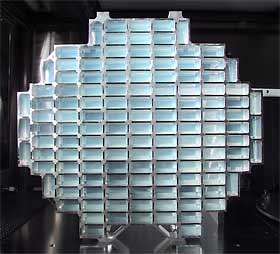
Based on previous measurements of interstellar dust by both the Ulysses and Galileo spacecrafts, Westphal expects to find approximately 45 grains of submicroscopic dust in the collector, a mosaic of tiles of lightweight aerogel forming a disk about 16 inches in diameter - nearly a square foot in area - and half an inch thick. Though those searching for pieces of Wild 2's tail will easily be able to pick out the thousands of cometary dust grains embedded in the front of the detector, finding the 45 or so grains of interstellar dust stuck in the back of the detector won't be so easy.
Thanks to a grant from NASA and assistance from the Planetary Society, however, Westphal and his colleagues at the Space Sciences Laboratory have created a "virtual microscope" that will allow anyone with an Internet connection to scan some of the 1.5 million pictures of the aerogel for tracks left by speeding dust. Each picture will cover an area smaller than a grain of salt.
"Twenty or 30 years ago, we would have hired a small army of microscopists who would be hunched over microscopes focusing up and down through the aerogel looking for the tracks of these dust grains," said Westphal. "Instead, we developed an automated microscope to scan the aerogel and hope to use volunteers we have trained and tested to search for these tracks."
The Web-based virtual microscope will be made available to the public in mid-March, even before all the scans have been completed in a cleanroom at Houston's Johnson Space Center. In all, Westphal expects to need some 30,000 person hours to look through the scanned images at least four times. Searching each picture should take just a few seconds, but the close attention required as the viewer repeatedly focuses up and down through image after image will probably limit the number a person can scan in one sitting.
To insure that the volunteer scanners know what they're doing, each must pass a test where he or she is asked to find the track in a few test samples. To judge the reliability of each volunteer - and to provide some reward in what for most will be a fruitless search - the team also plans to throw in some ringers with and without tracks.
"We will throw in some calibration images that allow us to measure the volunteers' efficiency," Westphal said.
If at least two of the four volunteers viewing each image report a track, that image will be fed to 100 more volunteers for verification. If at least 20 of these report a track, UC Berkeley undergraduates who are expert at spotting dust grain tracks will confirm the identification. Eventually, the grain will be extracted for analysis. Discoverers will get to name their dust grains.
The dust grains were collected in two phases during the Stardust spacecraft's seven-year journey to and from Wild 2 as the spacecraft turned its Stardust Interstellar Dust Collector (SIDC) into the interstellar dust stream, which courses through the solar system at a speed of about 20 kilometers (12 miles) per second. The dust grains will have made carrot-shaped trails in the aerogel, which is a novel, silicon-based sponge 100 times lighter than water.
In the early morning hours of Jan. 15, 2006, the Stardust payload will parachute into Utah's Salt Lake Desert and be airlifted to Houston, where teams will open it so as to minimize contamination from other dust. When launched in 1999, NASA was unsure how to remove from the aerogel the micron-sized cometary grains and the nearly invisible interstellar dust grains.
"It's amazing that Stardust flew without anyone having a clue as to how to get particles out of the aerogel after it came back," Westphal said. "You have to give NASA credit for taking a risk."
During Stardust's quiet journey to a rendezvous with a comet, however, Westphal led a team that created tools for extracting both comet grains and interstellar dust grains. Working with Chris Keller, formerly at the Berkeley Sensor and Actuator Center and now at MEMS Precision Instruments, he developed microtweezers and what he calls micro-pickle forks to pull comet grains from the aerogel for detailed analysis of their elemental and isotopic composition. The abundances and composition within comet grains will tell scientists about the conditions in the early solar system.
These same techniques will be used to extract interstellar dust grains, but first they have to be found. Based on earlier work with glass cosmic-ray detectors on the Mir space station, Westphal developed an automated microscope to digitally photograph the entire area of the aerogel in patches - the size of a salt grain - that can be viewed later in search of dust particles. The lengthy but exciting search for dust grains will be conducted by Internet volunteers.
Once the grains are identified and analyzed, Westphal hopes the information will tell about the internal processes of distant stars such as supernovas, flaring red giants or neutron stars that produce interstellar dust and also generate the heavy elements like carbon, nitrogen and oxygen necessary for life.
The virtual microscope was developed by computer scientist David Anderson, director of the SETI@home project, along with physics graduate student Joshua Von Korff. Craig and Mendez are now creating a teacher's lesson guide that uses the Stardust@home Virtual Microscope to teach students about the origins of the solar system. A section of the Stardust@home Web site also will be aimed at the general public.
Source: University of California - Berkeley


