NEC, JST and RIKEN demonstrate world's first controllably coupled qubits
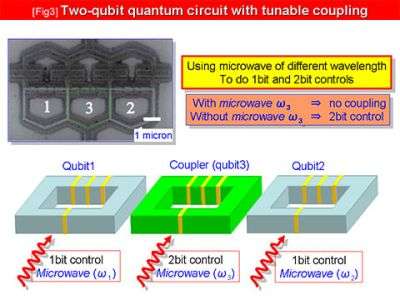
May 3, 2007 Two-qubit quantum circuit with tunable coupling

Two-qubit quantum circuit with tunable coupling

NEC Corp., Japan Science and Technology Agency (JST) and the Institute of Physical and Chemical Research (RIKEN) have together successfully demonstrated the world's first quantum bit (qubit) circuit that can control the strength of coupling between qubits. Technology achieving control of the coupling strength between qubits is vital to the realization of a practical quantum computer, and has been long awaited in the scientific field.

The quantum computer, when it is finally brought to fruition, is expected to far surpass the capabilities of even the most modern of today's supercomputers. Actual computing in a quantum computer is carried out by manipulating the quantum state of qubits in time sequence by external controls. To achieve such manipulation, it is necessary to control the: 1. States of individual qubits, 2. States of two qubits (logic operation), and 3. Ability to turn on /off the coupling between qubits.

NEC, JST, and RIKEN have already announced successful development of key technologies for the world's first solid-state qubit and the world's first two-qubit logic gate, based on solid-state technology that excels in its ability to integrate qubits. Following these achievements, the research group addressed the controllable coupling of qubits as the next logical step in realization of a practical quantum computer. Their new research result represents the world's first successful demonstration of controllably coupled qubits.

To date, the coupling of qubits has been difficult to control. In order to realize this control, the research group devised an original mechanism that employs another qubit in between the two qubits for coupling. The coupling qubit functions as a non-linear transformer that is able to turn on and off the magnetic coupling between the two qubits, and on/off control is achieved simply by inputting a microwave. Moreover, coupling operation has been achieved without shortening the lifetime of each qubit. Scalability is also realized through the repetition of coupled two-qubit units - a feature necessary for future quantum computers.

To demonstrate the operation feasibility of the controllable coupling scheme, the research group employed a coupled two-qubit system, the smallest quantum logic unit, to carry out a multi-quantum control experiment involving the turning on and off of the coupling. As a result, a simple quantum protocol has been successfully demonstrated, allowing controllable coupling for the execution of quantum algorithms.

In the near future, NEC, JST, and RIKEN, plan to implement a larger-scale, more elaborate quantum computation, aiming for the realization of a practical quantum computer.

The result of this joint research will be published in the May 4th issue of the international weekly science journal, Science.

Source: NEC Corporation of America


print this article email this article download pdf blog this article bookmark this article     Stumble it Digg this share on Facebook retweet share on Reddit add to delicious
Rate this story - 4.4 /5 (30 votes)


May 3, 2007 all stories

Comments: 0

4.4 /5 (30 votes)
  • Stumble this up

  • Digg this

  • share this

  • hide
  • Related Stories

  • Proposed Quantum Computer Consists of Billions of Electron Spins
    created Sep 09, 2009 | popularity not rated yet | comments 0
  • Making quantum computing scalable
    created Mar 20, 2009 | popularity not rated yet | comments 0
  • Graphene quantum dot may solve some quantum computing problems
    created Jan 15, 2008 | popularity not rated yet | comments 0
  • Ultrafast quantum computer uses optically controlled electrons
    created Aug 15, 2007 | popularity not rated yet | comments 0
  • Indium arsenide may provide clues to quantum information processing
    created Jul 23, 2007 | popularity not rated yet | comments 0


  • hide
  • Relevant PhysicsForums posts

  • Rocket Experiment Help
    created 8 hours ago
  • Coulomb's Law
    created 12 hours ago
  • Laser spots
    created 17 hours ago
  • Do you know elementary physics?
    created 18 hours ago
  • More from Physics Forums - General Physics

Other News

Nuclear weapons: Predicting the unthinkable

Physics / General Physics

created 22 hours ago | popularity 2.6 / 5 (5) | comments 3

If a nuclear weapon were detonated in a metropolitan area, how large would the affected area be? Where should first responders first go? According to physicist Fernando Grinstein, we have some initial understanding to address ...


Generating electricity from air flow

Physics / General Physics

created 22 hours ago | popularity 3.9 / 5 (8) | comments 2

A group of researchers at the City College of New York is developing a new way to generate power for planes and automobiles based on materials known as piezoelectrics, which convert the kinetic energy of motion into electricity. ...


Aquatic creatures mix ocean water

Physics / General Physics

created 18 hours ago | popularity 5 / 5 (3) | comments 1

Understanding mixing in the ocean is of fundamental importance to modeling climate change or predicting the effects of an El Niño on our weather. Modern ocean models primarily incorporate the effects of winds and tides. However, ...


Restored machine to explore mysteries of Big Bang (AP)

Restored machine to explore mysteries of Big Bang

Physics / General Physics

created Nov 21, 2009 | popularity 4.6 / 5 (18) | comments 21

(AP) -- Scientists are preparing the world's largest atom smasher to explore the depths of matter after successfully restarting the $10 billion machine following more than a year of repairs.


nuclear power plant

Doubts raised on nuclear industry viability

Physics / General Physics

created Nov 19, 2009 | popularity 3.1 / 5 (20) | comments 19

(PhysOrg.com) -- The investment in nuclear power has been growing around the world over the last few years, being viewed as a means for countries to control their energy security, avoid the price fluctuations ...