Can Nemo Find His Way Home?
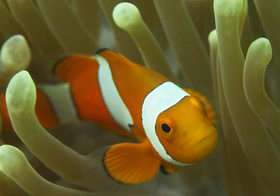
The fate of ocean fish larvae has remained a mystery to science until now, but a University of Arkansas researcher and his colleagues have used a novel technique to directly explore their journey from egg to adult for the first time. Their findings, which also may help governments and marine organizations better manage marine protected areas, appear in the May 4 issue of the journal Science.
Michael Berumen, a postdoctoral researcher at the University of Arkansas, and his colleagues Glenn R. Almany and Geoffrey P. Jones of James Cook University in Australia, together with Simon R. Thorrold of Woods Hole Oceanographic Institution and Serge Planes of the University of Perpignan, France, examined the dispersion of two species of coral reef fish larvae on a small, isolated island near Papua New Guinea.
"The fate of fish larvae has been a major question for marine ecologists," said Berumen. Researchers know that fertilized fish eggs become larvae with an ability to swim, and they remain in the larval stage anywhere from one week to almost two months. The big question is, where are they during this time? And do they return to the reef where they were spawned?
The researchers attempted to answer these questions by injecting small amounts of signature barium isotopes into female fish of two species: The orange clownfish, a brightly colored specimen made popular by the movie Finding Nemo, and the vagabond butterflyfish, which is white with black, yellow and blue markings. Both are found in coral reef populations in the South Pacific. The barium isotopes enter the bloodstream of the female fish and finally end up in the eggs that she disperses. This barium signal remains with the "tagged" larval fish as they grow into juveniles, settling in the otolith, an ear bone found in fish.
Berumen and his colleagues tagged 176 clownfish females and 123 butterflyfish on a coral reef surrounding Kimbe Island near Papua New Guinea. They chose the two species because each one reproduces in a different way and their larval stages differ in length: Clownfish spend less than two weeks in the larval stage, while butterflyfish spend over a month at that stage. The scientists returned to the island about one month after the initial tagging and collected 15 juvenile clownfish and 77 juvenile butterflyfish. They then examined the barium composition of the otoliths using mass spectrometry.
The results showed that about 60 percent of the juveniles from each species developed from larvae that originated on the reef.
"So if we were to answer the question: Can Nemo find his way home? In this case, it looks like about 60 percent of the time he can," Berumen said. "It's also important to note that we estimate that 40 percent of the juveniles came from other reefs - at least six miles away across open ocean - so we can also confirm that these populations are ecologically connected."
"If this result is typical, appropriate scales for management may be smaller than previously realized," Berumen said. This study suggests that the design of marine protected areas should be small-scale to both be able to sustain the reef, yet also populate reefs outside of the protected area, the researchers write.
Source: University of Arkansas


