Astronomers Provide New Insights Into Massive Black Hole Surroundings at Center of the Milky Way
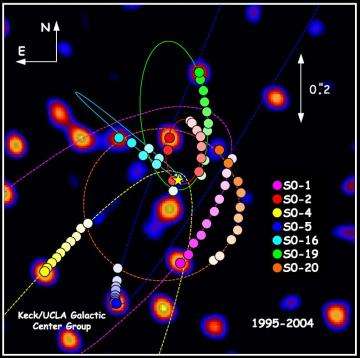
January 10, 2006 The orbits of stars within the central 1.0 X 1.0 arcseconds of our Galaxy.

The orbits of stars within the central 1.0 X 1.0 arcseconds of our Galaxy. In the background, the central portion of a diffraction-limited image taken in 2004 is displayed. While every star in this image has been seen to move over the past 9 years, estimates of orbital parameters are only possible for the seven stars that have had significant curvature detected. The annual average positions for these seven stars are plotted as colored dots, which have increasing color saturation with time. Also plotted are the best fitting simultaneous orbital solutions. These orbits provide the best evidence yet for a supermassive black hole, which has a mass of 3.7 million times the mass of the Sun.

UCLA astronomers can determine, for the first time, orbits of massive young stars located a few light months from the enormous black hole at the center of our Milky Way galaxy — stars that hold an imprint of how they were born.

The origin of young stars at the center of our galaxy has puzzled astronomers, but the orbits may be the key to unlocking the mystery, UCLA astronomy graduate student Jessica Lu reported today at the annual meeting of the American Astronomical Society in Washington, D.C. The astronomers use a new laser virtual star at the W.M. Keck observatory in Hawaii.

The hostile environment around the supermassive black hole should make it extremely difficult for stars to form, but many young stars have been detected around the black hole, said Lu, who reported that she and a UCLA team are tracking a puzzling group of more than 30 massive young stars of uncertain origins.

"How were these stars formed in such an inhospitable region?" Lu asked. "My advisor, Andrea Ghez, calls this mystery 'the paradox of youth.' Using the Keck's Laser Guide Star adaptive optics system, we expect to resolve the paradox. We are able to measure how these young stars move across the sky with an unparalleled precision (only two kilometers per second) and determine, for the first time, the orbit of each of the young stars located a few light months from the black hole.

"Just as a fingerprint can be used to identify a person, the information encoded in the orbits of the young stars will tell us how and where they formed," said Lu, a member of a UCLA research team including her advisor, Ghez, a UCLA professor of physics and astronomy.

Lu added that these are the closest stars to the supermassive black hole that have not had their orbits distorted by their inhospitable environment.

"The orbits of these young stars suggest the stars were born far from the black hole in a massive star cluster, which migrated in," Lu reported. "We can now track the stars so precisely as they move around the black hole that we can determine each star's exact orbit."

The research was conducted using the 10-meter Keck II Telescope, which is the world's first 10-meter telescope with a laser on it. Laser Guide Star allows astronomers to "generate an artificial bright star" exactly where they want it, which reveals the atmosphere's distortions.

Black holes are collapsed stars so dense that nothing can escape their gravitational pull, not even light. Black holes cannot be seen directly, but their influence on nearby stars is visible, and provides a signature, Ghez said.

The supermassive black hole, with a mass more than 3 million times that of our sun, is in the constellation of Sagittarius. The galactic center is located due south in the summer sky.

Co-authors on the research include fellow UCLA graduate student Seth Hornstein; the adaptive optics team at W. M. Keck Observatory: David Le Mignant, Marcos Van Dam and Peter Wizinowich; Antonin Bouchez (formerly with the W. M. Keck Observatory) and Keith Matthews at Caltech; Mark Morris, a UCLA professor of physics and astronomy; and Eric Becklin, a UCLA professor of physics and astronomy.

Source: UCLA


Rate this story - 4.8 /5 (13 votes)

Rank Filter

Move the slider to adjust rank threshold, so that you can hide some of the comments.


Display comments: newest first

  • AJW - Feb 14, 2008
    • Rank: not rated yet
    Hello, Does a black hole and its companion galaxy leave a space time distortion 'wake'? And, would this wake modify the close star's orbits? Regards, AJWeibel

January 10, 2006 all stories

Comments: 1

4.8 /5 (13 votes)

  • hide
  • Related Stories

  • NASA's WISE Set to Blast Off and Map the Skies
    created Dec 09, 2009 | popularity not rated yet | comments 0
  • Is Twitter the news outlet for the 21st century?
    created Jul 01, 2009 | popularity not rated yet | comments 0
  • Astronomers Report Unprecedented Double Helix Nebula Near Center of the Milky Way
    created Mar 16, 2006 | popularity not rated yet | comments 0
  • Astronomers Use Laser to Take Clearest Images of the Center of the Milky Way
    created Dec 21, 2005 | popularity not rated yet | comments 0
  • Astronomers discover cool stars in nearby space
    created Jan 29, 2010 | popularity not rated yet | comments 0


Other News

A new 3-D map of the interstellar gas within 300 parsecs from the sun

A new 3D map of the interstellar gas within 300 parsecs from the Sun

Space & Earth / Astronomy

created 24 minutes ago | popularity 5 / 5 (1) | comments 0 | with audio podcast

(PhysOrg.com) -- Astronomy & Astrophysics is publishing new 3D maps of the interstellar gas in the local area around our Sun. A French-American team of astronomers presents new absorption measurements toward ...


New international satellite observations help assess future earthquake risk in Haiti

New international satellite observations help assess future earthquake risk in Haiti

Space & Earth / Earth Sciences

created 54 minutes ago | popularity not rated yet | comments 0

Virginia Key, Florida--Scientists at the University of Miami have analyzed images based on Synthetic Aperture Radar (SAR) observations taken before and just after Haiti's earthquake, on January 12. The images ...


Rho Ophiuchus cloud

Professor: We have a 'moral obligation' to seed universe with life

Space & Earth / Astronomy

created 8 hours ago | popularity 3.6 / 5 (18) | comments 28 | with audio podcast report

(PhysOrg.com) -- Eventually, the day will come when life on Earth ends. Whether that’s tomorrow or five billion years from now, whether by nuclear war, climate change, or the Sun burning up its fuel, the last ...


Russian Soyuz TMA-17 rocket blasts off to the International Space Station

Russia wants to charge more for rides to space: report

Space & Earth / Space Exploration

created 11 hours ago | popularity 5 / 5 (1) | comments 2

Russia, which is set to hold a monopoly on flights to the international space station (ISS), wants to charge more for rides on its Soyuz rocket, the space agency head said Tuesday.


UB geographers help map devastation in Haiti

Space & Earth / Earth Sciences

created 4 hours ago | popularity not rated yet | comments 0

In the wake of the earthquake in Haiti, University at Buffalo geography students are participating in a global effort to enhance the international response and recovery effort by helping to assess damage, using images hosted ...