Astronomers report mysterious giant star clusters
January 10, 2006 Astronomers report mysterious giant star clusters

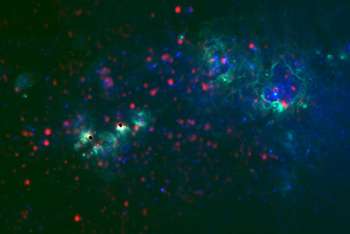
Super star clusters and super nebulae in the nearby galaxy NGC 4214. A Keck Telescope infrared image is superimposed on a Hubble Space Telescope image, with visible star clusters shown in blue. The black dots, revealed in radiographs, are young super star clusters in the process of forming.

An international team of astronomers reported evidence for the formation of mysterious "super star clusters" Jan. 9 at the annual meeting of the American Astronomical Society in Washington, D.C. These star clusters are the likely precursors to the familiar globular clusters of the Milky Way; however in our galaxy, globular clusters are all believed to be older than 10 billion years -- close to the age of the universe itself -- and none are forming.

Using the Very Large Array Telescope, the astronomers detected radio-infrared "super nebulae" around giant star clusters in the process of formation in a dozen nearby galaxies.

"The super nebulae are gas clouds heated by intense ultraviolet light from young super star clusters," said Chao-Wei Tsai, UCLA astronomy graduate student and leader of the team. "The star clusters are young and still hidden within their birth clouds. Although we cannot see the clusters directly, we can clearly detect the infrared and radio emissions from the hot gas surrounding them."

"The super star clusters hidden within these super nebulae are probably a lot like globular clusters in our own Milky Way, only younger, and they can contain up to a million young stars," said Jean Turner, UCLA professor of physics and astronomy, and a member of the team, along with Sara C. Beck of Tel Aviv University. "The mystery is why our own Milky Way no longer forms globular star clusters and hasn't for 10 billion years. These galaxies still can. We want to know why. This is star formation on steroids."

Super star clusters pack a huge number of bright and blue stars into a very small volume of space, with a density of stars up to a million times higher than near the sun. The radiant power emitted by these clusters can be up to a billion times the sun's wattage, in a region only a few light years across.

"The brightest of even one of these stars at the distance of the sun could charge a solar powered car in one second with enough energy to drive from Los Angeles to San Francisco!" Turner said.

The researchers obtained their radio and infrared images of the super nebulae using the Very Large Array of the National Radio Astronomy Observatory, a facility of the National Science Foundation, and the W. M. Keck Observatory in Hawaii, operated jointly by the University of California and the California Institute of Technology, with support from NASA.

The discovery of young super nebulae around these potential proto-globular clusters was made by a team led by Beck and Turner several years ago. This latest result shows just how common young super clusters outside the Milky Way are.

"Life on a planet orbiting a star in a young super star cluster would be very different," mused Beck. "There would be light coming from every direction, and no darkness or night -- sunlight would be very blue -- it would be a strange place to live."

Source: University of California - Los Angeles


print this article email this article download pdf blog this article bookmark this article     Stumble it Digg this share on Facebook retweet share on Reddit add to delicious
Rate this story - 4.9 /5 (10 votes)


January 10, 2006 all stories

Comments: 0

4.9 /5 (10 votes)
  • Stumble this up

  • Digg this

  • share this

  • hide
  • Related Stories

  • Star-Forming Backbone of a Massive Structure in the Early Universe Photographed
    created May 20, 2009 | popularity not rated yet | comments 0
  • Hubble celebrates 19th anniversary with fountain of youth
    created Apr 21, 2009 | popularity not rated yet | comments 0
  • Open clusters like Orion have low fertility rate
    created Jul 08, 2008 | popularity not rated yet | comments 0
  • Antennae Galaxies
    created May 19, 2008 | popularity not rated yet | comments 0
  • Million-Degree Plasma May Flow throughout the Galaxy
    created Feb 07, 2008 | popularity not rated yet | comments 0


Other News

Past regional cold and warm periods linked to natural climate drivers

Space & Earth / Earth Sciences

created 15 hours ago | popularity 3.8 / 5 (11) | comments 18

Intervals of regional warmth and cold in the past are linked to the El Niņo phenomenon and the so-called "North Atlantic Oscillation" in the Northern hemisphere's jet stream, according to a team of climate scientists. These ...


Russia: no space for space tourists (AP)

Russia: no space for space tourists

Space & Earth / Space Exploration

created 23 hours ago | popularity 2.7 / 5 (3) | comments 2

(AP) -- A top Russian space official says there is no space for tourists wishing to fly to the International Space Station.


Astronauts surprised by holiday turkey dinners (AP)

Astronauts surprised by holiday turkey dinners

Space & Earth / Space Exploration

created 18 hours ago | popularity 5 / 5 (1) | comments 0

(AP) -- Space shuttle Atlantis' astronauts thought they were going to give thanks with pantry leftovers Thursday as their mission drew to a close, but found turkey dinners awaiting them.


Gullies and Flow Features on Crater Wall

Gullies and Flow Features on Crater Wall

Space & Earth / Space Exploration

created 19 hours ago | popularity 5 / 5 (1) | comments 0

(PhysOrg.com) -- This image from the High Resolution Imaging Science Experiment (HiRISE) camera on NASA's Mars Reconnaissance Orbiter shows a sample of the variety and complexity of processes that may occur ...


Thanksgiving last full day in space for shuttle (AP)

Thanksgiving last full day in space for shuttle

Space & Earth / Space Exploration

created 22 hours ago | popularity not rated yet | comments 0

(AP) -- Space shuttle Atlantis' astronauts will spend Thanksgiving checking their ship for the ride home.