Venus Express' infrared camera goes filming
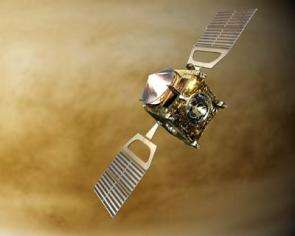
An exciting new series of videos from ESA’s Venus Express has been capturing atmospheric details of day and night areas simultaneously, at different altitudes.
The south pole of the planet and its gigantic double vortex has been pictured as never before.
The south pole of Venus and the double-eyed storm permanently rule atmospheric phenomena in that area of the planet. They are key to understanding the global atmospheric dynamics on Venus and will contribute to a better comprehension of the global meteorology of the planet.
In the search for all possible clues on how to solve the global atmospheric ‘puzzle’, the team of scientists behind the Ultraviolet, Visible and Near-Infrared Mapping Spectrometer (VIRTIS) on board Venus Express, have tried something new – starting from the south pole.
They started by focusing on this target from the advantageous position of the orbit apocentre (the furthest distance of the spacecraft from the planet). This allows the instrument to keep the target in the field of view for longer than in other portions of the orbit, where the spacecraft travels faster. In this favourable position, scientists made efficient use of the multi-wavelength capability of VIRTIS.
By using wavelengths longer than 3 microns in the thermal infrared range, VIRTIS can obtain a combined view of the day and night sides simultaneously. This is more convenient since at shorter wavelengths, the difference between the thermal radiation emitted on the day and night sides is too high to observe both regions simultaneously without ‘blinding’ some channels of the camera.
"It is comparable to looking at bright, sun-illuminated snow and at a dark sky without having to change your glasses," said Giuseppe Piccioni, VIRTIS co-Principal Investigator. "In addition, within this observation process, not only can we look at the dark and lit sides of the south pole at the same time, but we can also look into the atmosphere at different depths. What we are building is the most complete 3D data set of the Venusian atmosphere to date."
The VIRTIS videos of the south polar vortex presented here are the result of combined observations at two different wavelengths (3.8 and 1.7 microns, respectively) used at the same time. The various images were taken over five orbits, during a time-span of about 8 hours per orbit.
The 3.8-micron channel was chosen because of its compatibility (in exposure time) with the 1.7-micron observations, as well as for its capability to provide information about the cloud deck at about 65 kilometres altitude over the planet. The 1.7-micron wavelength was chosen to probe the atmosphere below the clouds when looking at the night side.
It is clearly possible to see that the morphology of the vortex changes a lot during the 8-hour observation session and from one orbit to the next (one Venus Express orbit is 24 hours long).
It is interesting to note that due to ‘bad weather conditions’, by the time of the observations, the videos do not show the maximum achievable image contrast. In fact, the visibility of the polar structure was somewhat reduced by the local increase of the upper atmospheric haze.
"If the weather permits, by extending the time span of our future observations, we may have the chance to obtain even clearer and more detailed views of the polar vortex," added Piccioni.
"With video sequences of this kind, combining all the pieces of information together, we can study the dynamics and the evolution of the vortex both in the short and the long term," said Pierre Drossart, the other co-Principal Investigator on VIRTIS. "What we want to understand is the overall 3D thermal structure of the vortex, especially the vertical variation of the horizontal winds."
The next step will be the correlation of this data and data collected in the next sessions, with fluid dynamics computer models. This will eventually help the scientists create the best possible atmospheric model of Venus to date.
Source: European Space Agency


