Chandra sees brightest supernova ever
May 7th, 2007 Chandra sees brightest supernova ever

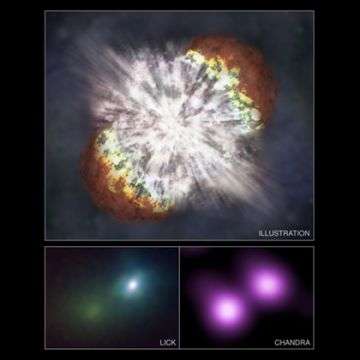
According to observations by NASA's Chandra X-ray Observatory and ground-based optical telescopes, the supernova SN 2006gy is the brightest and most energetic stellar explosion ever recorded and may be a long-sought new type of explosion. Credit: Illustration: NASA/CXC/M.Weiss; X-ray: NASA/CXC/UC Berkeley/N.Smith et al.; IR: Lick/UC Berkeley/J.Bloom & C.Hansen

The brightest stellar explosion ever recorded may be a long-sought new type of supernova, according to observations by NASA's Chandra X-ray Observatory and ground-based optical telescopes. This discovery indicates that violent explosions of extremely massive stars were relatively common in the early universe, and that a similar explosion may be ready to go off in our own Galaxy.

"This was a truly monstrous explosion, a hundred times more energetic than a typical supernova," said Nathan Smith of the University of California at Berkeley, who led a team of astronomers from California and the University of Texas. "That means the star that exploded might have been as massive as a star can get, about 150 times that of our Sun. We've never seen that before."

Astronomers think many of the first generation of stars were this massive, and, therefore, this new supernova may provide a rare glimpse of how the first stars died. It is unprecedented, however, to find such a massive star and witness its death in the local Universe. The discovery of the supernova, known as SN 2006gy, provides evidence that the death of such massive stars is fundamentally different from theoretical predictions.

"Of all exploding stars ever observed, this was the king," said Alex Filippenko, leader of the ground-based observations at the Lick Observatory in California and the Keck Observatory in Hawaii. "We were astonished to see how bright it got, and how long it lasted."

The Chandra observation allowed the team to rule out the most likely alternative explanation for the supernova, namely that it was an explosion of a white dwarf star with a mass only slightly higher than the Sun into a dense, hydrogen-rich environment. In that event, SN 2006gy should have been 1,000 times brighter in X-rays than what Chandra detected.

"This provides strong evidence that SN 2006gy was, in fact, the death of an extremely massive star," said Dave Pooley of U.C. Berkeley who led the Chandra observations.

The star that produced SN 2006gy apparently expelled a large amount of mass prior to exploding. This eruption is similar to one seen from Eta Carinae, a massive star in our Galaxy, raising suspicion that Eta Carinae may be poised to explode as a supernova. Although SN 2006gy is intrinsically the brightest supernova ever, it is in the galaxy NGC 1260 some 240 million light years away. However, Eta Carinae is only about 7500 light years away in our own Milky Way galaxy.

"We don't know for sure if Eta Carinae will explode soon, but we had better keep a close eye on it just in case," said Mario Livio of the Space Telescope Science Institute in Baltimore, who was not involved in the research. "Eta Carinae's explosion could be the best star-show in the history of modern civilization."

Supernovas usually occur when massive stars exhaust their fuel and collapse under their own gravity. In this case of SN 2006gy, astronomers think that a very different effect may have triggered the explosion. Under some conditions, the core of a massive star produces so much gamma-ray light that some of the energy from the radiation is converted into particle and anti-particle pairs. The resulting drop in energy causes the star to collapse under its own huge gravity.

After this violent collapse, runaway thermonuclear reactions ensue and the star explodes, spewing the remains into space. The SN 2006gy data suggest that spectacular supernovas from the first stars -- rather than complete collapse to a black hole -- may be more common than previously believed.

"In terms of the effect on the early Universe, there's a huge difference between these two possibilities," said Smith. "One pollutes the galaxy with large quantities of newly made elements and the other locks them up forever in a black hole."

Source: Chandra X-ray Center


print this article email this article download pdf blog this article bookmark this article     Digg this Stumble it share on Facebook share on Reddit add to delicious save to Yahoo! bookmarks
4.7/5 after 72 votes


May 7th, 2007 all stories
Space & Earth / Astronomy

Comments: 0
Rank: 4.7/5 after 72 votes

  • Stumble this up

  • Digg this

  • Share it:
  • share on Facebook
  • share on MySpace
  • share on Slashdot
  • rss-newsfeed
  • share on Google
  • share on Reddit
  • add to delicious
  • save to Yahoo! bookmarks
  • share on Windows Live
  • Add to Mixx!
Rating: 4.7/5 after 72 votes

  • Related Stories

  • Unusual shape of exploded star puzzles scientists
    created Jun 17, 2009 | popularity not rated yet | comments 0
  • Peculiar, junior-sized supernova discovered by New York teen
    created Jun 11, 2009 | popularity not rated yet | comments 0
  • New technique improves estimates of pulsar ages
    created Jun 09, 2009 | popularity not rated yet | comments 0
  • Supernova remnant is an unusual suspect
    created Jun 09, 2009 | popularity not rated yet | comments 0
  • Queen's astronomers propose new supernova interpretation
    created Jun 09, 2009 | popularity not rated yet | comments 0

Tags


  • Physicists Demonstrate Quantum Memory with Matter Qubits
    Physicists Demonstrate Quantum Memory with Matter Qubits
    Physics / General Physics
    created 19 hours ago | popularity 4.5 / 5 (11) | comments 1
  • 'Holey' Nanosheets for Wastewater Dye Removal
    Nanotechnology / Nanomaterials
    created Jul 01, 2009 | popularity 5 / 5 (5) | comments 1
  • Jellyfish Robot Swims Like its Biological Counterpart
    Jellyfish Robot Swims Like its Biological Counterpart
    Electronics / Robotics
    created Jun 26, 2009 | popularity 4.4 / 5 (7) | comments 1
  • Could Maxwell's Demon Exist in Nanoscale Systems?
    Could Maxwell's Demon Exist in Nanoscale Systems?
    Physics / General Physics
    created Jun 24, 2009 | popularity 4.4 / 5 (18) | comments 29
  • Living Safely with Robots, Beyond Asimov's Laws
    Living Safely with Robots, Beyond Asimov's Laws
    Electronics / Robotics
    created Jun 22, 2009 | popularity 4.6 / 5 (51) | comments 39
  • Other News

    Global warming tactic cools climate but won’t help corals, say researchers

    Space & Earth / Earth Sciences

    created 16 hours ago | popularity 2.3 / 5 (3) | comments 5

    (PhysOrg.com) -- “Geoengineering” experiments proposed to reduce global warming by blocking sunlight with atmosphere-injected particles may cool the world but still leave carbon dioxide levels dangerously high, Stanford scientists ...


    Coolest spacecraft ever in orbit around L2

    Coolest spacecraft ever in orbit around L2

    Space & Earth / Space Exploration

    created 18 hours ago | popularity 4.8 / 5 (4) | comments 3

    (PhysOrg.com) -- Last night, the detectors of Planck's High Frequency Instrument reached their amazingly low operational temperature of -273°C, making them the coldest known objects in space. The spacecraft ...


    Senator may have won fight over private rocket manufacturing

    Space & Earth / Space Exploration

    created 18 hours ago | popularity 4.5 / 5 (2) | comments 2

    For months, a powerful Republican senator from Alabama has fought the Obama administration to block $150 million that the White House wanted to spend to help private companies build rockets capable of reaching the international ...


    The least sea ice in 800 years

    The least sea ice in 800 years

    Space & Earth / Earth Sciences

    created Jul 01, 2009 | popularity 4.3 / 5 (57) | comments 43

    New research, which reconstructs the extent of ice in the sea between Greenland and Svalbard from the 13th century to the present indicates that there has never been so little sea ice as there is now. The ...


    Gas around young galaxy

    Intense heat killed the Universe's would-be galaxies, researchers say

    Space & Earth / Astronomy

    created Jul 01, 2009 | popularity 3.1 / 5 (18) | comments 23

    (PhysOrg.com) -- Our Milky Way galaxy only survived because it was already immersed in a large clump of dark matter which trapped gases inside it, scientists led by Durham University's Institute for Computational ...