Transcontinental wildfire emissions monitored from space
May 8, 2007 Transcontinental wildfire emissions monitored from space

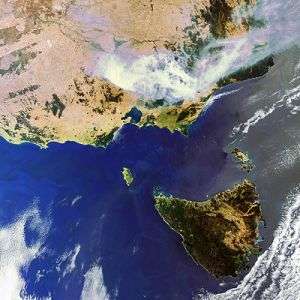
This image was acquired on 7 December 2006 by Envisat’s Medium Resolution Imaging Spectrometer (MERIS) instrument and shows the smoke arising from raging fires burning across the state of Victoria in the southeastern corner of Australia. As well as detecting the smoke billowing from major conflagrations, satellites also detect the fires themselves. For a decade now, ESA satellites have been continuously surveying fires burning across the Earth’s surface. Credits: ESA

Using data from the SCIAMACHY instrument aboard ESA’s environmental satellite Envisat, scientists have determined that the carbon monoxide hovering over Australia during the wildfire season largely originated from South American wildfires some 13 000 kilometres away.

Using SCIAMACHY, Annemieke Gloudemans from SRON Netherlands Institute for Space Research and her colleagues at Utrecht University, the Vrije Universiteit Amsterdam and the Netherlands Meteorological Institute (KNMI) witnessed large quantities of released carbon monoxide (CO) above the southern continents. They also saw increased concentrations of carbon monoxide above Central Australia, a desert region that is not prone to forest fires.

"Initially we assumed that the wildfires in North Australia were responsible for this. Yet when we took a closer look at the transport of carbon monoxide, we had to conclude that the majority originated from fires in South America. Even one-third of the carbon monoxide enhancements above the fires in North Australia originated from South America," Gloudemans said.

Knowledge about the global distribution of carbon monoxide is important because it affects air quality and climate.

SCIAMACHY is the first satellite instrument that can measure the global distribution of carbon monoxide with nearly equal sensitivity from the uppermost layer of the atmosphere down to the Earth surface where the carbon monoxide sources are located.

"SCIAMACHY allows us to map the sources of carbon monoxide and see where they are blown to," Gloudemans added. "We did this for all of the continents in the southern hemisphere – South America, Australia and Southern Africa – for the years 2003 and 2004 and found surprising results.

"It has been known for many years now that carbon monoxide from forest fires can be transported over long distances, but one would expect that the plume would rapidly become more diffuse the longer it travels. So, it was very surprising to find that even over Australian biomass-burning areas still up to 30% of the enhanced carbon monoxide levels from forest fires originate in South America."

Forest fires in South America produced much more carbon monoxide in 2004 than in 2003, Gloudemans explained. "These levels correlated to the amounts found over Australia for the same periods, confirming that the carbon monoxide levels over Australia are severely influenced by South American forest fires."

Plumes of carbon monoxide signal strong biomass burning. Apart from the carbon monoxide detected by SCIAMACHY, numerous other compounds are emitted that have severe consequences for air quality and climate.

Depending on the aridity, much of Australia is prone to fires between October and March, and the direct consequences for humans and the environment are disastrous. The fire season in South America, often concentrated in Brazil, Argentina, Bolivia and Venezuela, lasts from July to December roughly and contributes up to 50% of the enhanced carbon monoxide levels in the atmosphere over Australia.

Source: ESA


print this article email this article download pdf blog this article bookmark this article     Stumble it Digg this share on Facebook retweet share on Reddit add to delicious
Rate this story - not rated yet


May 8, 2007 all stories

Comments: 0

not rated yet
  • Stumble this up

  • Digg this

  • share this

  • hide
  • Related Stories


  • hide
  • Relevant PhysicsForums posts

  • The IPCC and the term "most"
    created 22 hours ago
  • Is global warming a fact?
    created 23 hours ago
  • Random variability of wind patterns
    created Nov 23, 2009
  • Record precipitation in the UK
    created Nov 22, 2009
  • More from Physics Forums - Earth

Other News

First black holes may have incubated in giant, starlike cocoons, says CU-Boulder study

First black holes may have incubated in giant, starlike cocoons

Space & Earth / Astronomy

created 47 minutes ago | popularity 5 / 5 (1) | comments 5

(PhysOrg.com) -- The first large black holes in the universe likely formed and grew deep inside gigantic, starlike cocoons that smothered their powerful x-ray radiation and prevented surrounding gases from ...


Oceans absorbing carbon dioxide more slowly, scientist finds

Space & Earth / Earth Sciences

created 49 minutes ago | popularity not rated yet | comments 1

The world's oceans are absorbing less carbon dioxide (CO2), a Yale geophysicist has found after pooling data taken over the past 50 years. With the oceans currently absorbing over 40 percent of the CO2 emitted by human activity, ...


LSU gets to the bottom of things -- in Antarctica

Space & Earth / Earth Sciences

created 6 minutes ago | popularity not rated yet | comments 0

Antarctica has long held secrets of the earth's history locked in its icy depths, and until recently, there has been very little information on the environments that have been sealed beneath miles of ice for millions of years. ...


Researchers Establish Common Seasonal Patterns Among Bacterial Communities in Arctic Rivers

Researchers Establish Common Seasonal Patterns Among Bacterial Communities in Arctic Rivers

Space & Earth / Earth Sciences

created 3 hours ago | popularity not rated yet | comments 0

(PhysOrg.com) -- New research on bacterial communities throughout six large Arctic river ecosystems reveals predictable temporal patterns, suggesting that scientists could use these communities as markers ...


From Greenhouse to Icehouse

From Greenhouse to Icehouse

Space & Earth / Earth Sciences

created 6 hours ago | popularity 4.6 / 5 (5) | comments 7

A new study that reconstructed ocean temperatures from millions of years ago could provide new insight into how the Earth responds to climate change.