Space propulsion breakthrough: new spacecraft ion engine tested
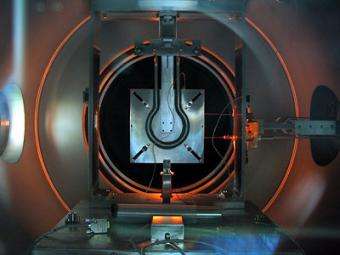
January 11th, 2006 DS4G thruster firing during tests in the ESTEC Electric Propulsion facility

DS4G thruster firing during tests in the ESTEC Electric Propulsion facility (CORONA vacuum chamber) Credits: ESA

The European Space Agency and the Australian National University have successfully tested a new design of spacecraft ion engine that dramatically improves performance over present thrusters and marks a major step forward in space propulsion capability.

Ion engines are a form of electric propulsion and work by accelerating a beam of positively charged particles (or ions) away from the spacecraft using an electric field. ESA is currently using electric propulsion on its Moon mission, SMART-1. The new engine is over ten times more fuel efficient than the one used on SMART-1. "Using a similar amount of propellant as SMART-1, with the right power supply, a future spacecraft using our new engine design wouldn't just reach the Moon, it would be able to leave the Solar System entirely," says Dr Roger Walker of ESA's Advanced Concepts Team, Research Fellow in Advanced Propulsion and Technical Manager of the project.

The new experimental engine, called the Dual-Stage 4-Grid (DS4G) ion thruster, was designed and built under a contract with ESA in the extremely short time of four months by a dedicated team at the Australian National University. "The success of the DS4G prototype shows what can be achieved with the passion and drive of a capable and committed team. It was an incredible experience to work with ESA to transform such an elegant idea into a record-breaking reality", says Dr. Orson Sutherland, the engine's designer and head of the development team at the ANU. During November 2005, the DS4G engine was tested for the first time in ESA's Electric Propulsion Laboratory at ESTEC in the Netherlands, with support from Dr Sutherland and ESA test engineers.
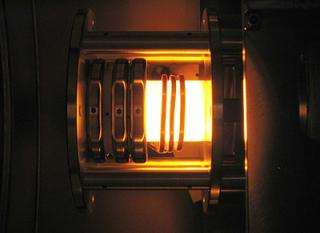
DS4G thruster firing during tests in the ESTEC Electric Propulsion facility

DS4G thruster firing during tests in the ESTEC Electric Propulsion facility (CORONA vacuum chamber) Credits: ESA

Traditional ion engines use three closely separated perforated grids containing thousands of millimetre-sized holes attached to a chamber containing a reservoir of the charged particles. The first grid has thousands of volts applied, and the second grid operates at low voltage. The voltage difference over the gap between the two grids creates an electric field that acts to simultaneously extract and accelerate the ions out of the chamber and into space in a single step. The higher the voltage difference, the faster the ions are expelled and the greater the fuel efficiency of the thruster. However, at higher voltage differences approaching five thousand volts (5kV), some of the ions collide with the second grid as they are accelerated, thus eroding and damaging the grid and thereby limiting its lifetime in space.

The DS4G ion engine utilises a different concept first proposed in 2001 by David Fearn, a pioneer of ion propulsion in the UK, which solves this limitation by performing a two-stage process to decouple the extraction and acceleration of ions using four grids. In the first stage, the first two grids are closely spaced and both are operated at very high voltage and a low voltage difference between the two (3 kV) enables the ions to be safely extracted from the chamber without hitting the grids. Then, in the second stage, two more grids are positioned at a greater distance 'downstream' and operated at low voltages. The high voltage difference between the two pairs of grids powerfully accelerates the extracted ions.

The test model achieved voltage differences as high as 30kV and produced an ion exhaust plume that travelled at 210,000 m/s, over four times faster than state-of-the-art ion engine designs achieve. This makes it four times more fuel efficient, and also enables an engine design which is many times more compact than present thrusters, allowing the design to be scaled up in size to operate at high power and thrust. Due to the very high acceleration, the ion exhaust plume was very narrow, diverging by only 3 degrees, which is five times narrower than present systems. This reduces the fuel needed to correct the orientation of spacecraft from small uncertainties in the thrust direction.

There is of course still a great deal of work to be done before the new engine design can fly in space. "Working with our industrial partners, the next challenge is to transition this promising new engine design from laboratory experiment to spacecraft flight model and properly define the new missions that it will enable", says José Gonzalez del Amo, Head of Electric Propulsion at ESA. The flight-suitable engines must then be tested: and for ion engines this is a long process.

Since they must operate continuously in space for tens of thousands of hours providing a small thrust, ground tests in a vacuum facility must last several thousand hours to prove their reliability. Only after all this could the first flight models be launched.

Once ready, these engines will be able to propel spacecraft to the outermost planets, the newly discovered planetoids beyond Pluto and even further, into the unknown realm of interstellar space beyond the Solar System. Closer to home, these supercharged ion engines could figure prominently in the human exploration of space. With an adequate supply of electrical power, a small cluster of larger, high power versions of the new engine design would provide enough thrust to propel a crewed spacecraft to Mars and back.

"This is an ultra-ion engine. It has exceeded the current crop by many times and opens up a whole new frontier of exploration possibilities," says Dr Walker.

Source: ESA


print this article email this article download pdf blog this article bookmark this article     Digg this Stumble it share on Facebook share on Reddit add to delicious save to Yahoo! bookmarks
4.8/5 after 697 votes

Rank Filter

Move the slider to adjust rank threshold, so that you can hide some of the comments.


Display comments: newest first

  • holoman - Oct 28, 2007
    • Rank: 4 / 5 (2)
    It will have the horse power of a hummingbird.

    I really think we need to keep working on something that can really make a life saving change to man's future. This one isn't it.
  • holoman - May 16, 2008
    • Rank: not rated yet
  • Modernmystic - Feb 27, 2009
    • Rank: not rated yet
    The holy grail of near term space propulsion IMO is somehow unifying gravity with electromagnetism and putting a fusion reactor on the ship. Then you just convert your electricity to gravity and zoom off...

    Of course I think, even this "non fantastic" sublight dream is still a long way away unfortunately.

    In the interim we could use this...

    http://en.wikiped...opulsion

    ...if we weren't so TERRIFIED of anything with the word nuclear in in....

January 11th, 2006 all stories
Physics /

Comments: 3
Rank: 4.8/5 after 697 votes

  • Stumble this up

  • Digg this

  • Share it:
  • share on Facebook
  • share on MySpace
  • share on Slashdot
  • rss-newsfeed
  • share on Google
  • share on Reddit
  • add to delicious
  • save to Yahoo! bookmarks
  • share on Windows Live
  • Add to Mixx!
Rating: 4.8/5 after 697 votes

  • Related Stories

  • GOCE's 'heart' starts beating
    created Apr 08, 2009 | popularity not rated yet | comments 0
  • GOCE's electric ion propulsion engine switched on
    created Apr 06, 2009 | popularity not rated yet | comments 0
  • ESA designs its smallest ever space engine to push back against sunshine
    created Mar 10, 2009 | popularity not rated yet | comments 0
  • Ion engine to propel spacecraft to Mercury
    created Jan 20, 2008 | popularity not rated yet | comments 0
  • NASA's Ion Engine Breaks Performance Record
    created Sep 28, 2007 | popularity not rated yet | comments 0

Tags


  • Physicists Demonstrate Quantum Memory with Matter Qubits
    Physicists Demonstrate Quantum Memory with Matter Qubits
    Physics / General Physics
    created 19 hours ago | popularity 4.5 / 5 (11) | comments 1
  • 'Holey' Nanosheets for Wastewater Dye Removal
    Nanotechnology / Nanomaterials
    created Jul 01, 2009 | popularity 5 / 5 (5) | comments 1
  • Jellyfish Robot Swims Like its Biological Counterpart
    Jellyfish Robot Swims Like its Biological Counterpart
    Electronics / Robotics
    created Jun 26, 2009 | popularity 4.4 / 5 (7) | comments 1
  • Could Maxwell's Demon Exist in Nanoscale Systems?
    Could Maxwell's Demon Exist in Nanoscale Systems?
    Physics / General Physics
    created Jun 24, 2009 | popularity 4.4 / 5 (18) | comments 29
  • Living Safely with Robots, Beyond Asimov's Laws
    Living Safely with Robots, Beyond Asimov's Laws
    Electronics / Robotics
    created Jun 22, 2009 | popularity 4.6 / 5 (51) | comments 39
  • Other News

    Physicists Demonstrate Quantum Memory with Matter Qubits

    Physicists Demonstrate Quantum Memory with Matter Qubits

    Physics / General Physics

    created 19 hours ago | popularity 4.5 / 5 (11) | comments 1

    (PhysOrg.com) -- For the first time, scientists have successfully operated a quantum gate between two remote particles of matter, marking an important step toward the development of a quantum computer. In ...


    Scientists create first electronic quantum processor

    Scientists create first electronic quantum processor

    Physics / General Physics

    created Jun 28, 2009 | popularity 4.8 / 5 (49) | comments 38

    A team led by Yale University researchers has created the first rudimentary solid-state quantum processor, taking another step toward the ultimate dream of building a quantum computer.


    Fermilab's CDF observes Omega-sub-b baryon

    Fermilab's CDF observes Omega-sub-b baryon

    Physics / General Physics

    created Jun 29, 2009 | popularity 4.6 / 5 (13) | comments 7

    (PhysOrg.com) -- At a recent physics seminar at the Department of Energy’s Fermi National Accelerator Laboratory, Fermilab physicist Pat Lukens of the CDF experiment announced the observation of a new particle, ...


    New insights, and a new angle, on high-temperature superconductivity

    New insights, and a new angle, on high-temperature superconductivity

    Physics / Superconductivity

    created Jun 29, 2009 | popularity 4.8 / 5 (12) | comments 6

    (PhysOrg.com) -- A Princeton-led research team has revealed surprising information about how electron behavior influences the conduction of electricity in a class of high-temperature superconductors. An increased ...


    The art of invisibility and the perfect cat's eye

    The art of invisibility and the perfect cat's eye

    Physics / Optics & Photonics

    created Jun 30, 2009 | popularity 3.9 / 5 (7) | comments 6

    (PhysOrg.com) -- In recent years scientists have explored the impossible by developing invisibility or 'cloaking' devices, but can the same technology also help make things more visible?