Biosensor sniffs out explosives
May 8, 2007 Biosensor sniffs out explosives

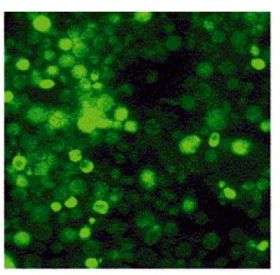
When the biosensor detects DNT, it lights up green. Credit: D. Dhanasekaran

Temple University School of Medicine researchers have developed a new biosensor that sniffs out explosives and could one day be used to detect landmines and deadly agents, such as sarin gas, according to a paper in the June issue of Nature Chemical Biology.

To create the biosensor, Danny Dhanasekaran and colleagues genetically engineered a yeast strain with mammalian (rat) olfactory signaling machinery and genetically linked it to the expression of green fluorescent protein. Into these yeast cells, they cloned individual rat olfactory receptors. When the olfactory receptor "smells" the odor of DNT, an ingredient in the explosive TNT, the biosensor turns fluorescent green. The research team is the first to identify, clone and sequence this novel olfactory receptor.

"We suspected that harnessing the potential of the olfactory system, which can detect innumerable chemical agents with unparalleled sensitivity and selectivity, would be of immense value in the detection of environmental toxins and chemical warfare agents even at sublethal levels," said Dhanasekaran, Associate Professor of Biochemistry at Temple’s Fels Institute for Cancer Research and Molecular Biology.

The research team is now perfecting the utility of the biosensor, for example, its response time, and believes that the potential therapeutic applications extend beyond the detection of chemical agents.

"With further genetic fine-tuning of the olfactory receptor pathway, this system could also be used to screen experimental medications, a crucial step in the development of new drugs," said Dhanasekaran.

Biosensors, which are made from natural ingredients, are preferable to man-made sensors, which can be expensive, cumbersome and inflexible. Dhanasekaran envisions that the biosensor will soon be incorporated into a handheld device or a remote device that can be left at a location and monitored from afar.

Source: Temple University


print this article email this article download pdf blog this article bookmark this article     Stumble it Digg this share on Facebook retweet share on Reddit add to delicious
Rate this story - 4.1 /5 (9 votes)


May 8, 2007 all stories

Comments: 0

4.1 /5 (9 votes)
  • Stumble this up

  • Digg this

  • share this

  • hide
  • Related Stories

  • Smell of success for nanobiosensors
    created May 15, 2006 | popularity not rated yet | comments 0
  • Magnetic Nanotags Spot Cancer in Mice Earlier Than Current Methods
    created Nov 17, 2009 | popularity not rated yet | comments 0
  • Researchers to develop probes to study cellular GPS
    created Nov 10, 2009 | popularity not rated yet | comments 0
  • Implantable Glucose Sensor Could Spell Relief for Millions of Diabetics (w/ Video)
    created Nov 09, 2009 | popularity not rated yet | comments 0
  • Biosensor to help enlist cancer resistance fighters?
    created Oct 23, 2009 | popularity not rated yet | comments 0


Other News

Accidental discovery produces durable new blue pigment for multiple applications

Accidental discovery produces durable new blue pigment for multiple applications

Chemistry / Biochemistry

created Nov 16, 2009 | popularity 4.5 / 5 (30) | comments 6

An accidental discovery in a laboratory at Oregon State University has apparently solved a quest that over thousands of years has absorbed the energies of ancient Egyptians, the Han dynasty in China, Mayan ...


One word: bioplastics

One word: bioplastics

Chemistry / Materials Science

created Nov 17, 2009 | popularity 4.5 / 5 (11) | comments 4

(PhysOrg.com) -- Every year, more than 250 billion pounds of plastic are produced worldwide. Much of it ends up in the world's oceans, a fact that troubles MIT biology professor Anthony Sinskey.


New on-off 'switch' triggers and reverses paralysis in animals with a beam of light

New on-off 'switch' triggers and reverses paralysis in animals with a beam of light (w/ Video)

Chemistry / Biochemistry

created Nov 18, 2009 | popularity 4.8 / 5 (5) | comments 3

In an advance with overtones of Star Trek phasers and other sci-fi ray guns, scientists in Canada are reporting development of an internal on-off "switch" that paralyzes animals when exposed to a beam of ultraviolet ...


New research provides blueprint for molecular basis of global warming

New research provides blueprint for molecular basis of global warming

Chemistry / Materials Science

created Nov 17, 2009 | popularity 4 / 5 (4) | comments 3

A new study indicates that major chemicals most often cited as leading causes of climate change, such as carbon dioxide and methane, are outclassed in their warming potential by compounds receiving less attention.


Ethanol

Microbes to Take Over Ethanol Production?

Chemistry / Biochemistry

created Nov 20, 2009 | popularity 3.5 / 5 (6) | comments 0

(PhysOrg.com) -- Not too long ago, it seemed that ethanol production was the wave of the future. The use of trash, wood chips or different types of plants -- usually grass or corn -- to make ethanol was considered ...