Scientists 'RAVE-ing' about most ambitious star survey ever
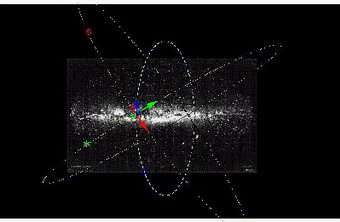
An international team of astronomers today announced the first results from the Radial Velocity Experiment, an ambitious all-sky spectroscopic survey aimed at measuring the speed, temperature, surface gravity and composition of up to a million stars passing near the sun.
Those first results from the project, known for short as RAVE, confirm that dark matter dominates the total mass of our home galaxy, the Milky Way, team members at The Johns Hopkins University and elsewhere said. The full survey promises to yield a new, detailed understanding of the origins of the galaxy, they said.
The team is using the "six-degree field" multi-object spectrograph on the 1.2-meter UK Schmidt Telescope at the Anglo-Australian Observatory, located at Siding Spring Observatory in New South Wales, Australia. The instrument is capable of obtaining spectroscopic information for as many as 150 stars at once, said Rosemary Wyse, a professor in the Henry A. Rowland Department of Physics and Astronomy in Johns Hopkins' Krieger School of Arts and Sciences and a member of the RAVE team. RAVE includes members from the United States, Germany, Australia, Canada, the Netherlands, the United Kingdom, Slovenia, Italy, Switzerland and France.
"One important early application of RAVE aims to measure just how much stuff there is in our Milky Way galaxy -- the collection of stars, gas and dark matter that is the home of our sun," Wyse said. "Newton's Law of Gravity allows us to figure out from the orbital motions of stars how much mass is holding them together. Faster motions need more mass. We know from analyzing the motions in other galaxies that there is a lot more mass than we can see and this dark matter appears to dominate. But we are not sure exactly how much dark matter is needed in our own galaxy, and we don't know what the dark matter is made up of. That information is important, and the RAVE survey is going to help us answer some of those questions."
Greg Ruchti, a graduate student in physics and astronomy at Johns Hopkins who also is a member of the RAVE team, notes that the project "needs large samples of very fast stars, and the unprecedented scope of the survey is ideal to find these rare objects. I'm really excited about being part of the RAVE team."
With more data and more modeling, the RAVE team plans to ascertain the Milky Way's overall mass, which, at present, is poorly understood, Wyse said. The team has what it considers a "better approach" to the problem: a model that makes very definite predictions about the way mass varies as a function of distance from the center of the Milky Way. If the team adopts this model, it can then estimate the overall mass from just the local "escape velocity," Wyse said.
Escape velocity is the speed at which a star would have to be moving to leave the galaxy. The value of this special speed depends on the mass of the galaxy: The higher the mass, the higher the speed necessary to escape. Thus, researchers can estimate the weight of the Milky Way galaxy by measuring how fast objects must move to leave it, Wyse said.
Current RAVE limits show that stars would need to move faster than around 500 kilometers per second to escape, more than twice as fast as the sun is moving around the galactic center. At that escape speed, it would take less than eight seconds to travel from Baltimore to Los Angeles.
"Some groups believe that our neighbor, the Andromeda Galaxy -- also known as M31 -- is the most massive galaxy in our local group. But we suspect from our early results that our Milky Way is actually the local heavyweight," said Martin Smith of the University of Groningen in the Netherlands. "We are, with RAVE, on the verge of an answer."
Funding for RAVE is provided by the National Science Foundation, for Johns Hopkins, and by the national research councils of other team members' countries as well as by private sources.
"RAVE will run for several more years, and the full RAVE survey will provide a vast resource of stellar motions and chemical abundances, allowing us to answer fundamental questions about the formation and evolution of our galaxy," said Matthias Steinmetz, director of the Astrophysical Institute Potsdam, and leader of the RAVE collaboration.
The results were released at the American Astronomical Society's 207th meeting in Washington, D.C.
Source: Johns Hopkins University


