Scientists report new take on sexual signaling
May 9, 2007
Uca terpsichores

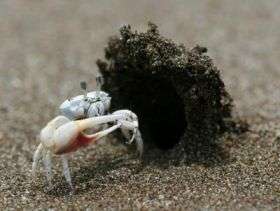
Male Fiddler Crab, Uca terpsichores, with hood. Credit: John Christy, STRI

In dangerous environments, females looking for a mate run great risks. Scientists from Seoul National University, in Korea, and the Smithsonian Tropical Research Institute in Panama present a new take on sexual signaling in the May issue of the Public Library of Science. The researchers report that females prefer a male sexual signal that helps them avoid their predators as they sequentially visit and assess potential mates.

The traditional explanation for the evolution of outrageous sexual signals like the male peacock’s plumage is that showy males attract females and give them better offspring. Showy males escape from predators despite their highly conspicuous ornaments and behaviors—proof of their superiority.

"In our study of fiddler crabs, the strength of female preference for a male signal that increases her own survival increases with her perceived risk of predation. That a female’s choice of a mate is based on sexual signals that benefit her directly is a fundamentally new and perhaps widely applicable idea," said Tae Won Kim, who did this work as a student at Seoul National University and is now a post-doctoral fellow at Ewha Women’s University in Korea.

As the tide recedes, revealing great expanses of Pacific beach, fiddler crabs (Uca terpsichores) segue in and out of their burrows, dodging predatory shorebirds. Male crabs build hood-like sand castles next to the entrance of their burrows, attracting the attention of females by waving their one, super-sized claw.

Females prefer males that have built hoods to males that have not. When they run across the beach to check out or mate with a male, they orient visually to both the waving male and to his hood. In this way they reach the male’s burrow quickly and directly and avoid their predators.

"When we bait predatory birds into the area—artificially increasing the risk of predation, females show an even greater preference for males who have built hoods," said STRI staff scientist John Christy, who has studied sexual selection in this group for nearly 35 years. This study illustrates how the ecology of choosing a mate can shape sexual communication. "Conspicuous male sexual signals need not advertise the quality of the signaler as a mate," Christy suggests. "Some may simply allow choosy females to stay safe."

Citation: Ref. Tae Won Kim, John H. Christy, Jae C. Choe. 2007. A preference for sexual signal keeps females safe. Public Library of Science ONE. DOI 10.1371/journal.pone.0000422

Source: Smithsonian Tropical Research Institute

4.5 /5 (2 votes)  

Rank 4.5 /5 (2 votes)
Tags

Relevant PhysicsForums posts

More news stories

Entire genome of extinct human decoded from fossil

(PhysOrg.com) -- In 2010, Svante Pääbo and his colleagues presented a draft version of the genome from a small fragment of a human finger bone discovered in Denisova Cave in southern Siberia. The ...

Biology / Biotechnology

created Feb 07, 2012 | popularity 4.7 / 5 (58) | comments 44 | with audio podcast

Why are there so few fish in the Earth's oceans?

(PhysOrg.com) -- A Stony Brook University researcher has found that, contrary to popular belief, there are not plenty of fish in the sea.

Biology / Plants & Animals

created Feb 08, 2012 | popularity 4.3 / 5 (17) | comments 25 | with audio podcast

Miami battling invasion of giant African snails

No one knows how they got there. But an invasion of African giant snails has southern Florida in a panic over potential crop damage, disease and general yuckiness surrounding the slimy gastropods.

Biology / Ecology

created Feb 10, 2012 | popularity 4.5 / 5 (2) | comments 5

The power of estrogen -- male snakes attract other males

A new study has shown that boosting the estrogen levels of male garter snakes causes them to secrete the same pheromones that females use to attract suitors, and turned the males into just about the sexiest ...

Biology / Plants & Animals

created Feb 10, 2012 | popularity 4.8 / 5 (6) | comments 2 | with audio podcast

Deciding to go left or right: Researchers use device to determine that lower animals can navigate too

For decades, scientists have associated binary decision making — opting to go left or right — with higher-ranking animals, including humans. A team of Harvard researchers, however, is rewriting that ...

Biology / Plants & Animals

created Feb 09, 2012 | popularity 4 / 5 (1) | comments 4 | with audio podcast


Walney offshore wind farm is world's biggest (for now)

(PhysOrg.com) -- The Walney wind farm on the Irish Sea--characterized by high tides, waves and windy weather--officially opened this week. The farm is treated in the press as a very big deal as the Walney ...

GPS court ruling leaves US phone tracking unclear

A US Supreme Court decision requiring a warrant to place a GPS device on the car of a criminal suspect leaves unresolved the bigger issue of police tracking using mobile phones, legal experts say.

Europeans protest controversial Internet pact

Tens of thousands of people marched in protests in more than a dozen European cities Saturday against a controversial anti-online piracy pact that critics say could curtail Internet freedom.

Europe stakes billion-dollar bet on new rocket

A pencil-slim rocket is scheduled to lift into space from South America on Monday, carrying a billion-dollar bet that Europe can grab a juicy slice of the market to place satellites in low orbit.

Study finds that anti-diabetic medication can prevent the long-term effects of maternal obesity

In a study to be presented today at the Society for Maternal-Fetal Medicine's annual meeting, The Pregnancy Meeting, in Dallas, Texas, researchers will report findings that show that short therapy with the anti-diabetic medication ...

Netflix settlement trims 14 pct off 4Q earnings

(AP) -- Netflix pressed the rewind button on its fourth-quarter earnings after settling allegations that the video subscription service violated a consumer-privacy law.