X-rays provide a new way to investigate exploding stars
May 9, 2007
X-rays provide a new way to investigate exploding stars

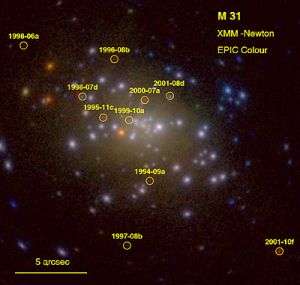
This image is a mosaic of XMM-Newton's European Photon Imaging Camera’s (EPIC) observations of the central region of M31 as seen from 2000 to 2004. The color coding is such that red displays X-ray photons received in the energy band 0.2-0.5 keV, green in the 0.5-1 keV band and blue in the 1-2 keV band. The positions of ten counterparts of optical novae detected in these images are indicated with circles and nova names. Nova names are given omitting the M31N prefix. It was detected that eleven out of the 34 novae that had exploded in the galaxy during the previous year were shining X-rays into space. An additional seven novae remained detectable in X-rays up to 10 years after outburst. The conclusion of the scientists is that the number of X-ray-detected optical novae is higher than previously expected, an important indication of the physical properties of these systems. The short-lived optical novae form a new ‘live fast and die young’ class of X-ray sources that would have been overlooked in the past by surveys carried out only every six months. To investigate further, the team have been awarded more XMM-Newton and Chandra observing time. They now plan to monitor M31’s novae every ten days for several months, starting in November 2007. Credits: W. Pietsch (MPE Garching, Germany), ESA/XMM Newton

ESA’s X-ray observatory XMM-Newton has revealed a new class of exploding stars – where the X-ray emission ‘lives fast and dies young’. The identification of this particular class of explosions gives astronomers a valuable new constraint to help them model and understand stellar explosions.

Exploding stars called novae remain a puzzle to astronomers. “Modelling these outbursts is very difficult,” says Wolfgang Pietsch of the Max Planck Institut für Extraterrestrische Physik. Now, ESA’s XMM-Newton and NASA’s Chandra space-borne X-ray observatories have provided valuable information about when individual novae emit X-rays.

Between July 2004 and February 2005, the X-ray observatories watched the heart of the nearby galaxy, Andromeda, also known to astronomers as M31. During that time, Pietsch and his colleagues monitored novae, looking for the X-rays.

They detected that eleven out of the 34 novae that had exploded in the galaxy during the previous year were shining X-rays into space. “X-rays are an important window onto novae. They show the atmosphere of the white dwarf,” says Pietsch.

White dwarfs are hot stellar corpses left behind after the rest of the star has been ejected into space. A typical white dwarf contains about the mass of the Sun, in a spherical volume little bigger than the Earth. Given its density, it has a strong pull of gravity. If in orbit around a normal star, it may rip gas from the star.

This material builds up on the surface of the white dwarf until it reaches sufficient density for a nuclear detonation. The resultant explosion creates a nova visible in the optical region for a few to a hundred days. However, these particular events are not strong enough to destroy the underlying white dwarf.

The X-ray emission becomes visible some time after the detonation, when the matter ejected by the nova thins out. This allows astronomers to peer down to the atmosphere of the white dwarf, which is burning by nuclear fusion.

At the end of the process, the X-ray emission stops when the fuel is exhausted. The duration of this X-ray emission traces the amount of material left on the white dwarf after the nova has ended.

A well determined start time of the optical nova outburst and the X-ray turn-on and turn-off times are therefore important benchmarks, or constraints, for replication in computer models of novae.

Whilst monitoring the M31 novae frequently over several months for the appearance and subsequent disappearance of the X-rays, Pietsch made an important discovery. Some novae started to emit X-rays and then turned them off again within just a few months.

“These novae are a new class. They would have been overlooked before,” says Pietsch. That’s because previous surveys looked only every six months or so. Within that time, the fast X-ray novae could have blinked both on and off.

In addition to discovering the short-lived ones, the new survey also confirms that other novae generate X-rays over a much longer time. XMM-Newton detected seven novae that were still shining X-rays into space, up to a decade after the original eruption.

The differing lengths of times are thought to reflect the masses of the white dwarfs at the heart of the nova explosion. The fastest evolving novae are thought to be those coming from the most massive white dwarfs.

To investigate further, the team, lead by Dr. Pietsch, have been awarded more XMM-Newton and Chandra observing time. They now plan to monitor M31’s novae every ten days for several months, starting in November 2007, to glean more information about these puzzling stellar explosions.

Source: European Space Agency

4.8 /5 (9 votes)  

Rank 4.8 /5 (9 votes)
Tags

Relevant PhysicsForums posts
  • Scale of the Universe
    createdFeb 10, 2012
  • Titan's lack of impact craters
    createdFeb 09, 2012
  • Real pictures of black hole eating a star?
    createdFeb 08, 2012
  • Hypothetical way to travel faster than light, but not technically exceed lightspeed
    createdFeb 06, 2012
  • How do scientists monitor the Sun's activity?
    createdFeb 05, 2012
  • Search patterns in observational studies
    createdFeb 05, 2012
  • More from Physics Forums - General Astronomy

More news stories

Europe stakes billion-dollar bet on new rocket

A pencil-slim rocket is scheduled to lift into space from South America on Monday, carrying a billion-dollar bet that Europe can grab a juicy slice of the market to place satellites in low orbit.

Space & Earth / Space Exploration

created 8 hours ago | popularity 3.5 / 5 (2) | comments 0

Political leaders play key role in how worried Americans are by climate change: study

More than extreme weather events and the work of scientists, it is national political leaders who influence how much Americans worry about the threat of climate change, new research finds.

Space & Earth / Environment

created Feb 06, 2012 | popularity 5 / 5 (6) | comments 72

Humans may have helped the decline of African rainforests 3000 years ago

(PhysOrg.com) -- Large areas of rainforests in Central Africa mysteriously disappeared over three thousand years ago, to be replaced by savannas. The prevailing theory has been that the cause was a change ...

Space & Earth / Environment

created Feb 10, 2012 | popularity 4.3 / 5 (13) | comments 16 | with audio podcast report

NASA budget will axe Mars deal with Europe: scientists

US President Barack Obama's budget proposal to be submitted next week for 2013 will cut NASA's budget by 20 percent and eliminate a major partnership with Europe on Mars exploration, scientists said Thursday.

Space & Earth / Space Exploration

created Feb 10, 2012 | popularity 5 / 5 (2) | comments 31

Could Venus be shifting gear?

(PhysOrg.com) -- ESA’s Venus Express spacecraft has discovered that our cloud-covered neighbour spins a little slower than previously measured. Peering through the dense atmosphere in the infrared, the ...

Space & Earth / Space Exploration

created Feb 10, 2012 | popularity 5 / 5 (8) | comments 10 | with audio podcast


Walney offshore wind farm is world's biggest (for now)

(PhysOrg.com) -- The Walney wind farm on the Irish Sea--characterized by high tides, waves and windy weather--officially opened this week. The farm is treated in the press as a very big deal as the Walney ...

GPS court ruling leaves US phone tracking unclear

A US Supreme Court decision requiring a warrant to place a GPS device on the car of a criminal suspect leaves unresolved the bigger issue of police tracking using mobile phones, legal experts say.

Study finds that anti-diabetic medication can prevent the long-term effects of maternal obesity

In a study to be presented today at the Society for Maternal-Fetal Medicine's annual meeting, The Pregnancy Meeting, in Dallas, Texas, researchers will report findings that show that short therapy with the anti-diabetic medication ...

Netflix settlement trims 14 pct off 4Q earnings

(AP) -- Netflix pressed the rewind button on its fourth-quarter earnings after settling allegations that the video subscription service violated a consumer-privacy law.

Europeans protest controversial Internet pact

Tens of thousands of people marched in protests in more than a dozen European cities Saturday against a controversial anti-online piracy pact that critics say could curtail Internet freedom.

Google users warned of threat to smartphone wallets

Users of Google smartphone wallets were being warned on Friday that there is a way to crack pass codes intended to thwart thieves from going on illicit shopping sprees.