Extreme winds rule exoplanet's weather
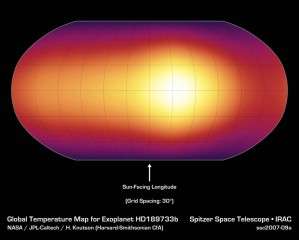
Supersonic winds more than six times faster than those on Jupiter are blasting through the atmosphere of a Jupiter-sized planet 60 light years away, say scientists who've analyzed results from NASA's Spitzer Space Telescope.
They're part of a team that mapped weather on a planet beyond our solar system, a gas giant planet called HD 189733b.
"The exoplanet's wind speeds probably exceed the speed of sound," said Adam Showman of the University of Arizona Lunar and Planetary Laboratory (LPL). "And the speed of sound on these planets is 10 times faster than on Earth, so that's saying something." The speed of sound in HD 189733b's atmosphere is about 3 kilometers per second (6,700 mph).
Showman and LPL research associate Curtis Cooper analyzed Spitzer data on planet HD 189733b using the numerical models they've been developing for exoplanet atmospheres. The planet, which is in constellation Vulpecula, is the closest known 'transiting' planet. A transiting planet is seen to cross in front and behind its star when viewed from Earth. The planet is "tidally locked" to its star, so that one side always faces the star and the other side is always dark, just as the moon is tidally locked to the Earth.
A team led by Heather Knutson of the Harvard-Smithsonian Center for Astrophysics, Cambridge, Mass., used the Spitzer Space Telescope to measure the infrared light, or heat, as the planet orbited its sun-like star. The result is one of the first-ever temperature maps for an exoplanet. The map shows that dayside and nightside temperatures differ only by about 500 degrees Fahrenheit, ranging from 1,200 degrees F on the nightside to 1,700 degrees F on the dayside.
"At these high temperatures, air cools off rapidly when it moves from the dayside to the nightside," Showman said. "That relatively small temperature difference implies that fierce winds redistribute a lot of the heat."
"We need to do more detailed modeling to calculate actual wind speeds. At this stage, the numbers are all quite uncertain," he said. "However, we can be certain the speeds are FAST, probably a couple of kilometers per second," or about 4,500 mph. The supersonic exoplanet winds might be as great as 10 kilometers per second, or about 22,000 mph, the UA researchers calculate.
"This isn't just the case where you need winds, but winds that are fast enough to move air from one side of the gas giant planet to the other before it has time to cool off," Showman said.
"We might have a situation where the winds are moving faster than the rotating planet itself because 'hot Jupiters' like this one rotate slowly," Showman said. The hot Jupiter exoplanet rotates at about 2 kilometers per second (about 4,500 mph) at its equator.
Earth and Jupiter's winds are anemic, by comparison. The Earth is spinning at almost 1,000 mph at its equator. A given point at Earth's equator rotates through Earth's 25,000 mile circumference in 24 hours. But its wind speeds are only around 20 to 200 mph. The same is true on Jupiter. Jupiter's equator rotates at almost 27,000 mph, but its wind speeds are only around 70 to 340 mph.
Cooper's and Showman's numerical simulations predicted a larger difference between dayside and nightside temperatures, so winds on exoplanet HD 189733b are more complex than their models currently reflect, Showman said.
But their simulations match the observations in some other respects. One of their predictions is that the winds distort the temperature pattern, blowing the hottest region downwind from the locations that get maximum starlight. "The exoplanet doesn't emit its greatest energy toward Earth when aimed at Earth," Showman said. "As our models predict, the hottest point is seen a couple of hours before the planet passes behind the star."
Source: University of Arizona


