Radical engine redesign would reduce pollution, oil consumption
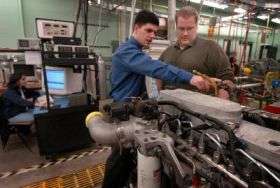
Researchers have created the first computational model to track engine performance from one combustion cycle to the next for a new type of engine that could dramatically reduce oil consumption and the emission of global-warming pollutants.
"We're talking about a major leap in engine technology that could be used in hybrid cars to make vehicles much more environmentally friendly and fuel stingy," said Gregory M. Shaver, an assistant professor of mechanical engineering at Purdue University.
A key portion of his research, based at Purdue's Ray W. Herrick Laboratories, hinges on designing engines so that their intake and exhaust valves are no longer driven by mechanisms connected to the pistons. The innovation would be a departure from the way automotive engines have worked since they were commercialized more than a century ago.
In today's internal combustion engines, the pistons turn a crankshaft, which is linked to a camshaft that opens and closes the valves, directing the flow of air and exhaust into and out of the cylinders. The new method would eliminate the mechanism linking the crankshaft to the camshaft, providing an independent control system for the valves.
Because the valves' timing would no longer be restricted by the pistons' movement, they could be more finely tuned to allow more efficient combustion of diesel, gasoline and alternative fuels, such as ethanol and biodiesel, Shaver said.
The concept, known as variable valve actuation, would enable significant improvements in conventional gasoline and diesel engines used in cars and trucks and for applications such as generators, he said. The technique also enables the introduction of an advanced method called homogeneous charge compression ignition, or HCCI, which would allow the United States to drastically reduce its dependence on foreign oil and the production of harmful exhaust emissions.
The homogeneous charge compression ignition technique would make it possible to improve the efficiency of gasoline engines by 15 percent to 20 percent, making them as efficient as diesel engines while nearly eliminating smog-generating nitrogen oxides, Shaver said.
This improved combustion efficiency also would reduce emission of two other harmful gases contained in exhaust: global-warming carbon dioxide and unburned hydrocarbons. The method allows for the more precise control of the fuel-air mixture and combustion inside each cylinder, eliminating "fuel rich" pockets seen in conventional diesel engines, resulting in little or no emission of pollutants called particulates, a common environmental drawback of diesels.
The variable valve actuation system makes it possible to "reinduct," or reroute a portion of the exhaust back into the cylinders to improve combustion efficiency and reduce emissions. The system also makes it possible to alter the amount of compression in the cylinders of both conventional and HCCI engines and to adjust the mixing and combustion timing, allowing for more efficient combustion.
"Variable valve actuation and HCCI would help to significantly reduce our dependence on oil by enabling engines to work better with ethanol and biodiesel and other alternative fuels," Shaver said. "But accomplishing this is going to require a strong effort in several research areas - a commitment of funding, people power, industrial involvement and academic involvement."
In HCCI, the "charge," or fuel-air mixture, is homogeneous, meaning it is uniform. Adding the reinducted exhaust both dilutes and increases the temperature of this air-fuel mixture before compression. The process also allows for a uniform "auto ignition," or combustion without the need of a spark, at a lower compression than normally required for diesel engines, reducing engine wear and tear.
Inside the cylinders of ordinary internal combustion engines, there is a large temperature difference, or gradient, between portions of the air-fuel mixture that have been ignited and portions that are still not burned. The homogeneous fuel-air mixture and reinducted exhaust work together to eliminate this temperature gradient during the auto-ignition, which decreases the overall combustion temperature. Decreasing the combustion temperature is a key step in dramatically reducing nitrogen oxides.
A major challenge will be learning how to automatically adjust valve motions and fuel injection to match changes in operating conditions dictated by factors such as a vehicle's varying speed, how much weight it is carrying and what type of fuel is being used.
Engines incorporating HCCI will use sensors to monitor an engine's performance, providing crucial data needed to dynamically alter the valves' timing. Controlling the combustion process via variable valve actuation will require specialized software algorithms being developed by the Purdue researchers.
"We will use feedback control, where you have sensors that provide data from the engine and an algorithm to precisely control the valves," Shaver said.
Shaver, his colleagues and students are in the process of building a one-of-a-kind multicylinder engine design with "fully-flexible variable valve actuation," which will allow the study of HCCI and alternative fuel combustion, he said.
He was the lead author of a research paper honored with the 2006 Rudolf Kalman Paper Award for the best paper published in the Journal of Dynamic Systems, Measurement, and Control. The award was issued last year during the International Mechanical Engineering Conference and Exposition in Chicago. The paper detailed findings related to a new mathematical model to help develop the homogeneous charge compression ignition system.
In order for the system to work, it is critical to track changing engine performance from one combustion cycle to the next. The mathematical model Shaver has developed is the first of its kind to precisely track this dynamic cycle-to-cycle performance and other data.
The highest efficiency would be realized by combining HCCI technologies in hybrid vehicles that use an electric motor in addition to an internal combustion engine.
"It's essential to continue research on multiple fronts, including work to tackle problems associated with fuel cells and hybrid systems and understanding how to incorporate the advanced combustion engines on hybrid powertrains," he said.
U.S. petroleum imports are predicted to increase about 35 percent by 2030. At the same time, the transportation-related emission of carbon dioxide is expected to rise by about 35 percent in the United States.
Source: Purdue University


