Supercomputer shows that nanolayers have turning sense
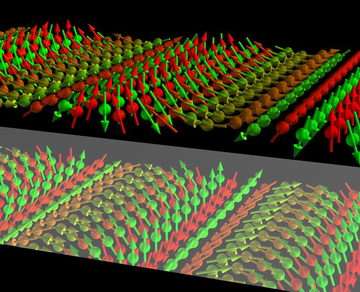
Physicists from Research Centre Jülich and the University of Hamburg have discovered that on the atomic level nature differentiates between the image and mirror image of magnetic structures.
With the aid of computer simulations in Jülich and experiments in Hamburg, they detected a so-called “homochiral” magnetic structure in a thin metal layer, as described in an article published in the current edition of the journal 'Nature'.
There is no version with mirror-image spin. The researchers found this surprising selectivity very exciting since, on the one hand, it opens up a whole new research area and, on the other hand, it may also lead to applications in “spintronics”, a promising field of future technology.
Although the image and mirror image appear similar, they are not necessarily identical – this insight is by no means revolutionary. Scientists call structures whose image and mirror image cannot be superimposed on each other “chiral”. An example of this is the human hand. In low-dimensional systems chirality displays surprising features. Thus, for example, in nature many biopolymers, such as amino acids, the building blocks of proteins, only occur in one of two theoretically conceivable variants: they are thus homochiral. The mirror image form only exists in the laboratory.
Physicists from Research Centre Jülich and the University of Hamburg have discovered that in the case of magnetic structures nature also prefers one form rather than its mirror image in thin metallic structures. They report their findings in the current issue of the high-impact journal “Nature”. With the aid of computer simulations they calculated that in a single atomic layer of manganese it is always the same three-dimensional, rotated arrangement that occurs and never the mirror image. This was also confirmed by their experiments. “Such chiral structures are hot candidates for practical applications, for example in the promising field of “spintronics”, since they permit a coupling of electronic, optical, magnetic and structural properties", Prof. Stefan Blügel, Director at the Jülich Institute of Solid State Research, underlines the significance of this finding.
“In the components of the future, the flowing current can transfer spin moment to the magnetic structure and thus set it in motion.” The tiny forms are not new but they were previously only known in very rare crystal structures. This work by physicists from Jülich revealed for the first time that this phenomenon is also present in other materials that are relatively easy to produce, easy to investigate and are already widely used in practical applications - namely thin metallic films. The authors of an accompanying article in the Nature “News and Views” section are convinced that these questions are more than an academic challenge: "Understanding and controlling the twists and turns of thin-film magnetic states could well be handy for new applications such as ultra-high-density magnetic recording media. "
The magnetic structure discovered by the theoretical physicist Blügel and his colleagues resembles a breaking wave whose motion is frozen, its form elongated and lined up like a string of beads. There is no mirror image, that is to say a wave turned upside down, at least not in the manganese layer studied. However, the calculations must be repeated for every material and all layer thicknesses. And these calculations are very tedious – consuming tens of thousands of hours of computing time on the fastest computers currently available. The scientists benefit from having ready access to two so-called supercomputers at the John von Neumann Institute for Computing (NIC) in Jülich so that the computing time can be reduced to about a month. This makes it possible for them to investigate even more complex magnetic structures.
The researchers managed to make their scientific breakthrough because they included in their calculations a magnetic interaction that had previously been ignored, the so-called Dzyaloshinskii-Moriya (DM) interaction, which is irrelevant in considerations of the bulk properties of manganese and similar metals. The physicists were, however, able to determine that this interaction arises when single atomic layers of manganese are deposited on a substrate. The DM interaction is then the decisive mechanism for the unique arrangement of the elementary magnetic moments. The Jülich solid-state physicists succeeded for the first time in quantitatively determining the strength of this interaction. The scientists are convinced that their findings will bring about a fundamental change in the understanding of magnetism on the nanoscale. “Our work will create a new basis and open up a completely new research field. At the moment, our studies are still in their infancy”, says Blügel. And the authors of the accompanying article in “Nature” confirm that “… many earlier results will have to be revisited."
Source: University of Hamburg


