Hyper-accurate clocks -- The beating heart of Galileo
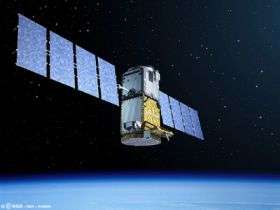
May 10, 2007 Artist's impression of GIOVE-B in orbit

Artist's impression of GIOVE-B in orbit. Credits: ESA

Travellers have relied on accurate timekeeping for navigation since the development of the marine chronometer in the eighteenth century. Galileo, Europe’s twenty-first century navigation system, also relies on clocks – but they are millions of times more accurate than those earlier timepieces.

The operational Galileo satellites will carry two types of clocks – passive hydrogen masers and rubidium atomic frequency standards. Each satellite will be equipped with two hydrogen masers, one of which will be the primary reference for generating the navigation signals, with the other as a cold (non-operating) spare.

Every operational satellite will also carry two rubidium clocks, one of which will be a hot (permanently running) backup for the operational hydrogen maser, instantly taking over should the maser fail and allowing signal generation to continue uninterrupted. The second rubidium clock will act as a cold spare.

GIOVE-A, the Galileo in-orbit verification satellite that is currently in service, carries two rubidium clocks – one operational and one cold spare. GIOVE-B, which is projected to enter service later this year, will carry one hydrogen maser and two rubidium clocks, one hot and one cold spare. The GIOVE-A2 satellite, which will be ready for launch in the second half of 2008, will carry a similar timekeeping payload to GIOVE-A, but will transmit additional navigation signals.

The Galileo passive hydrogen masers will keep time with an accuracy of around one nanosecond (one one-thousand-millionth of a second) in 24 hours – equivalent to losing or gaining a second in 2.7 million years. The rubidium clocks are accurate to 10 nanoseconds per day. In comparison, an ordinary digital wristwatch has an accuracy of about one second per day.

Galileo’s passive hydrogen maser clocks will be around one thousand million times more accurate than a digital wristwatch.

The need for accuracy

Conceptually, Galileo users will determine their position by measuring how much time radio waves transmitted by satellites in the Galileo constellation take to reach them. Radio waves travel at about 300 million metres per second, so they cover a distance of around 0.3 metres in one nanosecond. In order to offer navigation accuracies of the order of a metre, Galileo time measurements must therefore be performed with a precision in the nanosecond range.

As a by-product of satellite navigation’s need for accurate timekeeping, Galileo will also be able to offer precision time services to be used, for example, in the time stamping of financial transactions.

Galileo is a joint initiative between ESA and the European Commission. When fully deployed in the early years of the next decade, it will be the first civilian positioning system to offer global coverage.

Source: European Space Agency


print this article email this article download pdf blog this article bookmark this article     Stumble it Digg this share on Facebook retweet share on Reddit add to delicious
Rate this story - 4.6 /5 (5 votes)


May 10, 2007 all stories

Comments: 0

4.6 /5 (5 votes)
  • Stumble this up

  • Digg this

  • share this

  • hide
  • Related Stories

  • GIOVE-B spacecraft in good health
    created Apr 30, 2008 | popularity not rated yet | comments 0
  • First 'European GPS' Galileo satellites named 'GIOVE'
    created Nov 10, 2005 | popularity not rated yet | comments 0
  • Galileo Satellite Payload Testing Underway
    created Aug 26, 2005 | popularity not rated yet | comments 0
  • Astronomers seek to explore the cosmic Dark Ages
    created Oct 15, 2009 | popularity not rated yet | comments 0
  • A new class of dim supernovae
    created Jun 05, 2009 | popularity not rated yet | comments 0


  • hide
  • Relevant PhysicsForums posts

  • Gravity on the surface of Gliese 581 d
    created 8 hours ago
  • astronomy
    created Nov 30, 2009
  • mass of molecular clouds versus stars
    created Nov 30, 2009
  • Astronomy Problems PLEASE HELP! PLEASE PLEASE
    created Nov 30, 2009
  • More from Physics Forums - General Astronomy

Other News

A view of San Francisco

San Francisco vs Amsterdam in green city rivalry

Space & Earth / Environment

created 49 minutes ago | popularity not rated yet | comments 0

San Francisco and Amsterdam set an online stage for an environmental rivalry regarding which city is more nature-friendly.


Australia's Parliament defeats global warming bill

Space & Earth / Environment

created 58 minutes ago | popularity not rated yet | comments 0

(AP) -- Australia's plans for an emissions trading system to combat global warming were scuttled Wednesday in Parliament, handing a defeat to a government that had hoped to set an example at international climate change ...


Acid test: Study reveals both losers and winners of CO2-induced ocean acidification

Acid test: Study reveals both losers and winners of CO2-induced ocean acidification

Space & Earth / Earth Sciences

created 13 hours ago | popularity 4.2 / 5 (5) | comments 5

(PhysOrg.com) -- As the world’s seawater becomes more acidic due to rising atmospheric carbon dioxide, some shelled marine creatures may actually become bigger and stronger, according to a new study.


UK climate scientist to temporarily step down (AP)

UK climate scientist to temporarily step down

Space & Earth / Environment

created 10 hours ago | popularity 3.8 / 5 (4) | comments 6

(AP) -- The chief of a prestigious British research center caught in a storm of controversy over claims that he and others suppressed data about climate change has stepped down pending an investigation, the ...


Orbiter Puts Itself Into Safe Standby

Mars Odyssey Orbiter Puts Itself Into Safe Standby

Space & Earth / Space Exploration

created 13 hours ago | popularity 5 / 5 (2) | comments 0

(PhysOrg.com) -- NASA's Mars Odyssey orbiter put itself into a safe standby mode on Saturday, Nov. 28, and the team operating the spacecraft has begun implementing careful steps designed to resume Odyssey's ...