Study shows massive CO2 burps from ocean to atmosphere at end of last ice age
A University of Colorado at Boulder-led research team tracing the origin of a large carbon dioxide increase in Earth's atmosphere at the end of the last ice age has detected two ancient "burps" that originated from the deepest parts of the oceans.
The new study indicated carbon that had built up in the oceans over millennia was released in two big pulses, one about 18,000 years ago and one 13,000 years ago, said Thomas Marchitto and Scott Lehman of CU-Boulder's Institute of Arctic and Alpine Research, who jointly led the study. While scientists had long known as much as 600 billion metric tons of carbon were released into the atmosphere after the last ice age, the new study is the first to clearly track CO2 from the deep ocean to the upper ocean and atmosphere and should help scientists better understand natural CO2 cycles and possible impacts of human-caused climate change.
"This is some of the clearest evidence yet that the enormous carbon release into the atmosphere during the last deglaciation was triggered by abrupt changes in deep ocean circulation," said Marchitto. Marchitto and Lehman are both faculty members in the CU-Boulder geological sciences department.
While much of the CO2 released by the oceans after the end of the last ice age about 19,000 years ago was taken up by the re-growth of forests in areas previously covered by ice sheets, enough remained in the atmosphere to pump up CO2 concentrations significantly, the authors said. Today, CO2 levels are higher than at any time in at least the past 650,000 years because of increased fossil fuel burning.
"The timing of the major CO2 release after the last ice age corresponds closely with deep-sea circulation changes caused by ice melting in the North Atlantic at that time," said Lehman. "So our study really underscores ongoing concerns about the ocean's capacity to take up fossil fuel CO2 in the future, since continued warming will almost certainly impact the mode and speed of ocean circulation."
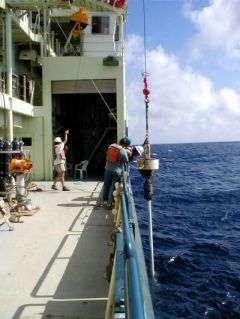
The team analyzed sediment cores hauled from the Pacific Ocean seafloor at a depth of about 2,300 feet off the coast of Baja California using an isotopic "tracer," known as carbon 14, to track the escape of carbon from the deep sea through the upper ocean and into the atmosphere during the last 40,000 years. Extracted from the shells of tiny marine organisms known as foraminifera -- which contain chemical signatures of seawater dating back tens of thousands of years -- carbon 14 is the isotope most commonly used to radiocarbon date organic material like wood, bone and shell.
They found the carbon 14 "age" of the upper ocean water was basically constant over the past 40,000 years, except during the interval following the most recent ice age, when atmospheric CO2 increased dramatically. The study shows the carbon added to the upper ocean and atmosphere at the end of the last ice age was "very old," suggesting it had been stored in the deep ocean and isolated from the atmosphere for thousands of years, said Marchitto.
"Because carbon 14 works both as a 'tracer' and a 'clock,' we were able to show that the uptake and release of CO2 by the ocean in the past was intimately linked to how and how fast the ocean circulated," said Marchitto.
Humans have pumped an estimated 300 billion tons of carbon into the atmosphere since the Industrial Revolution, and the oceans have taken up about half of it, said Lehman.
"If the oceans were not such a large storage 'sink' for carbon, atmospheric CO2 increases in recent decades would be considerably higher," he said. "Since the uptake of CO2 on Earth's land surface is being offset almost entirely by the cutting and burning of forests, any decrease in the uptake of fossil fuel CO2 by the world's oceans could pose some very serious problems," Lehman said.
"When the ocean circulation system changes, it alters how carbon-rich deep water rises to the surface to release its carbon to the atmosphere," said Interim Director of INSTAAR Jim White, a climate scientist who was not involved in the study. "This is important not only for understanding why glacial times came and went in the past, but it is crucial information we need to understand how the oceans will respond to future climate change."
Studies by CU-Boulder and other institutions in the past several years have shown sharp declines in Arctic sea ice in recent decades and a loss in ice mass from Greenland, which some believe could combine to alter North Atlantic circulation and disrupt ocean circulation patterns worldwide.
Source: University of Colorado at Boulder


