Mission Could Seek Out Spock's Home Planet
May 10, 2007 Mission Could Seek Out Spock's Home Planet

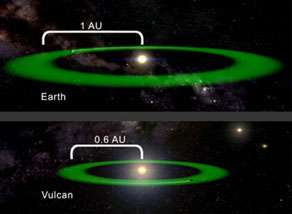
Artist's concept comparing our sun's habitable zone with that of 40 Eridani.

Science fiction may soon become science fact. Astronomers at NASA's Jet Propulsion Laboratory have recently concluded that the upcoming planet-finding mission, SIM PlanetQuest, would be able to detect an Earth-like planet around the star 40 Eridani, a planet familiar to "Star Trek" fans as "Vulcan." 40 Eridani, a triple-star system 16 light-years from Earth, includes a red-orange K dwarf star slightly smaller and cooler than our sun. Vulcan is thought to orbit that dwarf star, called 40 Eridani A.

When pondering the idea that SIM might be able to detect Vulcan, astronomer Dr. Angelle Tanner at Caltech had two questions: Can a planet form around 40 Eridani A? Can SIM detect such a planet?

She consulted a planetary theorist, Dr. Sean Raymond of the University of Colorado, Boulder. "Since the three members of the triple star system are so far away from each other [hundreds of astronomical units - the Earth-Sun distance], I see no reason why an Earth-mass planet would not be able to form around the primary star, 40 Eridani A," he said.

If Vulcan life were to exist on the planet, the orbit of the planet would have to lie in a sweet spot around the star where liquid water could be present on its surface. Water is an essential ingredient for any organism to live long and prosper. For 40 Eridani A, this spot, or "habitable zone," is 0.6 astronomical units from the star. That means Vulcans would get to celebrate a birthday about every six months.

The SIM PlanetQuest instrument will be so accurate, it could measure the thickness of a nickel at a distance from Earth to the moon. Using a set of mathematical models based on Newton's Laws, Tanner was able to conclude that SIM would be able to definitively determine whether there is an Earth-mass planet orbiting in the habitable zone around 40 Eridani A, and could also determine its orbit.

This is quite an exciting prospect, since NASA's Terrestrial Planet Finder mission, planned for launch after SIM, would not only be able to take a rudimentary "picture" of the planet, but also could search for signatures of life such as methane and ozone

When asked what life would be like on Vulcan, Tanner speculated that the inhabitants might be pale. "A K dwarf star emits its light at wavelengths which are a bit redder compared to those from the sun, so I wonder whether it's harder to get a tan there," she said.

The results of Tanner's simulations will be submitted for publication in the Publications of the Astronomical Society of the Pacific.

Source: NASA


print this article email this article download pdf blog this article bookmark this article     Stumble it Digg this share on Facebook retweet share on Reddit add to delicious
Rate this story - 4.3 /5 (33 votes)


May 10, 2007 all stories

Comments: 0

4.3 /5 (33 votes)
  • Stumble this up

  • Digg this

  • share this

  • hide
  • Related Stories

  • Solar System's Young Twin Has Two Asteroid Belts
    created Oct 27, 2008 | popularity not rated yet | comments 0
  • Hubble observations confirm that planets form from disks around stars
    created Oct 09, 2006 | popularity not rated yet | comments 0
  • Measuring the shape of distant stars using gravitational microlensing
    created May 31, 2005 | popularity not rated yet | comments 0
  • Planet 51 Star Brings NASA's Message of Exploration Down to Earth
    created Nov 20, 2009 | popularity not rated yet | comments 0
  • Hunting for Planets in the Dark
    created Nov 19, 2009 | popularity not rated yet | comments 0


  • hide
  • Relevant PhysicsForums posts

  • Sideral question
    created Nov 21, 2009
  • Doppler shifted blackbody spectrum
    created Nov 21, 2009
  • Earth v. Moon
    created Nov 21, 2009
  • help me with coordinates and orbits
    created Nov 21, 2009
  • More from Physics Forums - General Astronomy

Other News

The shore of Deception Island in Antarctica, in 2008

Antarctic ice loss vaster, faster than thought: study

Space & Earth / Earth Sciences

created 4 hours ago | popularity 3.5 / 5 (6) | comments 6

The East Antarctic icesheet, once seen as largely unaffected by global warming, has lost billions of tonnes of ice since 2006 and could boost sea levels in the future, according to a new study.


Astronaut's baby daughter born as he circles Earth (AP)

Astronaut's baby daughter born as he circles Earth

Space & Earth / Space Exploration

created 4 hours ago | popularity not rated yet | comments 0

(AP) -- Astronaut Randolph Bresnik jubilantly welcomed his new daughter into the world Sunday as he floated 220 miles above it.


Denmark: 65 world leaders for UN climate summit (AP)

Denmark: 65 world leaders for UN climate summit

Space & Earth / Environment

created 4 hours ago | popularity not rated yet | comments 0

(AP) -- Sixty-five world leaders have said they will attend the Copenhagen climate summit in December, and several more have responded positively to invitations, Danish officials said Sunday.


Commuters wait on the platform shrouded by fog in London

Climate change not man-made, say majority of Britons: poll

Space & Earth / Environment

created Nov 15, 2009 | popularity 3.4 / 5 (16) | comments 46

Less than half of Britons believes that human activity is to blame for global warming, according to a poll carried out for The Times newspaper and published on Saturday.


Mysteriously warm times in Antarctica

Mysteriously warm times in Antarctica

Space & Earth / Earth Sciences

created Nov 18, 2009 | popularity 4.2 / 5 (21) | comments 31

(PhysOrg.com) -- A new study of Antarctica's past climate reveals that temperatures during the warm periods between ice ages (interglacials) may have been higher than previously thought. The latest analysis ...