'Missing Mass' Found in Recycled Dwarf Galaxies
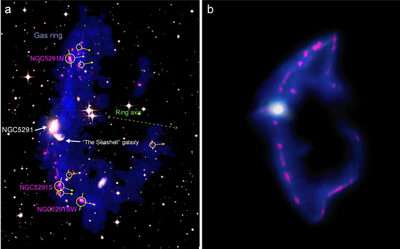
Astronomers studying dwarf galaxies formed from the debris of a collision of larger galaxies found the dwarfs much more massive than expected, and think the additional material is "missing mass" that theorists said should not be present in this kind of dwarf galaxy.
The scientists used the National Science Foundation's Very Large Array (VLA) radio telescope to study a galaxy called NGC 5291, 200 million light-years from Earth. This galaxy collided with another 360 million years ago, and the collision shot streams of gas and stars outward. Later, the dwarf galaxies formed from the ejected debris.
"Our detailed studies of three 'recycled' dwarf galaxies in this system showed that the dwarfs have twice as much unseen matter as visible matter. This was surprising, because they were expected to have very little unseen matter," said Frederic Bournaud, of the French astrophysics laboratory AIM of the French CEA and CNRS. Bournaud and his colleagues announced their discovery in the May 10 online issue of the journal Science.
"Dark matter," which astronomers can detect only by its gravitational effects, comes, they believe, in two basic forms. One form is the familiar kind of matter seen in stars, planets, and humans -- called baryonic matter -- that does not emit much light or other type of radiation. The other form, called non-baryonic dark matter, comprises nearly a third of the Universe but its nature is unknown.
The visible portion of spiral galaxies, like our own Milky Way, lies mostly in a flattened disk, usually with a bulge in the center. This visible portion, however, is surrounded by a much larger halo of dark matter. When spiral galaxies collide, the material expelled outward by the interaction comes from the galaxies' disks. For this reason, astronomers did not expect that "recycled" dwarf galaxies formed from this collision debris would contain much, if any, dark matter.
When Bournaud and his international team of scientists used the VLA to study three dwarf galaxies formed from the debris of NGC 5291's collision, they were surprised to find two to three times the amount of dark matter as visible matter in the dwarfs. They determined the dwarfs' masses by measuring the Doppler shift of radio waves emitted by atomic Hydrogen at a frequency of 1420 MHz. The amount of shift in the frequency indicated the rotational speed in the galaxy. That, in turn, allowed the scientists to calculate the dwarf's mass.
Images from two NASA satellites provided vital information about the dwarf galaxies. "Using ultraviolet images from the Galex satellite and infrared data collected by the Spitzer satellite, we had previously shown that the dwarfs all along the debris stream were star-forming galaxies," said Pierre-Alain Duc, also of the AIM laboratory (CEA/CNRS).
What is the dark matter in the dwarfs? The astronomers don't believe it is the mysterious non-baryonic type, but rather cold Hydrogen molecules that are extremely difficult to detect.
When the astronomers performed computer models of the collision of NGC 5291 to simulate the formation of the system seen today, the models left the resulting recycled dwarfs with almost no dark matter. These computer models had started off with all the dark matter in the galaxy's larger halo.
"The result of the computer models means that the additional mass we see in the real dwarfs came from the disks, not the haloes, of the larger galaxies that collided," Bournaud said. That additional mass, the scientists believe, almost certainly is "normal" baryonic matter, probably cold molecular Hydrogen.
While the discovery about NGC 5291's neighboring dwarf galaxies sheds new light on the composition of spiral galaxies, it doesn't tell the scientists anything about the non-baryonic dark matter, whose nature remains a mystery. "Still, this new information about the matter comprising galactic disks should help us work toward a better understanding of their formation and evolution," Bournaud concluded.
Bournaud and Duc worked with Mederic Boquien, also of the AIM laboratory (CEA/CNRS); Elias Brinks of the University of Hertfordshire in the UK; Phillipe Amram of the Astronomical Observatory of Marseille-Provence; Ute Lisenfeld of the University of Granada, Spain; Barbel S. Koribalski of the Australia Telescope National Facility; Fabian Walter of the Max Planck Institute for Astronomy in Heidelberg, Germany; and Vassilis Charmandaris of the University of Crete, Greece.
Source: National Radio Astronomy Observatory


