Magnetic Computer Sensors May Help Study Biomolecules
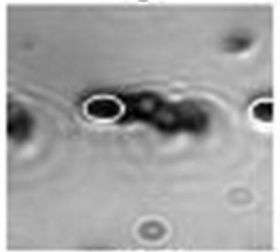
Magnetic switches like those in computers also might be used to manipulate individual strands of DNA for high-speed applications such as gene sequencing, experiments at the National Institute of Standards and Technology suggest.
As described in a recent paper, NIST researchers found that arrays of switches called "spin valves"—commonly used as magnetic sensors in the read heads of high-density disk drives—also show promise as tools for controlled trapping of single biomolecules.
The arrays might be used in chip-scale, low-power microfluidic devices for stretching and uncoiling, or capturing and sorting, large numbers of individual biomolecules simultaneously for massively parallel medical and forensic studies—a sort of magnetic random access memory (MRAM) for biosciences.
Spin valves are made by stacking thin layers of materials with different magnetic properties. Their net magnetization can be switched on and off by applying an external magnetic field of sufficient strength to align the electron "spins" in the magnetic layers in the same (on) or opposite (off) directions. NIST researchers made an array of spin valves, each about one by four micrometers in size, patterned on a 200-nanometer-thick silicon nitride membrane in fluid. When the spin valves are turned on, a local magnetic field is created that is strongest near the ends of the magnetic stack below the membrane—a field strong enough to trap nanoscale magnetic particles.
The NIST experiments demonstrated that the spin valves not only can trap magnetic particles, but also can be used as the pivot point for rotating strands of particles when a rotating magnetic field is applied. According to the researchers, these experimental results, combined with computer modeling, suggest that if biomolecules such as proteins or DNA strands were attached to the magnetic particles, the spin-valve array could apply torsional forces strong enough to alter the structure or shape of the biomolecules. The NIST group is now working on a microfluidic chip that will accomplish this electronically, which would be a significant milestone for applications.
Parallel processing of single biomolecules would be a significant advance over existing techniques limited to studying one molecule at a time. Optical tweezers, which use lasers to trap and manipulate biomolecules, tend to be slow and limited in force, and the particles need to be micrometer sized or larger. Existing magnetic tweezers can trap smaller particles and apply torque, but typically require permanent immobilization of biomolecules, which is time consuming and prevents subsequent analysis.
To view short video clip of the device in use, see: www.nist.gov/public_affairs/im … spin_valve_array.avi
Citation: E. Mirowski, J. Moreland, S. Russek, M. Donahue and K. Hsieh. Manipulation of magnetic particles by patterned arrays of magnetic spin-valve traps. Journal of Magnetism and Magnetic Materials, Vol. 311, pp. 401-404, (2007).
Source: National Institute of Standards and Technology


