DNA sieve -- Nanoscale pores can be tiny analysis labs
May 11th, 2007 DNA sieve -- Nanoscale pores can be tiny analysis labs

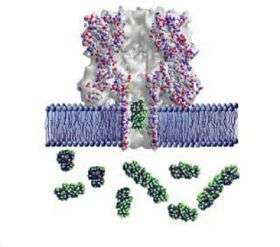
Graphic showing a lipid bilayer membrane (blue) with an alpha-hemolysin nanopore. A polyethylene glycol molecule (green globular structure) is transiting the pore; others are in solution on one side of the membrane. The colored spheres represent individual atoms, and are approximately 0.5 nanometers in diameter, or one twenty-thousandth the width of a human hair. Credit: NIST

Imagine being able to rapidly identify tiny biological molecules such as DNA and toxins using a system that can fit on a microchip or in a drop of salt water. It’s closer than you might think, say a team of researchers from the National Institute of Standards and Technology, Brazil’s Universidade Federal de Pernambuco, and Wright State University in Dayton, Ohio.

In a paper appearing next week in the Proceedings of the National Academy of Sciences, the team proves for the first time that a single nanometer-scale pore in a thin membrane—resembling one found in a living cell—can be used to accurately detect and sort different-sized polymer chains (a model for biological molecules) that pass through the channel.

Traditionally, unknown molecules in solution are measured and identified using mass spectrometry, a process that involves ionizing and disintegrating large numbers of the target molecule, then analyzing the masses of the resulting fragments to produce a "molecular fingerprint" for the original sample. The required equipment can cover a good-sized desk. By contrast, the "single-molecule mass spectrometry" system described in the PNAS paper is a non-destructive technique that in principle can measure one molecule at a time in a space small enough to fit on a single microchip-based device the size of a cell phone or PDA.

The technique involves creating a "lipid bilayer," a membrane of biological molecules similar to the walls of living cells, and creating a pore in it with a protein such as alpha-hemolysin, produced by the Staphyloccoccus aureus bacteria specifically to poke holes in cells. The target molecules are forced one-at-a-time through the nanopore, which is only 1.5 to 12 nanometers in diameter, by an applied electric current. As the molecules—in this experiment, different-sized chains of the polymer polyethylene glycol (PEG)—pass through the channel, the current flow is reduced in proportion to the size of each individual chain, allowing an easy measure of its mass.

As a control, a solution of a highly purified PEG of a specific size was characterized with the nanopore. The resulting "fingerprint" closely matched the one identifying samples of the same size polymer in the mixed-chain solution.

Further enhancement of the data from both the experimental and control tests yielded mass measurements and identifications of the different PEG chains that correlate with those made by traditional mass spectrometry.

Because the dimensions of the lipid bilayer and the alpha-hemolysin pore, as well as the required amount of electrical current, are at the nanoscale level, the "single-molecule mass spectrometry" technology may one day be incorporated into "lab-on-a-chip" molecular analyzers and single-strand DNA sequencers.

Citation: J.W.F. Robertson, C.G. Rodriguez, V.M. Stanford, K.A. Rubinson, O.V. Krasilnikov and J.J. Kasianowicz. Single-moelcule mass spectrometry in solution using a solitary nanopore. Proceedings of the National Academy of Sciences, 104 (20): 8207, May 15, 2007.

Source: National Institute of Standards and Technology


print this article email this article download pdf blog this article bookmark this article     Digg this Stumble it share on Facebook share on Reddit add to delicious save to Yahoo! bookmarks
4.6/5 after 12 votes


May 11th, 2007 all stories
Nanotechnology / Bio & Medicine

Comments: 0
Rank: 4.6/5 after 12 votes

  • Stumble this up

  • Digg this

  • Share it:
  • share on Facebook
  • share on MySpace
  • share on Slashdot
  • rss-newsfeed
  • share on Google
  • share on Reddit
  • add to delicious
  • save to Yahoo! bookmarks
  • share on Windows Live
  • Add to Mixx!
Rating: 4.6/5 after 12 votes


Tags


  • Physicists Demonstrate Quantum Memory with Matter Qubits
    Physicists Demonstrate Quantum Memory with Matter Qubits
    Physics / General Physics
    created Jul 03, 2009 | popularity 4.4 / 5 (17) | comments 1
  • 'Holey' Nanosheets for Wastewater Dye Removal
    Nanotechnology / Nanomaterials
    created Jul 01, 2009 | popularity 5 / 5 (5) | comments 1
  • Jellyfish Robot Swims Like its Biological Counterpart
    Jellyfish Robot Swims Like its Biological Counterpart
    Electronics / Robotics
    created Jun 26, 2009 | popularity 4.4 / 5 (8) | comments 1
  • Could Maxwell's Demon Exist in Nanoscale Systems?
    Could Maxwell's Demon Exist in Nanoscale Systems?
    Physics / General Physics
    created Jun 24, 2009 | popularity 4.4 / 5 (18) | comments 29
  • Living Safely with Robots, Beyond Asimov's Laws
    Living Safely with Robots, Beyond Asimov's Laws
    Electronics / Robotics
    created Jun 22, 2009 | popularity 4.6 / 5 (52) | comments 40
  • Other News

    A 'quantum of sol' -- how nanotechnology could hold the key to a solar-powered future

    A 'quantum of sol' -- how nanotechnology could hold the key to a solar-powered future

    Nanotechnology / Nanomaterials

    created Jun 30, 2009 | popularity 3.9 / 5 (15) | comments 17

    (PhysOrg.com) -- A new generation of 'nano-structured' millimetre-sized solar cells that could convert the sun's energy to electricity more than twice as efficiently as current technology, is the subject of ...


    Australian researchers are set to begin human trials of a tiny nano-cell that acts as a "Trojan horse" against cancer

    Hi-tech 'Trojan horse' can kill cancer cells: researchers

    Nanotechnology / Bio & Medicine

    created Jun 29, 2009 | popularity 4.7 / 5 (12) | comments 7

    Australian researchers are set to begin human trials of a tiny nano-cell that acts as a "Trojan horse" against cancer cells, a breakthrough they say may curb the need for debilitating chemotherapy.


    'Holey' Nanosheets for Wastewater Dye Removal

    Nanotechnology / Nanomaterials

    created Jul 01, 2009 | popularity 5 / 5 (5) | comments 1

    (PhysOrg.com) -- Researchers have discovered that extremely thin sheets of nickel oxide with hexagonally shaped holes can absorb hazardous dyes from wastewater nearly as well as the best traditional methods, but are recyclable. ...


    Harnessing Nanoparticles To Track Cancer Cell Changes

    Nanotechnology / Bio & Medicine

    created Jul 03, 2009 | popularity not rated yet | comments 1

    The more dots there are, the more accurate a picture you get when you connect them. Cancer researchers adopting that philosophy have developed a new imaging technology that could give scientists the ability to simultaneously ...


    Computer-Guided Nanoparticle Therapy Destroys Tumors

    Nanotechnology / Bio & Medicine

    created Jun 29, 2009 | popularity 4.9 / 5 (12) | comments 0

    Gold nanoshells are among the most promising new nanoscale therapeutics being developed to kill tumors, acting as antennas that turn light energy into heat that cooks cancer to death. Now, a multi-institutional research team ...