Tiny spectrometer offers precision laser calibration
May 11, 2007 Tiny spectrometer offers precision laser calibration

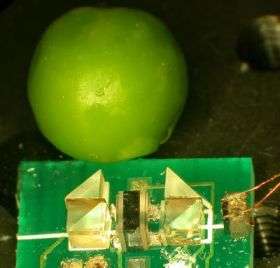
Photographed adjacent to an ordinary green pea, NIST's microfabricated spectrometer consists of a tiny container of atoms, a photodetector and miniature optics. Credit: Svenja Knappe/NIST

A tiny device for calibrating or stabilizing precision lasers has been designed and demonstrated at the National Institute of Standards and Technology. The prototype device could replace table-top-sized instruments used for laser calibration in atomic physics research, could better stabilize optical telecommunications channels, and perhaps could replace and improve on the precision of instrumentation used to measure length, chemicals or atmospheric gases.

The new spectrometer, described in the May 7 issue of Optics Express, is the latest in a NIST series of miniaturized optical instruments such as chip-scale atomic clocks and magnetometers. The spectrometer is about the size of a green pea and consists of miniature optics, a microfabricated container for atoms in a gas, heaters and a photodetector, all within a cube about 10 millimeters on a side. The package could be used to calibrate laser instruments, or, if a miniature laser were included in the device, could serve as a wavelength or frequency reference.

Most of the optical components are commercially available. The key to the device is a tiny glass-and-silicon container—designed and fabricated at NIST—that holds a small sample of atoms. The sample chambers were micromachined in a clean room and filled and sealed inside a vacuum to ensure the purity of the atomic gas, but they can be mass-produced from silicon wafers into much smaller sizes, requiring less power and potentially cheaper than the traditional blown-glass containers used in laboratories. Although shrinking container size creates some limitations, NIST scientists have accommodated these difficulties by adding special features, such as heaters to keep more atoms in the gas state. NIST tests predict that the stability and signal performance of the tiny, portable device can be comparable to standard table-top setups.

The instrument works by measuring the intensity of a laser beam after it interacts with the atoms. The amount of light absorbed at a particular wavelength produces a characteristic signature. NIST has demonstrated the spectrometer with rubidium and cesium atoms, which absorb light at infrared, near-visible wavelengths, commonly used in atomic physics research. Different atoms or molecules, such as potassium or iodine, could be used for different applications. Or, a waveguide could be added to the device to double the frequency to stabilize lasers used in fiber-optic telecommunications. The mini-spectrometer would offer greater precision than the physical references now used to separate fiber-optic channels, with the advantage that more channels might be packed into the same spectrum.

Citation: S.A. Knappe, H.G. Robinson and L. Hollberg. Microfabricated saturated absorption laser spectrometer. Optics Express. May 7, 2007.

Source: National Institute of Standards and Technology


print this article email this article download pdf blog this article bookmark this article     Stumble it Digg this share on Facebook retweet share on Reddit add to delicious
Rate this story - 4 /5 (3 votes)


May 11, 2007 all stories

Comments: 0

4 /5 (3 votes)
  • Stumble this up

  • Digg this

  • share this

  • hide
  • Related Stories

  • Quantum gas microscope offers glimpse of quirky ultracold atoms
    created Nov 04, 2009 | popularity not rated yet | comments 0
  • Modelling nano-worlds
    created Aug 10, 2009 | popularity not rated yet | comments 0
  • Jet-propelled Imaging for an Ultrafast Light Source
    created Aug 04, 2009 | popularity not rated yet | comments 0
  • Jet-propelled imaging for an ultrafast light source
    created Jul 29, 2009 | popularity not rated yet | comments 0
  • Physicists develop multifunctional storage device for light
    created Jul 29, 2009 | popularity not rated yet | comments 0


  • hide
  • Relevant PhysicsForums posts

  • Meniscus propulsion
    created 1hour ago
  • Average velocity from multiple displacement/velocities
    created 3 hours ago
  • Stefan's Radiation Law with Boxes
    created 3 hours ago
  • radiant heat energy
    created 4 hours ago
  • More from Physics Forums - General Physics

Other News

Spin polarization achieved in room temperature silicon

Spin polarization achieved in room temperature silicon

Physics / General Physics

created 13 hours ago | popularity 4.8 / 5 (10) | comments 0

(PhysOrg.com) -- A group in The Netherlands has achieved a first: injection of spin-polarized electrons in silicon at room temperature. This has previously been observed only at extremely low temperatures, ...


Multiferroic compounds used to produce smaller and cheaper digital memories

Multiferroic compounds used to produce smaller and cheaper digital memories

Physics / Condensed Matter

created 8 hours ago | popularity 4.5 / 5 (2) | comments 0

(PhysOrg.com) -- Is it possible to make even more compact digital memories for portable electronic devices and which consume even less energy? A team of French researchers has recently demonstrated that it ...


Superconductor magnet heat shield being developed

Superconductor magnet spacecraft heat shield being developed

Physics / General Physics

created Nov 26, 2009 | popularity 5 / 5 (22) | comments 22

(PhysOrg.com) -- European space agencies and an aerospace giant are developing a new re-entry heat shield that will use superconductor magnets to generate a magnetic field strong enough to deflect the superhot ...


Restored machine to explore mysteries of Big Bang (AP)

Restored machine to explore mysteries of Big Bang

Physics / General Physics

created Nov 21, 2009 | popularity 4.6 / 5 (18) | comments 26

(AP) -- Scientists are preparing the world's largest atom smasher to explore the depths of matter after successfully restarting the $10 billion machine following more than a year of repairs.


Scientists react as they stand in front of a screen at CERN

First atoms reported smashed in Large Hadron Collider (Update)

Physics / General Physics

created Nov 23, 2009 | popularity 4.5 / 5 (31) | comments 22

Two circulating beams on Monday produced the first particle collisions in the world's biggest atom smasher, the Large Hadron Collider (LHC), three days after its restart, scientists announced.