Carbon Joins the Magnetic Club
May 11th, 2007 Carbon Joins the Magnetic Club

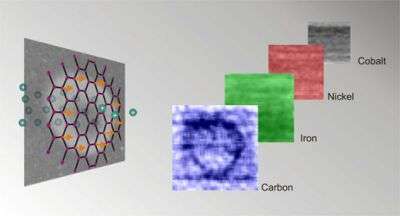
A carbon film is hit by a high-energy proton beam, causing the magnetic moments of the atoms to align around the beam impact area and creating a ring-shaped magnetic pattern that can be imaged with a magnetic-force microscope. The X-ray microscope can also be tuned to "scan" the sample for magnetism associated with other elements. The absence of a ring pattern in scans for cobalt, nickel and iron prove that the sample contains only carbon. Credit: SLAC

The exclusive club of magnetic elements officially has a new member—carbon. Using a proton beam and advanced x-ray techniques, researchers at the Department of Energy's Stanford Linear Accelerator Center (SLAC) in collaboration with colleagues from the University of Leipzig in Germany have finally put to rest doubts about carbon's ability to be made magnetic. The results appeared in the May 4 edition of Physical Review Letters.

Scientists have long suspected that carbon belongs on the short list of materials that can be magnetic at room temperature, but proof of that hypothesis has languished in controversy for nearly a decade. Since antiquity, magnetism has appeared to be a trick performed only by iron, nickel, cobalt and a handful of rare alloys.

"In the past, some groups thought they had discovered magnetic carbon," said Hendrik Ohldag, the paper's lead author and staff scientist at the Stanford Synchrotron Radiation Laboratory (SSRL) at SLAC. "Unfortunately, they realized later that they were misled by small amounts of iron, cobalt or nickel in their samples."

Carbon's possible magnetic identity first emerged when meteorites were found containing bits of the magnetized element, but those flecks of carbon were packed in close proximity to nickel, leading to the suspicion that the observed magnetism came from the nickel. But until now, attempts to prove that pure carbon can be magnetized have remained unconvincing.

"With carbon, we know how to make things very small," said Ohldag. "On the other hand we know a lot about how to process and store information using magnetism. This opens up the door for future studies that will lead to improved magnetism in carbon that could one day we will be able to combine the ‘magnetic' and the ‘carbon' world."

Harnessing the magnetic properties of carbon could one day revolutionize a range of fields from nanotechnology to electronics. Carbon nanodevices could be built one atom at a time, leading to miniaturized machines and lightweight electronics. Magnetism, which forms the basis of information storage and processing in computer hard drives, could be employed in novel ways in tomorrow's electronic devices.

According to Ohldag, magnetism is an "ordering phenomenon." All atoms behave like tiny magnets because of the spin orientation of electrons, he says. When enough of those tiny magnetic spins, or "moments," align, the material emanates a measurable magnetic field. The electron spins of iron align readily, even at high temperatures, making it an ideal magnetic material.

Carbon's electrons are arranged in such a way that magnetization has, until recently, seemed theoretically impossible. Carbon-containing meteorites found in 1999 challenged that notion, and subsequent research showed that transient magnetism on a small scale can be temporarily induced in carbon when it is brought near other magnetized elements.

Ohldag, in collaboration with six researchers from Lawrence Berkeley Lab's Advanced Light Source (ALS) and the Institute for Experimental Physics in Leipzig, Germany, have now shown that pure samples of carbon can be made permanently magnetic at room temperature. In Leipzig, Ohldag's team applied a beam of protons to disrupt and align a portion of the electrons in samples of pure carbon, magnetizing tiny, measurable spots within the carbon.

The team then used the x-ray microscope at ALS to obtain images of the magnetized portions—a measurement only possible with a state-of-the-art microscope that uses the brilliant x-ray beams generated when electrons accelerate around the ring of a synchrotron. The x-ray beam also enabled the team to verify beyond doubt that the sample remained free of impurities during the experiments, unlike the case in previous studies.

"The real trick was the unique combination of x-ray techniques used," said SSRL Director Jo Stöhr. "This is an exciting result."

Citation: Physical Review Letters, 98, 187204 (2007), doi:10.1103/PhysRevLett.98.187204; H. Ohldag, T. Tyliszczak, R. Höhne, D. Spemann, P. Esquinazi, M. Ungureanu, and T. Butz; "π-Electron Ferromagnetism in Metal-Free Carbon Probed by Soft X-Ray Dichroism".

Source: Stanford Linear Accelerator Center


print this article email this article download pdf blog this article bookmark this article     Digg this Stumble it share on Facebook share on Reddit add to delicious save to Yahoo! bookmarks
4.7/5 after 52 votes


May 11th, 2007 all stories
Physics / Condensed Matter

Comments: 0
Rank: 4.7/5 after 52 votes

  • Stumble this up

  • Digg this

  • Share it:
  • share on Facebook
  • share on MySpace
  • share on Slashdot
  • rss-newsfeed
  • share on Google
  • share on Reddit
  • add to delicious
  • save to Yahoo! bookmarks
  • share on Windows Live
  • Add to Mixx!
Rating: 4.7/5 after 52 votes

  • Related Stories

  • Scientists Produce First Movie of Individual Carbon Atoms in Action (w/Videos)
    created Mar 31, 2009 | popularity not rated yet | comments 0
  • Researchers Find Better Way To Manufacture Fast Computer Chips
    created Mar 31, 2009 | popularity not rated yet | comments 0
  • Earth Explorer mission GOCE launches
    created Mar 17, 2009 | popularity not rated yet | comments 0
  • Domain walls that conduct electricity
    created Jan 29, 2009 | popularity not rated yet | comments 0
  • New hybrid nanostructures detect nanoscale magnetism
    created Dec 08, 2008 | popularity not rated yet | comments 0

Tags


  • Physicists Demonstrate Quantum Memory with Matter Qubits
    Physicists Demonstrate Quantum Memory with Matter Qubits
    Physics / General Physics
    created Jul 03, 2009 | popularity 4.4 / 5 (17) | comments 1
  • 'Holey' Nanosheets for Wastewater Dye Removal
    Nanotechnology / Nanomaterials
    created Jul 01, 2009 | popularity 5 / 5 (5) | comments 1
  • Jellyfish Robot Swims Like its Biological Counterpart
    Jellyfish Robot Swims Like its Biological Counterpart
    Electronics / Robotics
    created Jun 26, 2009 | popularity 4.4 / 5 (8) | comments 1
  • Could Maxwell's Demon Exist in Nanoscale Systems?
    Could Maxwell's Demon Exist in Nanoscale Systems?
    Physics / General Physics
    created Jun 24, 2009 | popularity 4.4 / 5 (18) | comments 29
  • Living Safely with Robots, Beyond Asimov's Laws
    Living Safely with Robots, Beyond Asimov's Laws
    Electronics / Robotics
    created Jun 22, 2009 | popularity 4.6 / 5 (52) | comments 40
  • Other News

    Science journals

    How to Spot an Influential Paper Based on its Citations

    Physics / General Physics

    created 23 hours ago | popularity 4 / 5 (9) | comments 5

    (PhysOrg.com) -- At first it may seem that the number of citations received by a published scientific paper is directly related to that paper's quality of content. The higher the quality, the more people read ...


    Scientists create first electronic quantum processor

    Scientists create first electronic quantum processor

    Physics / General Physics

    created Jun 28, 2009 | popularity 4.8 / 5 (52) | comments 39

    A team led by Yale University researchers has created the first rudimentary solid-state quantum processor, taking another step toward the ultimate dream of building a quantum computer.


    Fermilab's CDF observes Omega-sub-b baryon

    Fermilab's CDF observes Omega-sub-b baryon

    Physics / General Physics

    created Jun 29, 2009 | popularity 4.7 / 5 (16) | comments 7

    (PhysOrg.com) -- At a recent physics seminar at the Department of Energy’s Fermi National Accelerator Laboratory, Fermilab physicist Pat Lukens of the CDF experiment announced the observation of a new particle, ...


    New insights, and a new angle, on high-temperature superconductivity

    New insights, and a new angle, on high-temperature superconductivity

    Physics / Superconductivity

    created Jun 29, 2009 | popularity 4.8 / 5 (13) | comments 6

    (PhysOrg.com) -- A Princeton-led research team has revealed surprising information about how electron behavior influences the conduction of electricity in a class of high-temperature superconductors. An increased ...


    The art of invisibility and the perfect cat's eye

    The art of invisibility and the perfect cat's eye

    Physics / Optics & Photonics

    created Jun 30, 2009 | popularity 4 / 5 (8) | comments 6

    (PhysOrg.com) -- In recent years scientists have explored the impossible by developing invisibility or 'cloaking' devices, but can the same technology also help make things more visible?