Probing Question: Are sports drinks better than water for athletes?
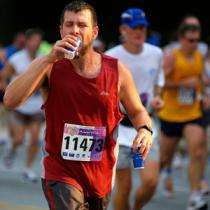
After finishing a long run in the heat of a July afternoon, you're thirsty, your muscles are weak, you feel generally fatigued, and you may have a minor headache. Your body is telling you that it needs to be rehydrated, so you grab a bottle of water from the refrigerator. It's cold and refreshing, but how well is that H2O replenishing the nutrients you lost during your workout? According to W. Larry Kenney, Penn State professor of physiology and kinesiology, a bottle of a sports drink like Gatorade may be a better choice.
"Sports drinks have extra ingredients that are not found in water," Kenney explained. "Electrolytes such as sodium and potassium are the most important additives, and carbohydrates are a close second."
Electrolytes are physiologically important substances that regulate the body's hydration, and nerve and muscle function, he added. During exercise, the body sweats to limit the rise in body temperature. This process keeps the body cool, but results in loss of fluid. "Sports drinks are designed to replenish electrolytes lost while sweating," he said.
The amount of fluid lost varies tremendously between individuals, Kenney noted, and is dependent upon exercise intensity and duration, temperature and humidity, and the type of clothing one wears. "Heavy sweaters can lose up to three pounds per hour," he said, and advised weighing oneself both before and after exercise. "The goal is to maintain your baseline body weight."
"There is another reason for adding electrolytes like sodium," Kenney said. "Think of a bartender who offers free pretzels and peanuts -- he wants you to drink more. The salt in sports drinks helps to maintain thirst." He continued, "If you drink plain water until you no longer feel thirsty, you've most likely not replenished all lost fluids."
As for the importance of carbohydrates in sports drinks, Kenney says that these sugars provide energy during prolonged exercise. Recent studies have shown that readily available carbs may not only benefit marathon runners and triathlon athletes.
"We tested the effect of sports drinks on youth basketball players and found that the carbohydrate-containing beverage improved sprinting and delayed fatigue," he explained. "More unexpectedly, the kids sunk more baskets while consuming sports drinks." Kenney said that this discovery suggests the ability of carbohydrates to improve cognitive function and maintain focus as well as limit fatigue.
Though some experts believe that sugars such as high fructose corn syrup have health drawbacks, Kenney says that the type of carbohydrate used in sports drinks doesn't matter. "Glucose, sucrose and fructose yield the same results when the body breaks them down," he said. However, he warns that fructose may upset some stomachs and so should be used with caution.
Like salt, sugar also is added for flavor appeal. "The rationale of flavor is a science in and of itself," said Kenney. "The goal of sports drink manufacturers is to determine what tastes best when you're hot and sweaty."
Sports drinks aren't needed for all types of activity, Kenney acknowledged. "Water is fine for low-intensity and non-endurance athletes whose priority is not carbohydrate replacement."
But for those extreme athletes who sustain physical activity for more than four hours at a time, Kenney said, the sodium in sports drinks can be helpful in warding off a condition called "hyponatremia." Also referred to as water intoxication and much rarer than dehydration or heat exhaustion, "hyponatremia occurs when excess water dilutes the sodium in the body," he explained. "The prototype person at risk is an endurance or ultra-endurance athlete -- typically someone who is smaller and slower than the average," he continued. "This athlete consumes excessive amounts of water during exercise and inadequately replaces sodium." Symptoms include nausea, vomiting and swelling of hands and feet. Such a serious disturbance in electrolyte levels may lead to cardiac or neurological complications -- such as swelled brain cells -- if not immediately treated. "The key message is not to excessively underdrink or overdrink," Kenney said.
A good rule of thumb, he suggests, is to choose sports drinks over water if you plan to participate in 45 minutes or more of high-intensity activity. "It's important to drink before, during and after activity," he adds. "You should drink one hour before a workout to give your kidneys time to dispose of excess fluid. And if possible, you should consume every 15 to 20 minutes during a workout. Most importantly, drink enough afterwards to replace all losses within the first two hours."
"It really depends on the situation," Kenney said. Water is a sufficient hydrator after riding your bike around the neighborhood or jogging through the park, but the extra ingredients in a sports drink will more successfully refuel your body after that long run. He added, "The longer the activity, the more important sports drinks become."
Source: By Emily Rowlands, Research Penn State


