Teaching ants: First demonstration of 'teaching' in non-human animals
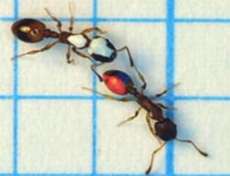
Certain species of ant use a technique known as ‘tandem running’ to lead another ant from the nest to a food source. Signals between the two ants control both the speed and course of the run. It is believed to be the first time a demonstration of formal teaching has been recognised in any non-human animal.
This behaviour indicates that it could be the value of information, rather than the constraint of brain size, that has influenced the evolution of teaching.
The research, by Professor Nigel Franks and Tom Richardson from Bristol University, is reported today in Nature [12 January 2006].
According to the accepted definition of teaching in animal behaviour, an individual is a teacher if it modifies its behaviour in the presence of a naïve observer, at some initial cost to itself, in order to set an example so that the other individual can learn more quickly.
Professor Franks said: “We also believe that true teaching always involves feedback in both directions between the teacher and the pupil. In other words, the teacher provides information or guidance for the pupil at a rate suited to the pupil’s abilities, and the pupil signals to the teacher when parts of the ‘lesson’ have been assimilated and that the lesson may continue.”
“We also believe that true teaching always involves feedback in both directions between the teacher and the pupil."
Professor Nigel FranksTandem running in Temnothorax ants meets all these criteria and thus qualifies as teaching. At the start of a tandem run, the leader finds a naïve individual who is willing to follow her. But tandem runs are rather slow because the follower frequently pauses to look round for landmarks so that it can learn the route. Only when the follower has done this does it tap on the hind legs and abdomen of the leader to let it know that the tandem run can proceed.
The researchers’ detailed analysis of the movements of tandem leaders and tandem followers shows the mutual feedback between them: if the gap between them gets too large, the leader decelerates and the follower accelerates, and if the gap between them gets too small, the leader accelerates and the follower decelerates.
It is as if the leader is towing the follower but the process is highly intermittent because the follower is dictating the speed of the lesson by stopping frequently to consolidate its growing knowledge of the path that it has taken.
Tandem leaders pay a cost because they would normally have reached the food around four times faster if not hampered by a follower. But the benefit is that the follower learns where the food is much quicker than it would have done independently. Tandem followers learn their lessons so well that they often become tandem leaders and in this way time-saving information flows through the ant colony.
Richardson added: “This behaviour is beautifully simple. If one experimentally removes the follower and taps the leader with a hair at a rate of two times per second or more, the leader will continue.”
The occurrence of teaching in ants indicates that teaching can evolve in animals with tiny brains. It is probably the value of information in social animals that determines when teaching will evolve, rather the constraints of brain size.
Source: Bristol University


