May 14, 2007 feature
Study maps network of 7 million cell phone users
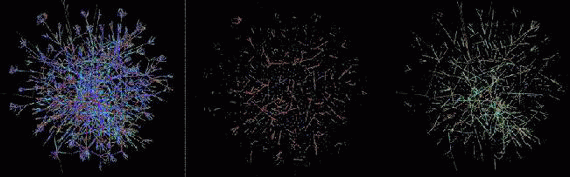
Scientists have constructed a map of a societal communication network based on the mobile phone usage of 7 million individuals during a span of 18 weeks. As the first study to have access to a large amount of direct data of cell phone calls, the results show a counterintuitive requirement of weak ties rather than strong ties to maintain the integrity of a global network. In fact, the scientists found that removing these fragile weak ties can cause a global network to collapse.
A group of scientists (Jukka-Pekka Onnela, et al.) from universities in Finland, the UK, the US, and Hungary recently published the results of their study in the Proceedings of the National Academy of Sciences.
While previous studies on communication networks had to rely on data from opinionated questionnaires of limited sizes, this study is the first to take advantage of cell phone technology to uncover a dimension of social interactions that had been previously unaccounted for at this scale: the strength of ties between individuals.
“Based on our findings, social networks seem to be organized in a way that maximizes information flow at the level of communities, or at the meso-scopic scale as a physicist would say, but not beyond them,” Onnela, who is from Oxford University and the Helsinki University of Technology, told PhysOrg.com.
In this study, the scientists defined the strength of a tie as the aggregate duration of phone calls between two individuals over the studied period. The longer two individuals talk, generally the more information is transferred. (All phone calls had to have been returned at least once for inclusion in the study.) Taken together, the data revealed a skewed distribution showing that, while most individuals talk with just a few others, a small minority communicates with dozens; also, while most individuals talk for only a few minutes, a small fraction spends hours talking.
The scientists then turned to the question of what factors influence the strength of a particular tie. Previous theoretical research has identified three hypotheses. In the global view, tie strength is determined by the total number of short paths an individual has throughout the entire network. In the dyadic view, tie strength is determined solely by the relationship between the two individuals in question. In the weak ties view, tie strength is driven by the two individuals’ local structure, and increases with the overlap of the individuals’ friends.
Onnela and his colleagues found that the stronger the tie between two users, the more their friends overlap—a finding consistent with the weak ties hypothesis. As the scientists explain, this result leads to somewhat of a paradox, as it suggests that global communication networks are better suited to local information transfer than global information transfer. The finding provides the first societal-level confirmation for the weak ties hypothesis.
“Many network measures that are used to characterize complex networks originate in social network analysis,” Onnela said. “In that field, the studied networks are usually fairly small. However, as the size of the system grows to the order of millions, we need to be careful in interpreting these measures in a social context. For example, to measure my ‘social centrality,’ we do not need to know where every individual on the planet is located with respect to me in the global social network.”
The scientists also investigated what would happen to the network overall if either the strong or weak ties were removed. They found that removing the weakest ties (i.e. individuals who only spoke to each other for the shortest time) caused the network to undergo a phase transition and suddenly collapse at a critical point. On the other hand, removing the strongest ties caused the network to gradually shrink, but not break apart.
“This finding is somewhat unexpected, because in most technology and biological networks the strong ties are believed to play a more importance structural role than the weak ties,” the scientists wrote in their paper. “In such systems the removal of the strong ties leads to the network’s collapse.”
The scientists explained these opposite results by pointing out that strong ties are usually within local communities, so their removal would only disintegrate the community but not the global network. Removing the weak ties, on the other hand, destroys the fragile links connecting different communities.
Finally, the group investigated how the dynamics of different tie strengths influence the spread of information in the network. They found that adjusting for the weighted ties slowed the information transfer due to the trapping of information in local communities, where it takes longer to disseminate the information beyond the community through weak ties. Also, contrary to previous studies, the scientists found that intermediate ties play the most important role in spreading information.
“Perhaps the most significant result of this study is the finding concerning the importance of ties of intermediate strength in information transfer, a phenomenon that we called ‘the weakness of weak and strong ties’ in the paper,” said Onnela. “This result goes against the celebrated role of weak ties in information access.”
Onnela also explained that, since the mobile phone communication network is a subset of the underlying social network, the former can be used to infer some large-scale properties of the latter.
“Having a more accurate understanding of the properties of large-scale social networks could turn out to be very important in, for example, epidemiology,” he said. “There it is precisely the large-scale structure of the society that is of interest when contemplating the possibility of an epidemic. I believe our work has also relevance to studying certain sociodynamic phenomena, such as collective opinion formation, because there the outcome will depend on whom you are connected to and how strongly.”
Citation: Onnela, J.-P., Saramäki, J., Hyvönen, J., Szabó, G., Lazer, D., Kaski, K., Kertész, J., and Barabási, A.-L. “Structure and tie strengths in mobile communication networks.” Proceedings of the National Academy of Sciences. May 1, 2007, vol. 104. no. 18, 7332-7336.
Copyright 2007 PhysOrg.com.
All rights reserved. This material may not be published, broadcast, rewritten or redistributed in whole or part without the express written permission of PhysOrg.com.


