Magnetic tweezers unravel cellular mechanics
May 14, 2007 Magnetic tweezers unravel cellular mechanics

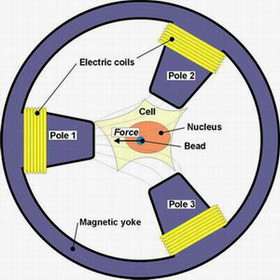
Scheme of the micromechanical experiments. Magnetic poles (6 µm wide, 20 µm separation) generate a force on a paramagnetic bead positioned in the nucleus of a HeLa cell. Electric coils allow the control of amplitude and direction of the force. Magnetic yoke and electric coils are not to scale. Credit: University of Twente

By injecting tiny magnetic beads into a living cell and manipulating them with a magnetic ‘tweezer’, scientists of the University of Twente, The Netherlands, succeed in getting to know more about the mechanics of the cell nucleus.

The way DNA is ‘translated’ into the specific functions of the cell strongly depends on the mechanics, so this information is of great value. Scientists Anthony de Vries, Hans Kanger and Vinod Subramaniam of the Biophysical Engineering Group present their results in Nano Letters.

The spatial organization in a living cell tells a lot about the way the cell works and the molecular processes within. It is clearly indicated that the mechanical properties of DNA and chromatin –the complex of DNA and proteins- play a major role in the activity of thousands of genes. Gene expression, in which DNA expresses itself in functional proteins, seems to depend highly on these mechanical properties. Until now, only individual chromosomes have been investigated: the new method allows scientists to monitor the mechanical properties of chromatin within the cell and investigate the internal structure of the cell nucleus.

Three magnets

The UT-scientists therefore inject a bead into the cell nucleus using a micro pipette. The bead is about 1 micron in diameter. The cell is placed in the centre of three tiny magnets (micron dimensions). Each of them can generate a force on the bead. From the nanometer distances the bead is allowed to move, the elasticity and viscosity of the chromatin can be determined. Using an intuitive polymer model of chromatin, the organization of chromatin within the cell can then be predicted: they organize themselves within domains not entirely filling the nucleus.

The scientists say that their technique is a crucial step towards magnetic nanodevices that can be implanted in a living cell, functioning as biosensors for monitoring chemical and physical processes in cell and tissue. It will also become possible to interact with these processes using the magnetic technique.

The research has been conducted within the Biophysical Engineering Group (http://bpe.tnw.utwente.nl), part of the BMTI Institute for Biomedical Technology and the MESA+ Institute for Nanotechnology, both at the University of Twente.

Source: University of Twente


print this article email this article download pdf blog this article bookmark this article     Stumble it Digg this share on Facebook retweet share on Reddit add to delicious
Rate this story - 4.4 /5 (11 votes)


May 14, 2007 all stories

Comments: 0

4.4 /5 (11 votes)
  • Stumble this up

  • Digg this

  • share this

  • hide
  • Related Stories

  • UW Scientists Research DNA, RNA Mysteries
    created Jan 10, 2007 | popularity not rated yet | comments 0
  • Biophysics : When chromosomes stretch
    created Apr 26, 2006 | popularity not rated yet | comments 0
  • Shape of things to come: Structure of HIV coat could lead to new drugs
    created Nov 12, 2009 | popularity not rated yet | comments 0
  • New explanation for nature's hardiest life form
    created Nov 12, 2009 | popularity not rated yet | comments 0
  • Magnetic nanoparticles to simultaneously diagnose, monitor and treat
    created Nov 06, 2009 | popularity not rated yet | comments 0


  • hide
  • Relevant PhysicsForums posts

Other News

Nanoparticles used in common household items caused genetic damage in mice

Nanotechnology / Bio & Medicine

created 10 hours ago | popularity 4.6 / 5 (14) | comments 8

Titanium dioxide (TiO2) nanoparticles, found in everything from cosmetics to sunscreen to paint to vitamins, caused systemic genetic damage in mice, according to a comprehensive study conducted by researchers at UCLA's Jonsson ...


Freezing: a phenomenon that 'jumps'

Freezing: a phenomenon that 'jumps'

Nanotechnology / Nanomaterials

created 7 hours ago | popularity not rated yet | comments 0

(PhysOrg.com) -- The freezing of suspensions of particles is not always a uniform phenomenon; in certain conditions it leads to a modification of the redistribution of particles and the growth of crystals.


carbon fiber

Ultra-Long Carbon Nanotubes Could Serve as Future Transmission Lines

Nanotechnology / Nanomaterials

created Nov 10, 2009 | popularity 4.8 / 5 (25) | comments 14

(PhysOrg.com) -- When it comes to carbon nanotubes, the majority of research so far has focused on small-scale applications. But now, a team of researchers from Rice University has created carbon nanotubes ...


Researchers turn algae into high-temperature hydrogen source

Researchers turn algae into high-temperature hydrogen source

Nanotechnology / Nanophysics

created Nov 12, 2009 | popularity 3.6 / 5 (7) | comments 5

In the quest to make hydrogen as a clean alternative fuel source, researchers have been stymied about how to create usable hydrogen that is clean and sustainable without relying on an intensive, high-energy ...


Argonne 'homegrown' hybrid solar cell aims for low-cost power

Argonne 'homegrown' hybrid solar cell aims for low-cost power

Nanotechnology / Nanomaterials

created Nov 10, 2009 | popularity 4.2 / 5 (11) | comments 3

(PhysOrg.com) -- Scientists at the U.S. Department of Energy’s (DOE) Argonne National Laboratory have refined a technique to manufacture solar cells by creating tubes of semiconducting material and then "growing" ...