The next big thing in molecular separation
May 15, 2007 By Richard Cairney
The next big thing in molecular separation

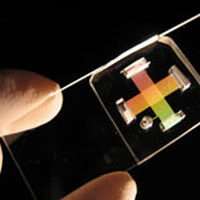
Detail of the new nanosieve designed by Yong Zeng and Chemistry Chair Dr. Jed Harrison.

A new sieve designed by a University of Alberta graduate student could be the next big thing in separating molecules using really, really small devices.

Yong Zeng, who is working towards his PhD in chemistry, and his supervisor, Department of Chemistry Chair Dr. Jed Harrison, have published research results that demonstrate a new nano-scale sieve design that is easier and cheaper to produce, and more efficient than sieves produced by other high-tech nanotechnologies. Their findings appear in the journal Analytical Chemistry.

The sieve has potential applications in biomedical research. It will, for example, allow researchers to separate viruses from fluid or tissue samples.

The sieve Zeng and Harrison designed uses silica sand, along with the same kind of silicone you'd use to line a bathtub, to act as a filter. The devices are produced quickly, can be used hundreds of times because they have many channels, and cost no more than $10 to manufacture.

In Zeng and Harrison's design, samples flow around uniformly packed silica pellets, the way water would flow around grapes packed into a box.

Researchers can customize the sieves to larger or smaller scales, to allow larger or smaller objects to pass through. For example, marbles would filter through a box of basketballs, but tennis balls wouldn't. By adjusting the size of the silica beads in the sieve, Zeng and Harrison are able to filter out objects as small as a virus.

"What Yong has developed is a way to make ordered lattice structures that are crystalline packings of 100 - 1,000 nanometers in diameter, and the space between the beads becomes ordered," said Harrison, adding that the design allows researchers to use larger fluid or tissue samples, yielding larger result samples to study - a definite improvement over other sieve designs.

Another recently designed sieve nanofabricated on silicon/glass chips has made a big scientific impact, but is far from practical because it is costly to produce (over $1,000 each), and can only be used about 10 times before samples clog its channels.

"So from our point of view this takes the advances discovered in the silicon/glass devices and makes them commercially viable," said Harrison.

Zeng, who completed his undergraduate studies at China's Wuhan University, began working on the new design when he'd grown frustrated by the work Harrison had originally assigned him - to work on sieves made in silicon using nanolithography.

"The goals are the same, the method's different," said Harrison of the outcome. "Yong just concluded that the conventional method was too hard and too expensive."

"I was a little nervous about it," Zeng said of presenting his idea to Harrison. "And I wanted to publish a paper on this right away, but thankfully Jed said that we should refine it and improve it first. And I'm glad we did - I'm not sure it would have had the same impact."

Manufactured on glass and plastic slides or "chips", the sieves measure a few square millimeters.

Harrison said the chips also have potential application in the field of photonics. The sieves could be used to manipulate beams of light shone through them as well.

Source: University of Alberta

4.6 /5 (27 votes)  

Rank 4.6 /5 (27 votes)
Tags

Relevant PhysicsForums posts

More news stories

Hydrogen from acidic water: Researchers develop potential low cost alternative to platinum for splitting water

A technique for creating a new molecule that structurally and chemically replicates the active part of the widely used industrial catalyst molybdenite has been developed by researchers with the Lawrence Berkeley ...

Chemistry / Materials Science

created Feb 09, 2012 | popularity 4.8 / 5 (15) | comments 21 | with audio podcast

Fool's gold may prove an unlikely alternative to overexploited catalytic materials

Catalytic materials, which lower the energy barriers for chemical reactions, are used in everything from the commercial production of chemicals to catalytic converters in car engines. However, with current catalytic materials ...

Chemistry / Materials Science

created Feb 10, 2012 | popularity 4.4 / 5 (8) | comments 8 | with audio podcast

Research provides octagonal window of opportunity for carbon capture

(PhysOrg.com) -- Filtering carbon dioxide, a greenhouse gas, from factory smokestacks is a necessary, but expensive part of many manufacturing processes. However, a collaborative research team from the National ...

Chemistry / Materials Science

created Feb 08, 2012 | popularity 5 / 5 (1) | comments 5 | with audio podcast

Flexible paper robots

(PhysOrg.com) -- These inexpensive robots can stretch, bend and twist under control, and lift objects up to 120 times their own weight. Being soft, they can apply gentle and even pressure, and adapt to varied ...

Chemistry / Materials Science

created Feb 09, 2012 | popularity 5 / 5 (5) | comments 4 | with audio podcast

New form of hafnium oxide developed

(PhysOrg.com) -- A novel material developed by researchers at the University of Cambridge is opening up new possibilities for next generation electronic and optoelectronic devices, and paving the way for further ...

Chemistry / Materials Science

created Feb 07, 2012 | popularity 4.6 / 5 (5) | comments 4 | with audio podcast


Latin America mining boom clashes with conservation

Latin America is experiencing a mining boom as prices rise fuelled by a hike in global demand, but the region is also being hit by a wave of violent protests, strikes and rallies by environmentalists.

Love a click away in Indonesia's Twitter Republic

He was a geeky kid from Yogyakarta, she a glamorous city girl in Jakarta. In a country with one of the world's most vibrant social networking scenes they fell in love on Twitter.

Walney offshore wind farm is world's biggest (for now)

(PhysOrg.com) -- The Walney wind farm on the Irish Sea--characterized by high tides, waves and windy weather--officially opened this week. The farm is treated in the press as a very big deal as the Walney ...

GPS court ruling leaves US phone tracking unclear

A US Supreme Court decision requiring a warrant to place a GPS device on the car of a criminal suspect leaves unresolved the bigger issue of police tracking using mobile phones, legal experts say.

Europeans protest controversial Internet pact

Tens of thousands of people marched in protests in more than a dozen European cities Saturday against a controversial anti-online piracy pact that critics say could curtail Internet freedom.

Europe stakes billion-dollar bet on new rocket

A pencil-slim rocket is scheduled to lift into space from South America on Monday, carrying a billion-dollar bet that Europe can grab a juicy slice of the market to place satellites in low orbit.