Hens change sex behaviour to outfox males
May 15, 2007 Hens change sex behaviour to outfox males

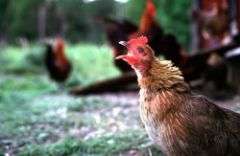
Hens choose to mate in the morning to avoid sexual harassment from gangs of cockerels later in the day. Credit: Pizzari/Løvlie

Hens solicit sex in the morning in male-dominated groups of chickens to avoid an evening of sexual harassment from amorous cockerels, according to new research.

The study, undertaken by Dr Tommaso Pizzari of the Department of Zoology and Dr Hanne Løvlie of the University of Stockholm, found that in female-dominated groups hens looked to mate with cockerels in the evening when both sexes are at their most fertile.

However, in groups where there were a higher proportion of males, hens chose to mate with desired males in the morning and then avoid males in the evening. This enabled them to mate without suffering sexual harassment from gangs of cockerels. It is the first study of its kind to demonstrate that female birds change their sexual behaviour in this way.

The scientists studied a population of free-ranging feral chickens at the Tovetorp research station in Sweden because, while used to humans, these fowl behave much like wild birds. By splitting the population up into groups with differing ratios of male to female birds the researchers were able to observe how sexual behaviour changed as the groups went from being dominated by females (a minimum ratio of two males to eight females) to being dominated by males (a maximum ratio of six males to four females).

‘What we found was that females were exposed to more intense sexual harassment in groups with more males,’ said Dr Tommaso Pizzari of the Department of Zoology at Oxford University, ‘in these groups females solicit sex early in the morning and avoid males in the evening. This ‘plasticity’ in sexual behaviour may enable females to reduce the cost of mating while maintaining some control over paternity.’

Most research on sexual conflict ignores the fact that the fitness pay-offs of mating may change drastically over a short timescale, for example over a day. This new study provides evidence that mating strategies can affect behaviour at a daily level and could shed new light on the evolutionary ‘battle of the sexes’.

A report on the research is published in the journal The American Naturalist.

Source: University of Oxford


Rate this story - 4 /5 (7 votes)


May 15, 2007 all stories

Comments: 0

4 /5 (7 votes)

  • hide
  • Related Stories


Other News

Looks Can Be Deceiving

Looks can be deceiving: Lizards acquire the same camouflaging adaptation in different ways

Biology / Plants & Animals

created 2 hours ago | popularity 5 / 5 (2) | comments 0

(PhysOrg.com) -- Does it matter if nature solves the same problem multiple ways? A NSF-supported study of lizard populations in White Sands, New Mexico has helped researcher Erica Rosenblum of the University ...


Famous San Francisco sea lions leave in droves (AP)

Famous San Francisco sea lions leave in droves

Biology / Plants & Animals

created 3 hours ago | popularity not rated yet | comments 0

(AP) -- Two mysteries surround a huge herd of sea lions that were hanging out on a pier in San Francisco Bay: Why did so many show up, and why did so many leave at once?


Student sleuths using DNA reveal zoo of 95 species in NYC homes -- and new evidence of food fraud

Student sleuths using DNA reveal zoo of 95 species in NYC homes -- and new evidence of food fraud

Biology / Cell & Microbiology

created Dec 28, 2009 | popularity 5 / 5 (15) | comments 5

Two New York City high school students exploring their homes using the latest high-tech DNA analysis techniques were astonished to discover a veritable zoo of 95 animal species surrounding them, in everything ...


Scientists develop technique to determine ethnic origin of stem cell lines

Biology / Cell & Microbiology

created 13 hours ago | popularity 4.5 / 5 (4) | comments 0

An international team of scientists led by researchers at The Scripps Research Institute has developed a straightforward technique to determine the ethnic origin of stem cells.


Tracking Virus Resistance Genes in Watermelon Made Easier

Tracking Virus Resistance Genes in Watermelon Made Easier

Biology / Biotechnology

created 20 hours ago | popularity not rated yet | comments 0

(PhysOrg.com) -- Finding watermelon genes that confer resistance to the devastating zucchini yellow mosaic virus (ZYMV) has just been made easier, thanks to molecular markers developed by Agricultural Research ...