Web-based program could ease treatment decisions for prostate cancer patients
May 15, 2007 Web-based program could ease treatment decisions for prostate cancer patients

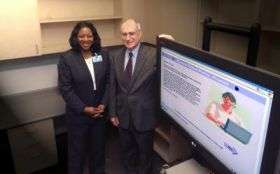
A team of MCG researchers is testing a Web-based program that provides prostate cancer patients with information about different treatment approaches. Researchers, including Dr. Gerald Bennett, principal investigator and chair of the Department of Health Environments and Systems in the MCG School of Nursing and Dr. Rosalind Jones, co-investigator, study coordinator and assistant professor of nursing, believe that the program may make treatment decisions easier. Credit: Medical College of Georgia

A Web-based program that provides prostate cancer patients with information about different treatment approaches may make deciding which path to follow a little easier, Medical College of Georgia researchers say.

Treatments for localized prostate cancer and associated side effects are so varied that patients are often confused about which option is best for them, says Dr. Gerald Bennett, chair of the Department of Health Environments and Systems in the MCG School of Nursing.

"This disease can be treated by observation alone, surgery, cryosurgery, hormonal therapy and radiation therapies," Dr. Bennett says. "But there have only been a few studies that adequately compare the complications of different treatments, which can include sexual, bladder and bowel dysfunction. Men can hear their doctors’ recommendations, but ultimately, they decide which treatment to pursue. Those decisions can dramatically affect their lives, but the bottom line is that we often don’t know enough scientifically to recommend one treatment over the other."

MCG is part of a National Institutes of Health-funded study to determine the impact of the Personal Patient Profile Prostate (P4) program, an innovative computer program that measures personal factors and creates an Internet decision-support system.

Led by the University of Washington in Seattle, the other sites are Fox Chase Cancer Center in Philadelphia and the University of Texas Health Science Center in San Antonio. Nearly 500 patients will be included in the study nationwide.

In Augusta, Dr. Bennett and his research team will recruit 72 prostate cancer patients from the Augusta Veterans Affairs Medical Center. Half of those men will follow a traditional treatment plan – diagnosis followed by a consultation with a cancer specialist and treatment. The other half will use the P4 program.

"These men will go to the Web site and answer questions like who they feel should be responsible for making treatment decisions – their doctor, themselves or a combination of the two – and the program will provide video examples of how to approach those discussions with their care providers," Dr. Bennett says. "We believe men who have access to the P4 program will have less inner conflict while making treatment decisions and, in the long run, will be more satisfied with whatever treatment path they choose."

"I often see patients struggle with treatment decisions," adds Dr .Martha Terris, urologist at the Veterans Affairs Medical Center in Augusta and the Medical College of Georgia. "While a program like this one doesn’t make the treatment decision for them, it does help them make better informed decisions and further open the lines of communication with their doctors."

Source: Medical College of Georgia


print this article email this article download pdf blog this article bookmark this article     Stumble it Digg this share on Facebook retweet share on Reddit add to delicious
Rate this story - 1 /5 (1 vote)


May 15, 2007 all stories

Comments: 0

1 /5 (1 vote)
  • Stumble this up

  • Digg this

  • share this

  • hide
  • Related Stories


  • hide
  • Relevant PhysicsForums posts

Other News

US Senate votes on landmark health bill

Medicine & Health / Health

created Dec 24, 2009 | popularity 2.6 / 5 (5) | comments 5

Senators gave Barack Obama a huge political boost on Thursday by passing a sweeping remake of the US health care system that aims to extend coverage to 31 million uninsured Americans.


Splitting fluorescent protein helps image clusters in live cells

Medicine & Health / Research

created 15 hours ago | popularity not rated yet | comments 0

Half a protein is better than none, and in this case, it's way better than a whole one. A Rice University lab has discovered that dividing a particular fluorescent protein and using it as a tag is handy for analyzing the ...


'Self-seeding' of cancer cells may play a critical role in tumor progression

Medicine & Health / Cancer

created Dec 24, 2009 | popularity 5 / 5 (3) | comments 0

Cancer progression is commonly thought of as a process involving the growth of a primary tumor followed by metastasis, in which cancer cells leave the primary tumor and spread to distant organs. A new study by researchers ...


New tool in the fight against mosquito-borne disease: A microbial 'mosquito net'

Medicine & Health / Diseases

created Dec 24, 2009 | popularity 4.8 / 5 (5) | comments 0

Earlier this year, researchers showed that they could cut the lives of disease-carrying mosquitoes in half by infecting them with a bacterium they took from fruit flies. Now, a new report in the December 24th issue of Cell, ...


Molecular anchor links the 2 inheritable diseases Fanconi anemia and Bloom's syndrome

Medicine & Health / Genetics

created Dec 24, 2009 | popularity not rated yet | comments 0

A new study establishes a molecular link that bridges two rare inherited disorders and explains why these diseases result in genetic instability. The research, published by Cell Press in the December 24th issue of the journal ...