Brain, Size and Gender Surprises in Latest Fossil Tying Humans, Apes and Monkeys
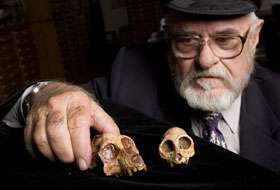
A surprisingly complete fossil skull of an ancient relative of humans, apes and monkeys bears striking evidence that our remote ancestor was less mentally advanced than expected by about 29 million years ago.
The second and most intact cranium found of Aegyptopithecus zeuxis was identified by Duke University primatologist Elwyn Simons, who is announcing the find this week with several colleagues. Because of the new specimen’s remarkable wholeness, Simons and his colleagues were able to subject it to micro CT scanning, a computerized X-ray technique that can be used to calculate the approximate dimensions of the brain the cranium once encased.
Based on previous fossils collected at the same dig site in a quarry outside Cairo, scientists had hypothesized that this early monkey already would have had a relatively large brain, said Simons, a professor of biological anthropology and anatomy.
But the researchers' new report, which displays the computer-reconstructed brain as a false-color red mass within the grey skull case, suggests that the species "had a brain that might have been even smaller than that of a modern lemur's," Simons said. "This means the big-brained monkeys and apes developed their large brains at a later point in time." Simons named this creature Aegyptopithecus zeuxis -- or "linking Egyptian ape" -- after his team found the first skull in 1966.
Simons and his colleagues reported the findings online during the week of May 14 in the journal Proceedings of the National Academy of Sciences. The work was supported by the National Science Foundation and the Leakey Foundation.
Sufficiently tiny to rest in Simons' palm, the new 29-million-year-old skull is less than half the size of the 1966 skull. Simons said he and his collaborators first thought it might represent a new species.
But having confirmed that the skull is from the same species, the new skull's strikingly small size suggests the animal may have been mentally robust enough to distinguish the numerous members of a fairly large social group.
After comparing the two skulls, which are of the same age, Simons and his collaborators concluded that the new one came from a female that might have weighed about five and a half pounds, while the first one was from a male of more than twice that size. This size difference between the Aegyptopithecus genders is comparable to that of gorillas, which genetically are humans' second-closest relatives.
Modern-day primates with significant gender size differences usually form multimale and multifemale troops, he said. "When you are in a large troop, that means maybe 15 or 20 individuals. So if we infer that an Aegyptopithecus had a large social group, that suggests it had enough sense to tell all of those members apart from nonmembers."
Simons said he originally overestimated Aegyptopithecus' likely brain size based on the original 1966 skull, which has a bigger snout and pronounced crests, features that he now attributes to its being male.
Aegyptopithecus' brain is smaller than once thought. "But other features in these skulls, and in many other Aegyptopithecus fossil pieces collected at the Egyptian site over four decades, suggest that this primate was already branching away from its lemurlike ancestry," he said.
"We also find that the visual cortex was large, which means that like many primates, this species likely had very acute vision," he said. "So the visual sense, which is regarded as a very important feature of anthropoids, or higher primates, had already expanded."
The shape of the animal’s eye sockets also suggests Aegyptopithecus was active in the daytime, like modern and ancient higher primates. In contrast, many but not all modern prosimians -- the group that includes lemurs -- are active at night, he said.
Aegyptopithecus fossils have been found in two quarries separated by about a kilometer within Egypt's Fayum Depression. Scientific evidence suggests the location, now arid, was a tropical forest 29 million years ago.
Simon’s co-authors include Erik Seiffert, a Duke-trained researcher now at the University of Oxford in England who will soon relocate to Stony Brook University in New York; Timothy Ryan of Pennsylvania State University, who did the micro-CT scanning; and Yousry Attia of the Egyptian Geological Museum in Cairo.
Source: Duke University


