Astronomers find magnetic Slinky in constellation of Orion
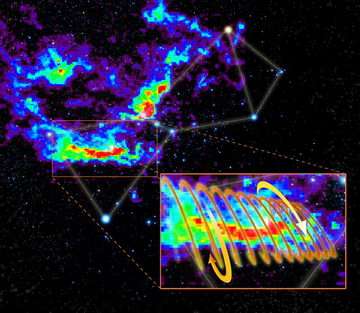
UC Berkeley astronomers announced today the first discovery of a helical magnetic field in interstellar space, coiled like a snake around a gas cloud in the constellation of Orion.
Astronomers have long hoped to find specific cases in which magnetic forces directly influence the shape of interstellar clouds, but according to Robishaw, "telescopes just haven't been up to the task ... until now."
"You can think of this structure as a giant, magnetic Slinky wrapped around a long, finger-like interstellar cloud,'' said Timothy Robishaw, a graduate student in astronomy at the University of California, Berkeley. "The magnetic field lines are like stretched rubber bands; the tension squeezes the cloud into its filamentary shape.''
The findings provide the first evidence of the magnetic field structure around a filamentary-shaped interstellar cloud known as the Orion Molecular Cloud.
Interstellar molecular clouds are the birthplaces of stars, and the Orion Molecular Cloud contains two such stellar nurseries - one in the belt and another in the sword of the Orion constellation. Interstellar clouds are dense regions embedded in a much lower-density external medium, but the "dense" interstellar clouds are, by Earth standards, a perfect vacuum. In combination with magnetic forces, it's the large size of these clouds that makes enough gravity to pull them together to make stars.
Astronomers have known for some time that many molecular clouds are filamentary structures whose shapes are suspected to be sculpted by a balance between the force of gravity and magnetic fields. In making theoretical models of these clouds, most astrophysicists have treated them as spheres rather than finger-like filaments. However, a theoretical treatment published in 2000 by Drs. Jason Fiege and Ralph Pudritz of McMaster University suggested that when treated properly, filamentary molecular clouds should exhibit a helical magnetic field around the long axis of the cloud. This is the first observational confirmation of this theory.
"Measuring magnetic fields in space is a very difficult task,'' Robishaw said, "because the field in interstellar space is very weak and because there are systematic measurement effects that can produce erroneous results.''
The signature of a magnetic field pointing towards or away from the Earth is known as the Zeeman effect and is observed as the splitting of a radio frequency line.
"An analogy would be when you're scanning the radio dial and you get the same station separated by a small blank space," Robishaw explained. "The size of the blank space is directly proportional to the strength of the magnetic field at the location in space where the station is being broadcast.''
The signal, in this case, is being broadcast at 1420 MHz on the radio dial by interstellar hydrogen - the simplest and most abundant atom in the universe. The transmitter is located 1750 light years away in the Orion constellation.
The antenna that received these radio transmissions is the National Science Foundation's Green Bank Telescope (GBT), operated by the National Radio Astronomy Observatory. The telescope, 148 meters (485 feet) tall and with a dish 100 meters (300 feet) in diameter, is located in West Virginia where 13,000 square miles have been set aside as the National Radio Quiet Zone. This allows radio astronomers to observe radio waves coming from space without interference from manmade signals.
Using the GBT, Robishaw and Heiles observed radio waves along slices across the Orion Molecular Cloud and found that the magnetic field reversed its direction, pointing towards the Earth on the upper side of the cloud and away from it on the bottom. They used previous observations of starlight to inspect how the magnetic field in front of the cloud is oriented. (There is no way to gain information about what's happening behind the cloud since the cloud is so dense that neither optical light nor radio waves can penetrate it.) When they combined all available measurements, the picture emerged of a corkscrew pattern wrapping around the cloud.
"These results were incredibly exciting to me for a number of reasons,'' Robishaw said. "There's the scientific result of a helical field structure. Then, there's the successful measurement: This type of observation is very difficult, and it took dozens of hours on the telescope just to understand how this enormous dish responds to the polarized radio waves that are the signature of a magnetic field.''
The results of these investigations suggested to Robishaw and Heiles that the GBT is not only unparalleled among large radio telescopes for measuring magnetic fields, but it is the only one that can reliably detect weak magnetic fields.
Heiles cautioned that there is one possible alternative explanation for the observed magnetic field structure: The field might be wrapped around the front of the cloud.
"It's a very dense object,'' Heiles said. "It also happens to lie inside the hollowed-out shell of a very large shock wave that was formed when many stars exploded in the neighboring constellation of Eridanus.''
That shock wave would have carried the magnetic field along with it, he said, "until it reached the molecular cloud! The magnetic field lines would get stretched across the face of the cloud and wrapped around the sides. The signature of such a configuration would be very similar to what we see now. What really convinces us that this is a helical field is that there seems to be a constant pitch angle to the field lines across the face of the cloud.''
However, the situation can be clarified by further research. Robishaw and Heiles plan to extend their measurements in this cloud and others using the GBT. They will also collaborate with Canadian colleagues to use starlight to measure the field across the face of this and other clouds.
"The hope is to provide enough evidence to understand what the true structure of this magnetic field is," said Heiles. "A clear understanding is essential in order to truly understand the processes by which molecular clouds form stars in the Milky Way galaxy.''
Today's announcement by Robishaw and Carl Heiles, UC Berkeley professor of astronomy, was made during a presentation at the American Astronomical Society meeting in Washington, D.C.


