Researchers to develop nano-size battery to be implanted in eye to power artificial retina
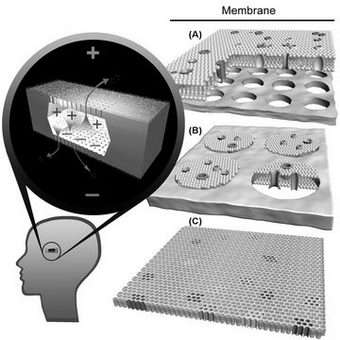
January 12th, 2006 Schematic of nanobattery that would be implanted in or near the eye

Schematic of nanobattery that would be implanted in or near the eye.

Several researchers from Sandia National Laboratories, led by principal investigator Susan Rempe, are part of a multi-institutional, multidisciplinary team developing a nano-size battery that one day could be implanted in the eye to power an artificial retina.

They are among the recipients of a five-year, $6.5 million grant recently awarded by the National Eye Institute of the National Institutes of Health (NIH) to establish a new center, the National Center for Design of Biomimetic Nanoconductors. Based at the University of Illinois Urbana-Champaign under the direction of principal investigator Eric Jakobsson, the center is designed to rapidly launch revolutionary ideas in the use of nanomedicine.

The center will design, model, synthesize, and fabricate nanomedical devices based on natural and synthetic ion transporters — proteins that control ion motion across the membranes of every living cell.

The first task for the center will be to design a class of devices for generating electric power — bio-batteries — for a wide array of implantable devices, starting with an artificial retina that has already been developed at the Doheny Eye Institute at the University of Southern California. The artificial retina and accompanying nanobattery will be used to correct certain types of macular degeneration.

Sandia’s role is on the theoretical and computational side of the project, Rempe says. Sandia is a National Nuclear Security Administration laboratory.

“We will use our expertise in multi-scale modeling to understand and predict how transporter structure leads to function, with an initial focus on specialized transporters found in the electric eel,” Rempe says. “This information will give us a better understanding of how power is naturally created in biological organisms — information to be used for designing and building the nanobattery.”

Speaking of the vital role of modeling, she adds, “If you don’t understand it, you can’t engineer it.”

Ultimately the algorithms, software, design expertise, and scientific knowledge gained through the modeling efforts, in which Rempe is joined by Kevin Leung and Steve Plimpton, will be shared with the external community through workshops, seminars, conferences, and collaborations.

Working on another aspect of the project is Jeff Brinker, who is affiliated with both Sandia and the University of New Mexico. He will engineer components of the bio-battery using silica technology.

The team plans to translate several categories of biological function into new devices that would treat disease and lead to implantable devices. Properties of interest that appear in the biological ion transporters include electrical signaling, osmotic pumping, and molecular detection.

Source: Sandia National Laboratories


print this article email this article download pdf blog this article bookmark this article     Digg this Stumble it share on Facebook share on Reddit add to delicious save to Yahoo! bookmarks
4.1/5 after 31 votes


January 12th, 2006 all stories
Nanotechnology /

Comments: 0
Rank: 4.1/5 after 31 votes

  • Stumble this up

  • Digg this

  • Share it:
  • share on Facebook
  • share on MySpace
  • share on Slashdot
  • rss-newsfeed
  • share on Google
  • share on Reddit
  • add to delicious
  • save to Yahoo! bookmarks
  • share on Windows Live
  • Add to Mixx!
Rating: 4.1/5 after 31 votes

  • Related Stories

  • Study: Thousands undergoing expensive, potentially risky spine surgery
    created Jul 01, 2009 | popularity not rated yet | comments 0
  • Reading the brain without poking it
    created Jun 29, 2009 | popularity not rated yet | comments 0
  • Disease prevention often costs more than it saves
    created Jun 24, 2009 | popularity not rated yet | comments 0
  • Going, going green
    created Jun 22, 2009 | popularity not rated yet | comments 0
  • Research explores interactions between nanomaterials, biological systems
    created Jun 19, 2009 | popularity not rated yet | comments 0

Tags


  • Physicists Demonstrate Quantum Memory with Matter Qubits
    Physicists Demonstrate Quantum Memory with Matter Qubits
    Physics / General Physics
    created Jul 03, 2009 | popularity 4.4 / 5 (17) | comments 1
  • 'Holey' Nanosheets for Wastewater Dye Removal
    Nanotechnology / Nanomaterials
    created Jul 01, 2009 | popularity 5 / 5 (5) | comments 1
  • Jellyfish Robot Swims Like its Biological Counterpart
    Jellyfish Robot Swims Like its Biological Counterpart
    Electronics / Robotics
    created Jun 26, 2009 | popularity 4.4 / 5 (8) | comments 1
  • Could Maxwell's Demon Exist in Nanoscale Systems?
    Could Maxwell's Demon Exist in Nanoscale Systems?
    Physics / General Physics
    created Jun 24, 2009 | popularity 4.4 / 5 (18) | comments 29
  • Living Safely with Robots, Beyond Asimov's Laws
    Living Safely with Robots, Beyond Asimov's Laws
    Electronics / Robotics
    created Jun 22, 2009 | popularity 4.6 / 5 (52) | comments 40
  • Other News

    A 'quantum of sol' -- how nanotechnology could hold the key to a solar-powered future

    A 'quantum of sol' -- how nanotechnology could hold the key to a solar-powered future

    Nanotechnology / Nanomaterials

    created Jun 30, 2009 | popularity 3.9 / 5 (14) | comments 16

    (PhysOrg.com) -- A new generation of 'nano-structured' millimetre-sized solar cells that could convert the sun's energy to electricity more than twice as efficiently as current technology, is the subject of ...


    Australian researchers are set to begin human trials of a tiny nano-cell that acts as a "Trojan horse" against cancer

    Hi-tech 'Trojan horse' can kill cancer cells: researchers

    Nanotechnology / Bio & Medicine

    created Jun 29, 2009 | popularity 4.6 / 5 (11) | comments 7

    Australian researchers are set to begin human trials of a tiny nano-cell that acts as a "Trojan horse" against cancer cells, a breakthrough they say may curb the need for debilitating chemotherapy.


    Harnessing Nanoparticles To Track Cancer Cell Changes

    Nanotechnology / Bio & Medicine

    created Jul 03, 2009 | popularity not rated yet | comments 1

    The more dots there are, the more accurate a picture you get when you connect them. Cancer researchers adopting that philosophy have developed a new imaging technology that could give scientists the ability to simultaneously ...


    'Holey' Nanosheets for Wastewater Dye Removal

    Nanotechnology / Nanomaterials

    created Jul 01, 2009 | popularity 5 / 5 (5) | comments 1

    (PhysOrg.com) -- Researchers have discovered that extremely thin sheets of nickel oxide with hexagonally shaped holes can absorb hazardous dyes from wastewater nearly as well as the best traditional methods, but are recyclable. ...


    Computer-Guided Nanoparticle Therapy Destroys Tumors

    Nanotechnology / Bio & Medicine

    created Jun 29, 2009 | popularity 5 / 5 (11) | comments 0

    Gold nanoshells are among the most promising new nanoscale therapeutics being developed to kill tumors, acting as antennas that turn light energy into heat that cooks cancer to death. Now, a multi-institutional research team ...