Biologists convert protein sequences into classical music
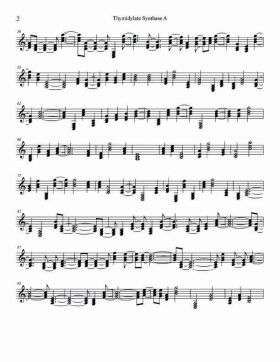
UCLA molecular biologists have turned protein sequences into original compositions of classical music.
"We converted the sequence of proteins into music and can get an auditory signal for every protein," said Jeffrey H. Miller, distinguished professor of microbiology, immunology and molecular genetics, and a member of UCLA's Molecular Biology Institute. "Every protein will have its unique auditory signature because every protein has a unique sequence. You can hear the sequence of the protein."
"We assigned a chord to each amino acid," said Rie Takahashi, a UCLA research assistant and an award-winning, classically trained piano player. "We want to see if we can hear patterns within the music, as opposed to looking at the letters of an amino acid or protein sequence. We can listen to a protein, as opposed to just looking at it."
The building blocks of proteins are linear sequences of 20 different amino acids. Assigning one note for each amino acid therefore results in a 20-note scale.
"A 20-note scale is too large a range," Takahashi said. "You need a reduced scale, so we paired similar amino acids together and used chords and chord variations for each amino acid. We used each component of the music to indicate a specific characteristic of the protein. We are faithful in the conversion from the sequence to the music. The rhythm is dictated by the protein sequence."
On the biologists' site (www.mimg.ucla.edu/faculty/miller_jh/gene2music/examples.html), you can listen to the compositions and even submit your own genetic sequence and have it translated to music. The browser allows anyone to send in a sequence coding for a protein, which will then be converted into music and returned as a MIDI audio file. The research is published in Genome Biology, a major journal in the field of genomics.
"I was thinking of doing a project like this for years," Miller said, "but realized I needed a person who has the unique characteristics of being both a molecular geneticist and a serious classical musician. When I met Rie, I realized this is the person I've been looking for."
Takahashi was a UCLA undergraduate in microbiology, immunology and molecular genetics who did the research as an honors thesis.
"Many scientists like classical music," she noted. "Before I took a course from Dr. Miller, those two worlds were separate in my mind. To bridge the two is very rewarding. My piano teacher doesn't have a science background, but when I use music to explain proteins to him, it goes from gibberish to something that really interests him."
Takahashi and Miller are not the first scientists to attempt to convert protein sequences into music, but they believe their music is more melodic and less "jumpy" than previous attempts. Initially, Takahashi converted the amino acids and played the resulting music on the piano. Now they are piloting a computer program, written by colleague Frank Pettit, that uses their translation rules to convert the protein sequences to music. They hope this will speed up the translation of large segments of genomes.
Takahashi first converted to music the human ThyA protein, which makes thymidine, a key component of DNA.
She also converted the Huntington protein, which plays a major role in Huntington's disease. Huntington's disease is an example of a triplet repeat disorder in which an expansion of a repeated glutamine sequence causes the protein to lose its proper function. Such an expansion leads to a neurological disorder. An untrained ear can hear the repeating chords.
"We believe this can be a tremendous teaching tool to get children, non-scientists and the visually impaired interested in proteins and molecular biology," Miller said. "When I was a kid, I listened to 'Peter and the Wolf,' which was a fabulous way to introduce young people to musical instruments and classical music."
In the music, individual amino acids are expressed as chords, and similar amino acids are paired. For example, the amino acids tyrosine and phenylalanine are both assigned a G major chord, but they can be distinguished because the notes in the chord are arranged differently. The music has a 20-note range spanning over two octaves, but with just 13 base notes.
Takahashi published an earlier version of the research in the UCLA Undergraduate Science Journal.
As a second phase of the research, Takahashi has added variations to the music and drawn out chords.
"Some of Rie's compositions sound Chopinesque," said Miller, who is encouraging her to make a CD with her compositions that contain variations of several proteins.
Source: University of California - Los Angeles


