Scientists discover new life in the Antarctic deep sea
May 16, 2007 Scientists discover new life in the Antarctic deep sea

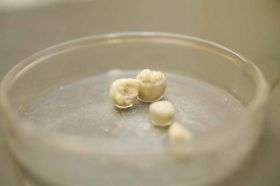
Anthosactis pearseae , a newly discovered species of sea anemone, are barely bigger than a human molar. The angled tip of the tweezers that the four anemones are shown against is about 2 centimeters (0.7 inches) long. Credit: Kevin Fitzsimons

Scientists have found hundreds of new marine creatures in the vast, dark deep-sea surrounding Antarctica. Carnivorous sponges, free-swimming worms, crustaceans, and molluscs living in the Weddell Sea provide new insights into the evolution of ocean life.

Reporting this week in the journal Nature, scientists describe how creatures in the deeper parts of the Southern Ocean - the source for much of the deep water in the world ocean – are likely to be related to animals living in both the adjacent shallower waters and in other parts of the deep ocean.

A key question for scientists is whether shallow water species colonised the deep ocean or vice versa. The research findings suggest the glacial cycle of advance and retreat of ice led to an intermingling of species that originated in shallow and deep water habitats.

Lead author Professor Angelika Brandt from the Zoological Institute and Zoological Museum, University Hamburg says,

"The Antarctic deep sea is potentially the cradle of life of the global marine species. Our research results challenge suggestions that the deep sea diversity in the Southern Ocean is poor. We now have a better understanding in the evolution of the marine species and how they can adapt to changes in climate and environments."

Dr Katrin Linse, marine biologist from British Antarctic Survey, says, "What was once thought to be a featureless abyss is in fact a dynamic, variable and biologically rich environment. Finding this extraordinary treasure trove of marine life is our first step to understanding the complex relationships between the deep ocean and distribution of marine life."

Three research expeditions, as part of the ANDEEP project (Antarctic benthic deep-sea biodiversity), onboard the German research ship Polarstern took place between 2002 and 2005. An international team from 14 research organisations investigated the seafloor landscape, its continental slope rise and changing water depths to build a picture of this little known region of the ocean. They found over 700 new species.

Source: British Antarctic Survey


print this article email this article download pdf blog this article bookmark this article     Stumble it Digg this share on Facebook retweet share on Reddit add to delicious
Rate this story - 4.5 /5 (16 votes)


May 16, 2007 all stories

Comments: 0

4.5 /5 (16 votes)
  • Stumble this up

  • Digg this

  • share this

  • hide
  • Related Stories


Other News

Variable Temperatures Leave Insects wtih a Frosty Reception

Biology / Plants & Animals

created 3 hours ago | popularity not rated yet | comments 0

(PhysOrg.com) -- For the first time, scientists at The University of Western Ontario have shown that insects exposed to repeated periods of cold will trade reproduction for immediate survival.


When camouflage is a plant's best protection

Rare woodland plant uses 'cryptic coloration' to hide from predators

Biology / Plants & Animals

created 5 hours ago | popularity 5 / 5 (1) | comments 0

It is well known that some animal species use camouflage to hide from predators. Individuals that are able to blend in to their surroundings and avoid being eaten are able to survive longer, reproduce, and ...


'Safety valve' protects photosynthesis from too much light

Biology / Cell & Microbiology

created 7 hours ago | popularity not rated yet | comments 0

Photosynthetic organisms need to cope with a wide range of light intensities, which can change over timescales of seconds to minutes. Too much light can damage the photosynthetic machinery and cause cell death. Scientists ...


Cells defend themselves from viruses, bacteria with armor of protein errors

Biology / Cell & Microbiology

created 7 hours ago | popularity 5 / 5 (4) | comments 0

When cells are confronted with an invading virus or bacteria or exposed to an irritating chemical, they protect themselves by going off their DNA recipe and inserting the wrong amino acid into new proteins to defend them ...


Researchers discover biological basis of 'bacterial immune system'

Biology / Cell & Microbiology

created 7 hours ago | popularity 4 / 5 (1) | comments 0

Bacteria don't have easy lives. In addition to mammalian immune systems that besiege the bugs, they have natural enemies called bacteriophages, viruses that kill half the bacteria on Earth every two days.