First demonstration of new hair follicle generation in an animal model
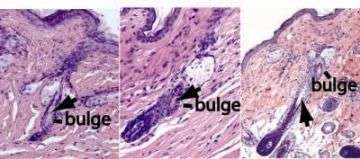
Researchers at the University of Pennsylvania School of Medicine have found that hair follicles in adult mice regenerate by re-awakening genes once active only in developing embryos. These findings provide unequivocal evidence for the first time that, like other animals such as newts and salamanders, mammals have the power to regenerate. These findings are published in the May 17 issue of Nature.
A better understanding of this process could lead to novel treatments for hair loss, other skin and hair disorders, and wounds.
“We showed that wound healing triggered an embryonic state in the skin which made it receptive to receiving instructions from wnt proteins,” says senior author George Cotsarelis, MD, Associate Professor of Dermatology. “The wnts are a network of proteins implicated in hair-follicle development.”
Researchers previously believed that adult mammal skin could not regenerate hair follicles. In fact, investigators generally believe that mammals had essentially no true regenerative qualities. (The liver can regenerate large portions, but it is not de novo regeneration; some of the original liver has to remain so that it can regenerate.)
In this study, researchers found that wound healing in a mouse model created an “embryonic window” of opportunity. Dormant embryonic molecular pathways were awakened, sending stem cells to the area of injury. Unexpectedly, the regenerated hair follicles originated from non-hair-follicle stem cells.
“We’ve found that we can influence wound healing with wnts or other proteins that allow the skin to heal in a way that has less scarring and includes all the normal structures of the skin, such as hair follicles and oil glands, rather than just a scar,” explains Cotsarelis.
By introducing more wnt proteins to the wound, the researchers found that they could take advantage of the embryonic genes to promote hair-follicle growth, thus making skin regenerate instead of just repair. Conversely by blocking wnt proteins, they also found that they could stop the production of hair follicles in healed skin.
Increased wnt signaling doubled the number of new hair follicles. This suggests that the embryonic window created by the wound-healing process can be used to manipulate hair-follicle regeneration, leading to novel ways to treat hair loss and hair overgrowth.
These findings go beyond just a possible treatment for male-pattern baldness. If researchers can effectively control hair growth, then they could potentially find cures for people with hair and scalp disorders, such as scarring alopecia where the skin scars, and hair overgrowth.
Source: University of Pennsylvania School of Medicine


