Frictional heating explains plumes on Enceladus
May 16, 2007 Frictional heating explains plumes on Enceladus

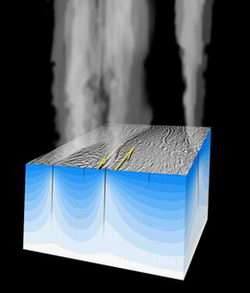
Plumes of water vapor and other gases escape at high velocity from the surface of Saturn´s moon Enceladus, as shown in this artist concept. Image credit: NASA/JPL

Rubbing your hands together on a cold day generates a bit of heat, and the same process of frictional heating may be what powers the geysers jetting out from the surface of Saturn's moon Enceladus.

Tidal forces acting on fault lines in the moon's icy shell cause the sides of the faults to rub back and forth against each other, producing enough heat to transform some of the ice into plumes of water vapor and ice crystals, according to a new study published in the May 17 issue of the journal Nature.

Francis Nimmo, assistant professor of Earth and planetary sciences at the University of California, Santa Cruz, and his coauthors calculated the amount of heat that could be generated by this mechanism and concluded that it is the most likely explanation for the plumes and other features observed in the south polar region of Enceladus. This region is warmer than the rest of the frozen surface of Enceladus and has features called "tiger stripes" that look like tectonic fault lines.

"We think the tiger stripes are the source of the plumes, and we made predictions of where the tiger stripes should be hottest that can be tested by future measurements," Nimmo said.

Driving the whole process is the moon's eccentric orbit, which brings it close to Saturn and then farther away, so that the gravitational attraction it feels changes over time.

"It's getting squeezed and stretched as it goes around Saturn, and those tidal forces cause the faults to move back and forth," Nimmo said.

Unlike some other proposals for the origin of the plumes, this mechanism does not require the presence of liquid water near the surface of Enceladus, noted coauthor Robert Pappalardo of NASA's Jet Propulsion Laboratory in Pasadena.

"The heat is sufficient to cause ice to sublimate, like in a comet--the ice evaporates into vapor, and the escaping vapor drags particles off into space," Pappalardo said.

The study does suggest, however, that Enceladus has a liquid ocean lying deep beneath the ice. That allows the ice shell to deform enough to produce the necessary movement in the faults. If the ice shell sat directly on top of the moon's rocky interior, tidal forces would not produce enough movement in the faults to generate heat, Nimmo said.

The frictional or "shear heating" mechanism is consistent with an earlier study by Nimmo and Pappalardo, in which they proposed that Enceladus reoriented itself to position the hot spot at the south pole. In that study, the researchers described how the reorientation of Enceladus would result from a lower density of the thick ice shell in this region.

In the new paper, the researchers estimated the thickness of the ice shell to be at least 5 kilometers (3 miles) and probably several tens of kilometers or miles. They also estimated that the movement along the fault lines is about half a meter over the course of a tidal period.

Enceladus has sparked great interest among scientists, particularly since the discovery more than a year ago by NASA's Cassini spacecraft of the geysers shooting off its surface. This is one of two papers about Enceladus appearing in the May 17 issue of Nature. In the other paper, scientists explain how cracks in the icy surface of Enceladus open and close under Saturn's pull. Saturn's tides could control the timing of the geysers' eruptions, researchers suggest.

Source: University of California - Santa Cruz


print this article email this article download pdf blog this article bookmark this article     Stumble it Digg this share on Facebook retweet share on Reddit add to delicious
Rate this story - 4.6 /5 (10 votes)


May 16, 2007 all stories

Comments: 0

4.6 /5 (10 votes)
  • Stumble this up

  • Digg this

  • share this

  • hide
  • Related Stories

  • Fantastic Voyage
    created Nov 02, 2009 | popularity not rated yet | comments 0
  • Hot Debate over Icy Moon
    created Oct 08, 2009 | popularity not rated yet | comments 0
  • Evidence for ocean on Enceladus: Tiny Saturn Moon Could Be Targeted in Search for Extraterrestrial Life
    created Jul 22, 2009 | popularity not rated yet | comments 0
  • How the moon got its stripes
    created Jul 15, 2009 | popularity not rated yet | comments 0
  • Jets on Saturn's moon Enceladus not geysers from underground ocean
    created Jun 24, 2009 | popularity not rated yet | comments 0


  • hide
  • Relevant PhysicsForums posts

  • Some help with a X-Ray astronomy question please!
    created 9 hours ago
  • Help with Images and Optical Instrument Question..
    created 20 hours ago
  • Redshift as a distance indicator
    created Nov 26, 2009
  • Question about 2-body gravity
    created Nov 24, 2009
  • More from Physics Forums - General Astronomy

Other News

Fermi Telescope Peers Deep into Microquasar

Fermi Telescope Peers Deep into Microquasar (w/ Video)

Space & Earth / Astronomy

created 2 hours ago | popularity 5 / 5 (1) | comments 0

(PhysOrg.com) -- NASA's Fermi Gamma-ray Space Telescope has made the first unambiguous detection of high-energy gamma-rays from an enigmatic binary system known as Cygnus X-3. The system pairs a hot, massive ...


The Energy Sources of Ultraluminous Galaxies

The Energy Sources of Ultraluminous Galaxies

Space & Earth / Astronomy

created 3 hours ago | popularity 5 / 5 (1) | comments 0

(PhysOrg.com) -- Ultraluminous infrared galaxies ((ULIRGs) are galaxies whose luminosity exceeds that of a trillion suns; for comparison, the Milky Way galaxy has a typical (and much more modest) luminosity ...


Space shuttle Atlantis, 7 astronauts back on Earth (AP)

Space shuttle Atlantis, 7 astronauts back on Earth

Space & Earth / Space Exploration

created 4 hours ago | popularity not rated yet | comments 0

(AP) -- Space shuttle Atlantis and its seven astronauts returned to Earth with a smooth touchdown Friday to end an 11-day flight that resupplied the International Space Station.


Herschel takes a peek at the ingredients of the galaxies

Herschel takes a peek at the ingredients of the galaxies

Space & Earth / Astronomy

created 1hour ago | popularity not rated yet | comments 0

(PhysOrg.com) -- The European Space Agency has today released spectacular new observations from the Herschel Space Observatory, including the UK-led SPIRE instrument. Spectrometers on board all three Hershel ...


China is set to launch its second moon orbiter next October, state media have reported

China to launch second lunar probe: state media

Space & Earth / Space Exploration

created 8 hours ago | popularity 5 / 5 (3) | comments 0

China will launch its second moon orbiter next October, state media reported Friday, as it powers ahead with a space programme that has sparked concerns abroad.