Television just got brighter: UCLA engineers developed next generation of LEDs
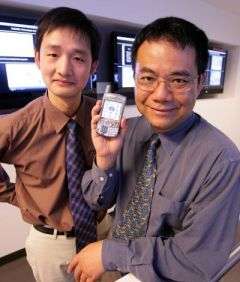
Two researchers at the UCLA Henry Samueli School of Engineering and Applied Science want to make sure future generations of flat panel TV watchers will see games like the upcoming NBA Finals in the brightest, most beautiful color possible — for a lot less money.
Most people don’t think much about the inner workings of LEDs, or light-emitting diodes, which illuminate today’s TV screens and cell phones, but making these LEDs more efficient, cheaper and higher quality is the obsession that occupies the daily thoughts of materials science and engineering professor Yang Yang and his graduate researcher Jinsong Huang.
Yang and Huang have recently achieved the highest lumens per watt ever recorded for a red phosphorescent LED using a new combination of plastic, or polymer, infused liquid — and they did it at half the current cost. Yang and Huang’s latest record will be presented at the Society for Information Display 2007 conference in Long Beach, Calif., from May 20 through 25.
“That means your next LED flat panel TV could be less expensive,” Yang said. “And the picture will be brighter and clearer than ever before.”
LEDs are generally measured in lumens per watt. Lumens, a measure of the perceived power of light, and watts, a standard measure of power, combine to define the optical efficiency of power — in other words, how bright a device is and how much power it consumes.
Current red LEDs generally score around 12 lumens per watt. Yang and Huang’s newest device rates a record-breaking 18 lumens per watt.
“That’s a significant difference,” Huang said. “Visually, it means you get a higher quality display, and the product is also lighter and thinner. And with our improvements, you also need less energy, but you get an all-around better product.”
Conventional organic LEDs are made from a variety of organic semiconductor materials and have a complicated multiple-layer structure formed by expensive thermal evaporation techniques constructed to control charge flow in the device. Liquid crystal display (LCD) televisions, for example, require polarization, color filters and other components to make the resulting picture clear and bright. The more you build into a product, Yang said, the more energy it takes to run it, and the bigger it is.
In Yang and Huang’s new polymer light emitting diodes, the devices have a very simple single-layer structure, generated by a much cheaper solution process. The new LED, or more precisely PLED, developed by the two UCLA engineers uses a polymer powder and liquid mixture added to a previously top-secret material developed by the Canon company to create a paint-like product. The product is used to coat a layer of glass, and a charge is added. The end result is a slim single layer of glass with two electrodes.
“It’s a much simpler, lighter, thinner and more elegant answer to creating a better LED product,” Yang said.
Yang began his high-performance PLED research at UCLA Engineering in early 2003 with a then-graduate student named Qianfei Xu, who was part of the professor’s research group, and achieved a record-high efficiency for green PLEDs.
“The current results represent our ongoing quest to create better, slimmer, less expensive high-performance PLEDs,” Yang said. “Using our simple solution method, we already have successfully achieved several world records in device efficiency, including 20 lumens/watt white emission fluorescent PLEDs, 30 lumens/watt green emission fluorescent PLEDs and 18 lumens/watt red emission phosphorescent PLEDs. So our latest red emission PLED is just one of our multiple records. It’s a very exciting development.”
The new technology, which already has been licensed by Canon, should be available to consumers in about three years.
Source: University of California - Los Angeles


