Left-right wiring determined by neural communication in the embryonic worm
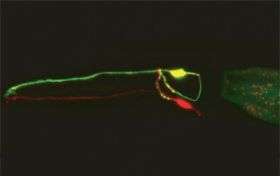
Most animals appear symmetrical at first glance, but we're full of internal lop-sidedness. From the hand used to pick up a pencil or throw a baseball, to where language is generated in the brain, to the orientation of our internal organs, humans are a glut of asymmetries. Worms aren't so different: The roundworm Caenorhabditis elegans has nerves on its left and right sides that perform different functions. Like handedness, the determination of which nerves develop on which side seems random from worm to worm.
But now, Rockefeller University and Howard Hughes Medical Institute scientists working to demystify the worm's asymmetry have discovered that the arbitrary left-right configurations of two types of olfactory neurons are established during development. In a study released in the May 18 issue of Cell, the researchers show that embryonic worms have a system of gap junctions -- "broadband" communication channels through which cells pass many kinds of molecules and electrical signals -- that allow growing neurons on the left and right to communicate with each other, a system that dissolves as the worm develops.
Every neuron in the adult C. elegans has been mapped and named. Handedness researchers are particularly interested in two olfactory neurons, AWCON and AWCOFF, one each on the left and right side of the worm's body. AWCON has one set of responsibilities, while AWCOFF has a totally different set of functions. Which side houses each of the nerves -- right or left -- appears to be random, with their positions reversed about 50 percent of the time. "What makes this an interesting puzzle to solve is understanding how the left and the right side become different from each other, and how they coordinate their activity so that every worm still has exactly one of each type of cell," says the paper's senior author Cori Bargmann, Torsten N. Wiesel Professor and head of the Laboratory of Neural Circuits and Behavior at Rockefeller. "What is it that sets up this kind of handedness in the brain?"
Prior studies had shown that a gene involved in human migraine headaches (an asymmetrical affliction) was involved in this decision, but something was happening earlier that researchers had yet to figure out. Bargmann, who also is an investigator at the Howard Hughes Medical Institute, and postdoctoral associate Chiou-Fen Chuang -- now an assistant professor at Cincinnati Children's Research Foundation -- found that the first step of left-right communication is carried out by a gene that makes gap junctions. And yet strangely, as far as worm researchers knew, no gap junctions existed anywhere on adult worm AWC neurons.
Then Bargmann and Chuang had a flash of insight: Since, like handedness, AWC asymmetry arises before the animal is fully developed, maybe they needed to examine the nervous system of the embryonic worm. Using an electron microscope, they discovered that the developing worm's neural network, which had not previously been mapped, was completely different from that of the mature animal. "A large number of embryonic neurons are heavily interconnected by gap junctions," says Bargmann, who is also an HHMI Investigator. "They all grow to the midline, communicate with each other, and create a conduit of information that links together these two different sides of the brain." Then, after the gap junctions do their job, they disappear. "This network is transient; we only know about it because we were able to look at this early period."
A similar system of extensive gap junctions appears in the developing mammalian brain, but researchers have yet to figure out exactly what it does. In worms, at least, they now know that it's involved in differentiating the left and right sides. Now, Bargmann says, she's interested in finding out how this brief embryonic communication translates into a permanent change that lasts for the rest of the animal's life.
Source: Rockefeller University


