Team discovers 'throttle' for solar wind
May 17th, 2007 Team discovers 'throttle' for solar wind

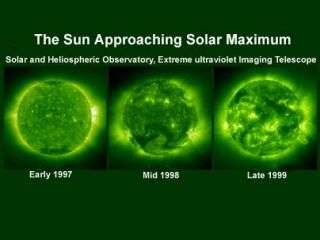
These are false-color images of ultraviolet light emitted by the solar atmosphere taken with SOHO's Extreme-ultraviolet Imaging Telescope. Note how more structures appear in the atmosphere as the solar maximum of 2000 approaches, from the left image in early 1997 to the right image in late 1999. These changing structures regulate the escape of helium in the solar wind. Image courtesy: ESA and NASA

Helium may act as a "throttle" for the solar wind, setting its minimum speed, according to new results from an MIT-led team using NASA's Wind spacecraft.

The solar wind is a diffuse stream of electrically conducting gas (plasma) constantly blowing from the sun. "This result gives us another clue about how the solar wind is accelerated, which may help us better understand space weather," said Justin Kasper, a research scientist at MIT's Kavli Institute for Astrophysics and Space Research and lead author of a paper on this research that appeared in the Astrophysical Journal May 1.

When turbulent solar wind hits Earth's magnetic field, it can cause magnetic storms that overload power lines and radiation storms that disrupt spacecraft.

The new research could also lead to a deeper understanding of plasma physics, which is of interest because stars are made of plasma and plasma is used in advanced devices like plasma TVs and experimental fusion reactors.

The sun's atmosphere, or corona, can be seen from Earth during the peak of a total solar eclipse, when it appears as a shimmering halo around the moon. At the beginning of the space age, scientists discovered that the corona is being blown into space as the solar wind, so we are actually embedded in the atmosphere of the sun. Later observations revealed the solar wind blows at a minimum speed of about 260 kilometers per second (161 miles/second). No one knows why this particular speed is in effect.

Hydrogen, the most common element in the universe, makes up most of the sun and the solar wind. Helium is the second most abundant element, but it is much rarer in the solar wind than it is elsewhere in the universe. The team discovered that the abundance of helium increased as the solar wind speed increased, from near zero around the minimum speed to more than four helium atoms for every 100 hydrogen atoms at speeds greater than about 500 kilometers per second (310 miles/second).

Because helium nearly vanishes from the solar wind at its minimum speed, the researchers believe helium might somehow set the minimum speed. Helium is not accelerated efficiently by any process thought to be propelling the solar wind. Instead, it has to be dragged along by the hydrogen: Solar wind hydrogen atoms exert a small electric field that drags the helium out along with it, according to the team.

When helium hitches a ride with hydrogen, it slows down the hydrogen atoms. "At the minimum speed--the speed where the solar wind is no longer able to drag out helium--the solar wind itself can't escape either," said Dr. Keith Ogilvie of NASA's Goddard Space Flight Center, Wind Project Scientist and a co-author on the paper.

"It's still not clear exactly how the helium sets the minimum speed at its particular value of around 260 kilometers per second, or why more helium is found as the solar wind speed increases, but it's a clue that we are missing something fundamental about what makes the solar wind blow," said Kasper.

It's also unknown what gets the solar wind blowing again once it falls below its minimum speed, but there are hints the process may be related to violent eruptions of plasma from the sun called coronal mass ejections, or CMEs. CMEs have five to 10 times the amount of helium seen in the solar wind, according to the team. As the solar wind stagnates, helium builds up until the plasma is explosively released as a CME in this scenario. Earthbound CMEs also cause disruptions in satellites, power systems and radio communication, including the Global Positioning System.

The team used the solar wind experiment (SWE) instrument on board the Wind spacecraft to sample the solar wind. The SWE instrument uses an electric field to measure the speed, density and temperature of hydrogen and helium in the solar wind. The results were compiled from about 2.5 million measurements by the instrument over more than 10 years. "The SWE instrument has been extremely stable over all this time, so we know the changes we see in the solar wind are real and not just from changes in the instrument," said Ogilvie.

Additional authors of the Astrophysical Journal paper are Michael L. Stevens, a graduate student in MIT's Department of Physics; Alan J. Lazarus, a senior research scientist in physics; and John T. Steinberg of Los Alamos National Laboratory.

Source: MIT


print this article email this article download pdf blog this article bookmark this article     Digg this Stumble it share on Facebook share on Reddit add to delicious save to Yahoo! bookmarks
4.6/5 after 19 votes


May 17th, 2007 all stories
Space & Earth / Astronomy

Comments: 0
Rank: 4.6/5 after 19 votes

  • Stumble this up

  • Digg this

  • Share it:
  • share on Facebook
  • share on MySpace
  • share on Slashdot
  • rss-newsfeed
  • share on Google
  • share on Reddit
  • add to delicious
  • save to Yahoo! bookmarks
  • share on Windows Live
  • Add to Mixx!
Rating: 4.6/5 after 19 votes

  • Related Stories

  • Scientists bid adieu to plucky solar probe
    created Jun 30, 2009 | popularity not rated yet | comments 0
  • Astronomers spot cosmic dust fountain
    created Feb 05, 2009 | popularity not rated yet | comments 0
  • Moon geology could solve three mysteries of early Earth
    created Dec 08, 2008 | popularity not rated yet | comments 0
  • Space scientists set for second spacecraft flyby of Mercury
    created Sep 30, 2008 | popularity not rated yet | comments 0
  • 1843 stellar eruption may be new type of star explosion
    created Sep 10, 2008 | popularity not rated yet | comments 0

Tags


  • Physicists Demonstrate Quantum Memory with Matter Qubits
    Physicists Demonstrate Quantum Memory with Matter Qubits
    Physics / General Physics
    created Jul 03, 2009 | popularity 4.4 / 5 (17) | comments 1
  • 'Holey' Nanosheets for Wastewater Dye Removal
    Nanotechnology / Nanomaterials
    created Jul 01, 2009 | popularity 5 / 5 (5) | comments 1
  • Jellyfish Robot Swims Like its Biological Counterpart
    Jellyfish Robot Swims Like its Biological Counterpart
    Electronics / Robotics
    created Jun 26, 2009 | popularity 4.4 / 5 (8) | comments 1
  • Could Maxwell's Demon Exist in Nanoscale Systems?
    Could Maxwell's Demon Exist in Nanoscale Systems?
    Physics / General Physics
    created Jun 24, 2009 | popularity 4.4 / 5 (18) | comments 29
  • Living Safely with Robots, Beyond Asimov's Laws
    Living Safely with Robots, Beyond Asimov's Laws
    Electronics / Robotics
    created Jun 22, 2009 | popularity 4.6 / 5 (53) | comments 40
  • Other News

    China environmental phenomena monitored from space

    Space & Earth / Earth Sciences

    created 56 minutes ago | popularity not rated yet | comments 0

    China is in a very seismically active area and has had many catastrophic earthquakes during its history. A joint European-Chinese team is using satellite radar data to monitor ground deformation across major continental faults ...


    California to require sun-blocking car windows

    Space & Earth / Environment

    created 2 hours ago | popularity 2.3 / 5 (3) | comments 4

    New cars sold in California must include windshields that block or absorb the sun's rays beginning in 2012, the state's Air Resources Board recently ruled.


    Scientists: Silent tremors may foretell next Big One

    Space & Earth / Earth Sciences

    created 2 hours ago | popularity not rated yet | comments 0

    The seismometer is snugged in its hole and tamped over with dirt. Now it's time for the stomp test.


    Steam billows from the cooling towers at a nuclear power generating station in Byron

    Tropical zone expanding due to climate change: study

    Space & Earth / Earth Sciences

    created 4 hours ago | popularity 3 / 5 (4) | comments 1

    Climate change is rapidly expanding the size of the world's tropical zone, threatening to bring disease and drought to heavily populated areas, an Australian study has found.


    The least sea ice in 800 years

    The least sea ice in 800 years

    Space & Earth / Earth Sciences

    created Jul 01, 2009 | popularity 4.1 / 5 (65) | comments 60

    New research, which reconstructs the extent of ice in the sea between Greenland and Svalbard from the 13th century to the present indicates that there has never been so little sea ice as there is now. The ...